
老年患者采用诱导膜覆盖骨外露创面,二期行聚甲基丙烯酸甲酯填充和植皮治疗,随访 3 年。
Management of wounds with exposed bone structures using an induced-membrane followed by polymethyl methacrylate and second-stage skin grafting in the elderly with a 3-year follow-up.
机构信息
Department of Orthopaedics Surgery, The Second Affiliated Hospital and Yuying Children's Hospital of Wenzhou Medical University, Wenzhou, Zhejiang Province, China.
出版信息
Int Wound J. 2023 Apr;20(4):1020-1032. doi: 10.1111/iwj.13955. Epub 2022 Oct 2.
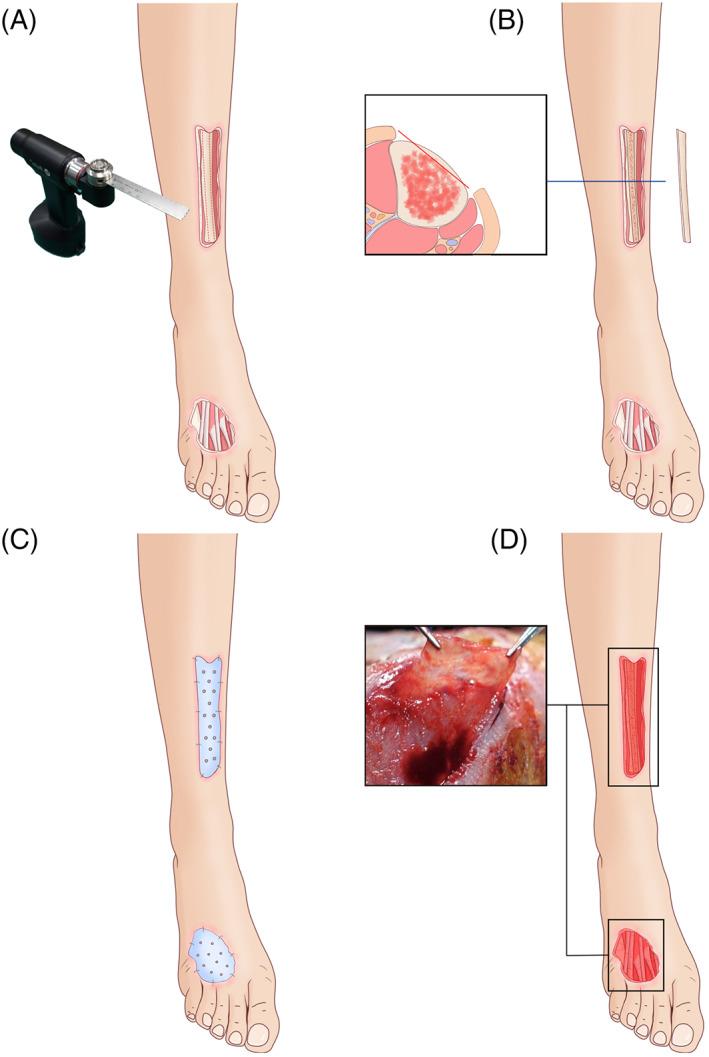
The treatment of traumatic wounds with exposed bone or tendons is often challenging. An induced membrane (IM) is used to reconstruct bone defects, as it provides an effective and sufficient blood supply for bone and soft-tissue reconstruction. This study explored a novel two-stage strategy for wound management, consisting of initial wound coverage with polymethyl methacrylate (PMMA) and an autologous split-thickness skin graft under the IM. Fifty inpatients were enrolled from December 2016 to December 2019. Each patient underwent reconstruction according to a two-stage process. In the first stage, the defect area was thoroughly debrided, and the freshly treated wound was then covered using PMMA cement. After 4-6 weeks, during the second stage, the PMMA cement was removed to reveal an IM covering the exposed bone and tendon. An autologous split-thickness skin graft was then performed. Haematoxylin and eosin (H&E) staining and immunohistochemical analysis of vascular endothelial growth factor (VEGF), CD31 and CD34 were used to evaluate the IM and compare it with the normal periosteal membrane (PM). The psychological status and the Lower Extremity Function Scale (LEFS) as well as any complications were recorded at follow-up. We found that all skin grafts survived and evidenced no necrosis or infection. H&E staining revealed vascularised tissue in the IM, and immunohistochemistry showed a larger number of VEGF-, CD31- and CD34-positive cells in the IM than in the normal PM. The duration of healing in the group was 5.40 ± 1.32 months with a mean number of debridement procedures of 1.92 ± 0.60. There were two patients with reulceration in the group. The self-rating anxiety scale scores ranged from 35 to 60 (mean 48.02 ± 8.12). Postoperatively, the LEFS score was 50.10 ± 9.77. Finally, our strategy for the management of a non-healing wound in the lower extremities, consisting of an IM in combination with skin grafting, was effective, especially in cases in which bony structures were exposed in the elderly. The morbidity rate was low.
外伤性骨或肌腱外露伤口的治疗往往具有挑战性。诱导膜(IM)用于重建骨缺损,因为它为骨和软组织重建提供了有效的充足的血液供应。本研究探讨了一种新的两阶段伤口管理策略,包括最初用聚甲基丙烯酸甲酯(PMMA)覆盖伤口,然后在 IM 下进行自体刃厚皮片移植。2016 年 12 月至 2019 年 12 月期间,50 名住院患者入组。每位患者均根据两阶段流程进行重建。在第一阶段,彻底清创缺损区域,然后用 PMMA 水泥覆盖新鲜处理的伤口。4-6 周后,在第二阶段,去除 PMMA 水泥,露出覆盖外露骨和肌腱的 IM。然后进行自体刃厚皮片移植。苏木精和伊红(H&E)染色以及血管内皮生长因子(VEGF)、CD31 和 CD34 的免疫组化分析用于评估 IM,并与正常骨膜(PM)进行比较。记录心理状态、下肢功能量表(LEFS)以及任何并发症。我们发现所有皮片均存活,无坏死或感染。H&E 染色显示 IM 中有血管化组织,免疫组化显示 IM 中 VEGF、CD31 和 CD34 阳性细胞数多于正常 PM。该组的愈合时间为 5.40±1.32 个月,平均清创次数为 1.92±0.60 次。该组有 2 例患者再溃疡。自评焦虑量表评分范围为 35 至 60 分(平均 48.02±8.12 分)。术后,LEFS 评分为 50.10±9.77。最后,我们采用 IM 联合皮片移植治疗下肢难愈性伤口的策略有效,尤其是在老年人存在骨结构外露的情况下。发病率较低。






 Zotero 插件