Wu Menglai, Luan Lijiang, Pranata Adrian, Witchalls Jeremy, Adams Roger, Bousie Jaquelin, Han Jia
School of Sports and Health, Shanghai University of International Business and Economics, Shanghai, China.
School of Exercise and Health, Shanghai University of Sport, Shanghai, China.
Front Med (Lausanne). 2022 Sep 15;9:956188. doi: 10.3389/fmed.2022.956188. eCollection 2022.
The use of physical therapy modalities, especially high intensity laser therapy (HILT), for individuals with knee osteoarthritis (KOA) is still controversial.
To compare the effects of HILT to other physical therapy modalities on symptoms and function in individuals with KOA.
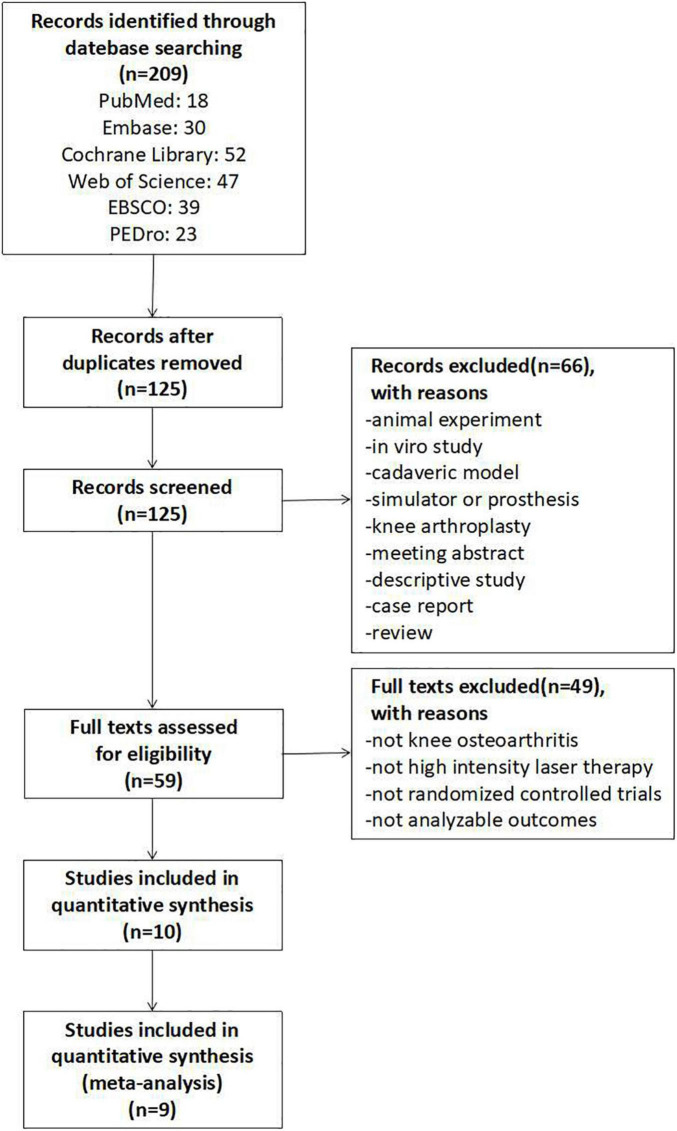
Six databases (PubMed, Embase, Cochrane Library, Web of Science, EBSCO, and PEDro) were searched in March 2022. Included studies were randomized controlled trials involving HILT conducted on individuals with KOA. The end-trial weighted mean difference (WMD) and standard deviations (SD) with 95% confidence intervals (CI) were analyzed.
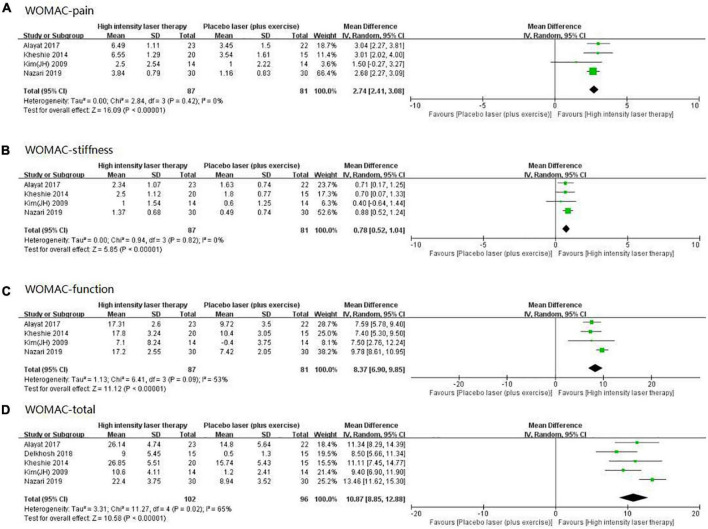
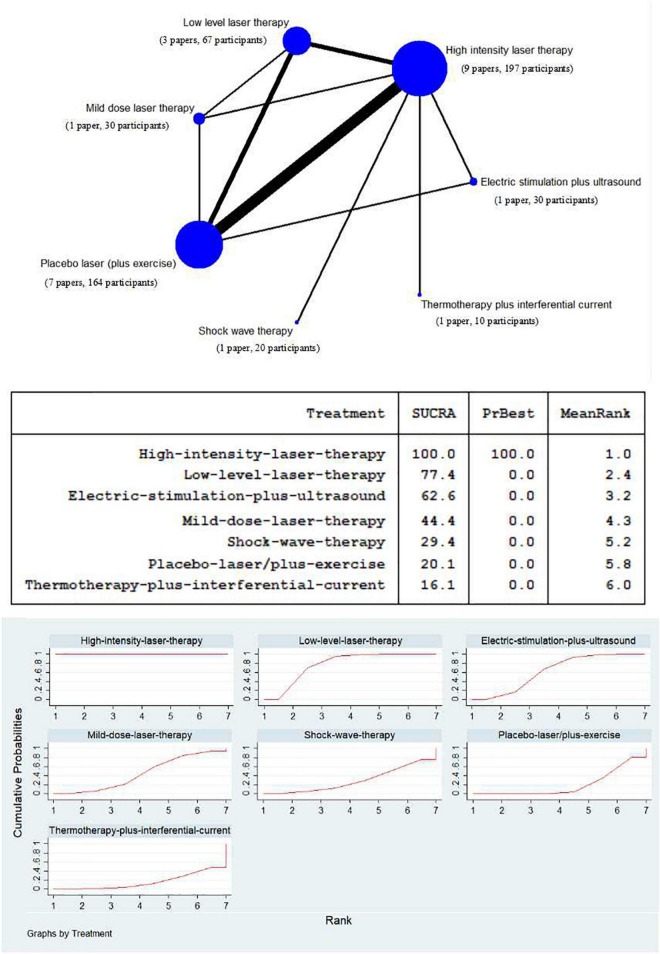
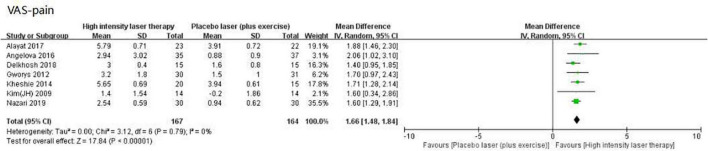
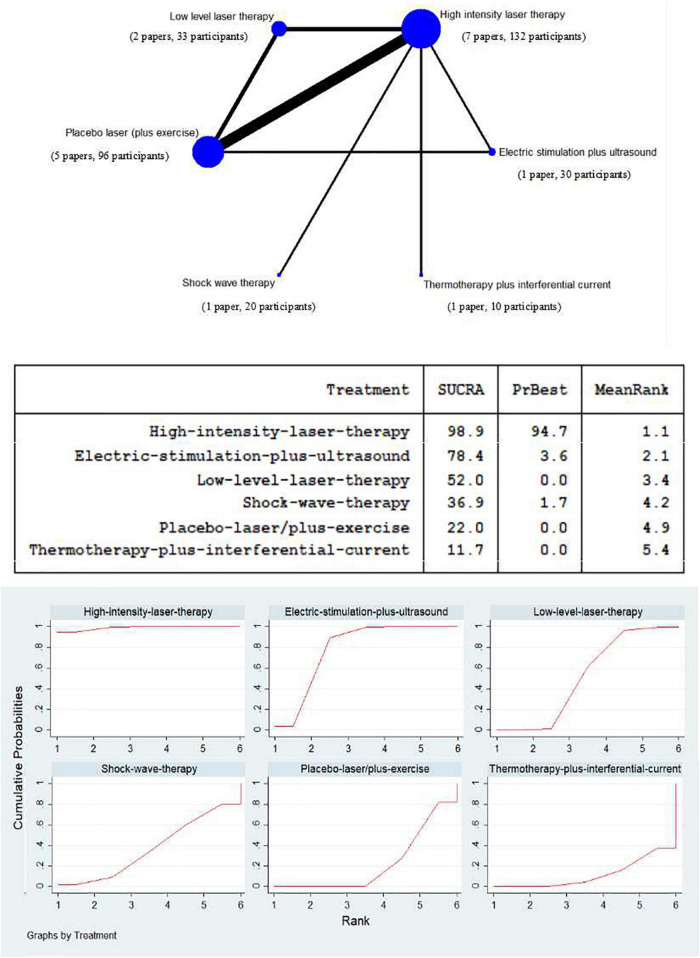
Ten studies with 580 participants were obtained, of which nine were included in the final network meta-analysis. In terms of relieving pain, HILT demonstrated the highest probability of being among the most effective treatments, with surface under the cumulative ranking (SUCRA) = 100%, and compared to a control (placebo laser or exercise or a combination of both) on the visual analog scale (VAS) for pain it demonstrated significant benefits (WMD 1.66, 95% CI 1.48-1.84). For improving self-reported function, as measured by the Western Ontario and McMaster Universities Osteoarthritis Index (WOMAC) total scores, the HILT SUCRA value led with 98.9%. When individuals with KOA were treated by HILT, the improvement in stiffness was statistically significant (WMD 0.78, 95% CI 0.52-1.04) but the amount of improvement was smaller than the minimal clinically important difference (MCID).
The current evidence suggests that HILT may be more effective than other physical therapy modalities for improving pain and function in individuals with KOA. For improving stiffness, however, it may not be clinically effective.
[https://www.researchregistry.com], identifier [1148].
对于膝骨关节炎(KOA)患者,物理治疗方式的使用,尤其是高强度激光治疗(HILT),仍存在争议。
比较HILT与其他物理治疗方式对KOA患者症状和功能的影响。
于2022年3月检索了六个数据库(PubMed、Embase、Cochrane图书馆、科学网、EBSCO和PEDro)。纳入的研究为对KOA患者进行的涉及HILT的随机对照试验。分析了试验结束时的加权平均差(WMD)和标准差(SD)以及95%置信区间(CI)。
获得了10项研究,共580名参与者,其中9项纳入了最终的网状Meta分析。在缓解疼痛方面,HILT显示出最有效的治疗概率最高,累积排名曲线下面积(SUCRA)=100%,与对照组(安慰剂激光或运动或两者结合)相比,在视觉模拟量表(VAS)疼痛评分上显示出显著益处(WMD 1.66,95%CI 1.48 - 1.84)。对于改善自我报告的功能,以西安大略和麦克马斯特大学骨关节炎指数(WOMAC)总分衡量,HILT的SUCRA值领先,为98.9%。当KOA患者接受HILT治疗时,僵硬程度的改善具有统计学意义(WMD 0.78,95%CI 0.52 - 1.04),但改善量小于最小临床重要差异(MCID)。
当前证据表明,HILT在改善KOA患者疼痛和功能方面可能比其他物理治疗方式更有效。然而,对于改善僵硬程度,其可能不具有临床有效性。