Wang Xiao-Kun, Gao Chao, Zhong He-Quan, Kong Xiang-Yu, Qiao Rui, Zhang Hui-Chun, Chen Bai-Yun, Gao Yang, Li Bing
Research Center for Clinical Medicine, JinShan Hospital, Fudan University, Shanghai, China.
Department of Rehabilitation, Children's Hospital Affiliated to Zhengzhou University, Henan Children's Hospital, Zhengzhou Children's Hospital, Zhengzhou, China.
Front Mol Neurosci. 2022 Sep 14;15:926791. doi: 10.3389/fnmol.2022.926791. eCollection 2022.
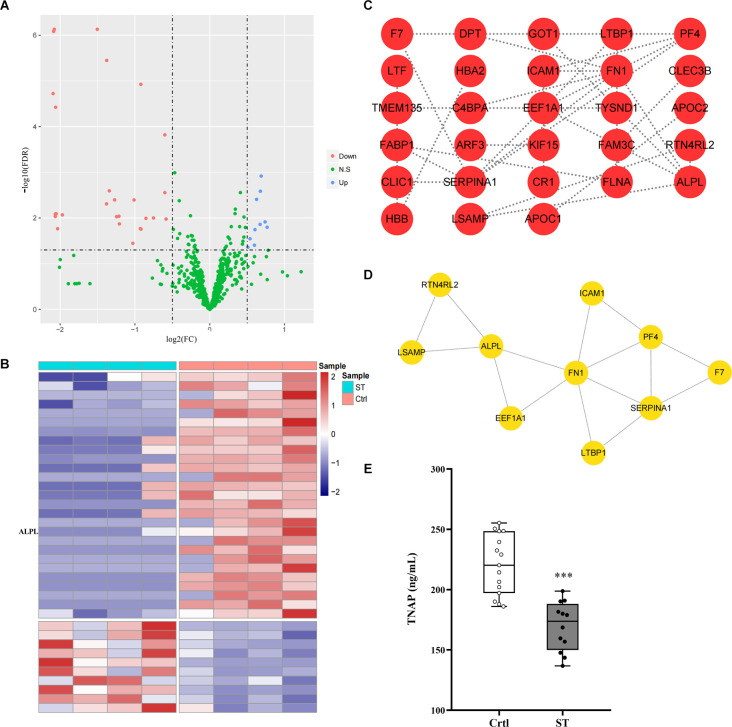
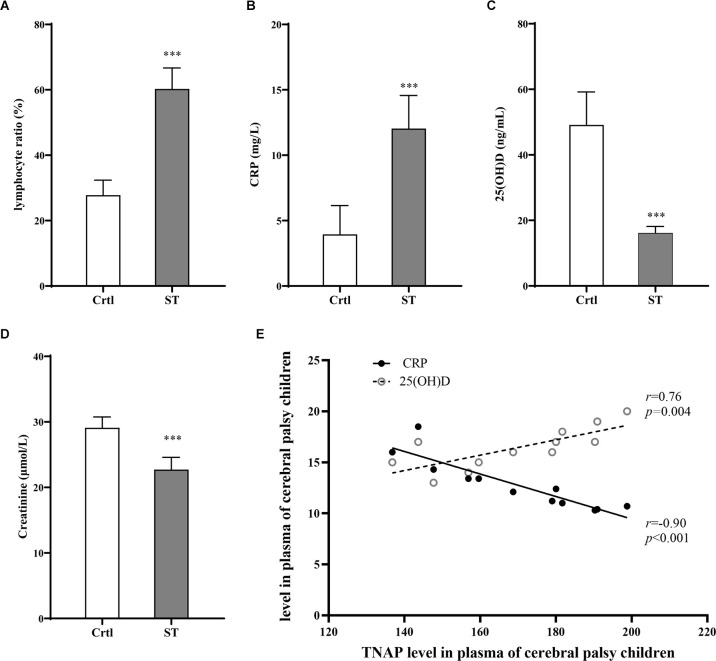
Several studies have shown the significance of neuroinflammation in the pathological progress of cerebral palsy (CP). However, the etiology of CP remains poorly understood. Spastic CP is the most common form of CP, comprising 80% of all cases. Therefore, identifying the specific factors may serve to understand the etiology of spastic CP. Our research aimed to find some relevant factors through protein profiling, screening, and validation to help understand the pathogenesis of cerebral palsy. In the current study, related clinical parameters were assessed in 18 children with spastic CP along with 20 healthy individuals of the same age. Blood samples of the spastic CP children and controls were analyzed with proteomics profiling to detect differentially expressed proteins. On the other hand, after hypoxic-ischemic encephalopathy (HIE) was induced in the postnatal day 7 rat pups, behavioral tests were performed followed by detection of the differentially expressed markers and inflammatory cytokines in the peripheral blood and cerebral cortex of the CP model rats by Elisa and Western blot. Independent sample -tests, one-way analysis of variance, and the Pearson correlation were used for statistical analysis. Through proteomic analysis, differentially expressed proteins were identified. Among them, tissue-nonspecific alkaline phosphatase (TNAP), the gene expression product of alkaline phosphatase , was downregulated in spastic CP. In addition, significantly lower TNAP levels were found in the children with CP and model rats. In contrast, compared with the sham rats, the model rats demonstrated a significant increase in osteopontin and proinflammatory biomarkers in both the plasma and cerebral cortex on the ischemic side whereas serum 25 hydroxyvitamin D and IL-10 were significantly decreased. Moreover, serum TNAP level was positively correlated with serum CRP and IL-10 in model rats. These results suggest that TNAP is the potential molecule playing a specific and critical role in the neuroinflammation in spastic CP, which may provide a promising target for the diagnosis and treatment of spastic CP.
多项研究表明神经炎症在脑瘫(CP)的病理进展中具有重要意义。然而,CP的病因仍知之甚少。痉挛型CP是CP最常见的形式,占所有病例的80%。因此,确定具体因素可能有助于理解痉挛型CP的病因。我们的研究旨在通过蛋白质谱分析、筛选和验证来寻找一些相关因素,以帮助理解脑瘫的发病机制。在本研究中,对18例痉挛型CP儿童和20名同龄健康个体进行了相关临床参数评估。对痉挛型CP儿童和对照组的血样进行蛋白质组学分析,以检测差异表达的蛋白质。另一方面,在出生后第7天的大鼠幼崽中诱导缺氧缺血性脑病(HIE)后,进行行为测试,然后通过酶联免疫吸附测定(ELISA)和蛋白质免疫印迹法检测CP模型大鼠外周血和大脑皮层中差异表达的标志物和炎性细胞因子。采用独立样本t检验、单因素方差分析和Pearson相关性分析进行统计分析。通过蛋白质组学分析,鉴定出差异表达的蛋白质。其中,组织非特异性碱性磷酸酶(TNAP),即碱性磷酸酶的基因表达产物,在痉挛型CP中表达下调。此外,在CP儿童和模型大鼠中发现TNAP水平显著降低。相比之下,与假手术组大鼠相比,模型大鼠缺血侧血浆和大脑皮层中的骨桥蛋白和促炎生物标志物显著增加,而血清25-羟基维生素D和白细胞介素-10显著降低。此外,模型大鼠血清TNAP水平与血清C反应蛋白(CRP)和白细胞介素-10呈正相关。这些结果表明,TNAP是在痉挛型CP神经炎症中起特定关键作用的潜在分子,这可能为痉挛型CP的诊断和治疗提供一个有前景的靶点。