School of Public Health, Tel Aviv University, Tel Aviv, Israel.
Porter School of the Environment and Earth Sciences, Tel Aviv University, Tel Aviv, Israel.
Front Public Health. 2022 Sep 15;10:966756. doi: 10.3389/fpubh.2022.966756. eCollection 2022.
New variants of SARS-CoV-2 are constantly discovered. Administration of COVID-19 vaccines and booster doses, combined with the application of non-pharmaceutical interventions (NPIs, is often used to prevent outbreaks of emerging variants. Such outbreak dynamics are further complicated by the population's behavior and demographic composition. Hence, realistic simulations are needed to estimate the efficiency of proposed vaccination strategies in conjunction with NPIs.
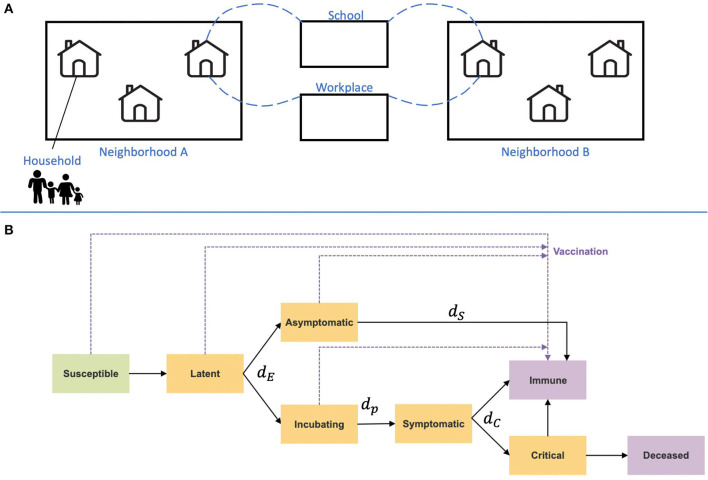
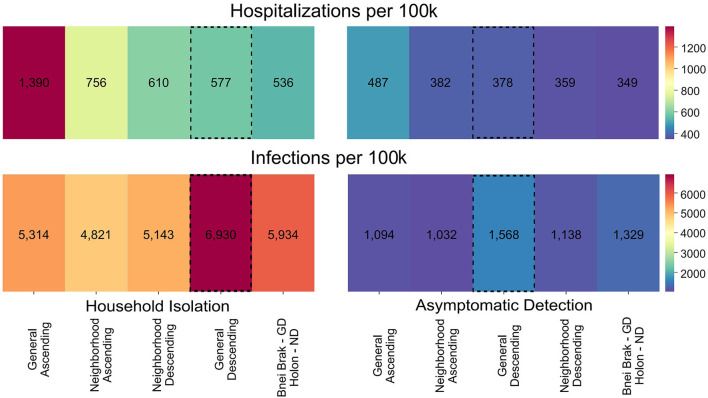
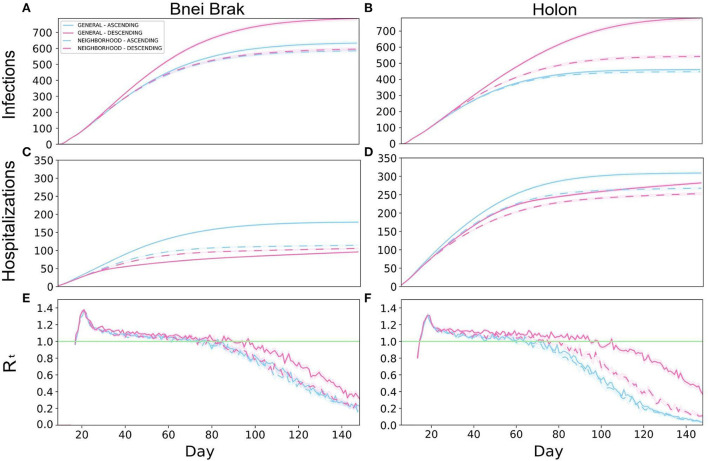
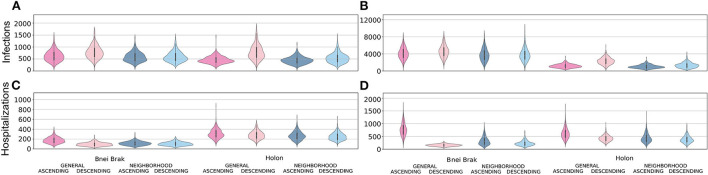
We developed an individual-based model of COVID-19 dynamics that considers age-dependent parameters such as contact matrices, probabilities of symptomatic and severe disease, and households' age distribution. As a case study, we simulate outbreak dynamics under the demographic compositions of two Israeli cities with different household sizes and age distributions. We compare two vaccination strategies: vaccinate individuals in a currently prioritized age group, or dynamically prioritize neighborhoods with a high estimated reproductive number. Total infections and hospitalizations are used to compare the efficiency of the vaccination strategies under the two demographic structures, in conjunction with different NPIs.
We demonstrate the effectiveness of vaccination strategies targeting highly infected localities and of NPIs actively detecting asymptomatic infections. We further show that different optimal vaccination strategies exist for each sub-population's demographic composition and that their application is superior to a uniformly applied strategy.
Our study emphasizes the importance of tailoring vaccination strategies to subpopulations' infection rates and to the unique characteristics of their demographics (e.g., household size and age distributions). The presented simulation framework and findings can help better design future responses against the following emerging variants.
不断发现 SARS-CoV-2 的新变体。结合非药物干预(NPIs)措施,常应用 COVID-19 疫苗和加强针来预防新变体的爆发。由于人群行为和人口结构的影响,这种爆发动态变得更加复杂。因此,需要进行现实模拟以评估提出的疫苗接种策略与 NPIs 结合的效率。
我们开发了一种基于个体的 COVID-19 动力学模型,考虑了年龄相关的参数,如接触矩阵、有症状和严重疾病的概率以及家庭的年龄分布。作为案例研究,我们模拟了两个以色列城市在不同家庭规模和年龄分布下的爆发动态。我们比较了两种疫苗接种策略:优先接种当前年龄组的个体,或根据高估计繁殖数动态优先接种有高感染风险的社区。我们使用总感染人数和住院人数来比较两种人口结构下,不同 NPIs 下两种疫苗接种策略的效率。
我们证明了针对高感染地区的疫苗接种策略和积极检测无症状感染的 NPIs 的有效性。我们进一步表明,对于每个亚人群的人口结构,存在不同的最佳疫苗接种策略,而且其应用优于统一应用的策略。
我们的研究强调了根据亚人群的感染率和人口结构的独特特征(例如家庭规模和年龄分布)来制定疫苗接种策略的重要性。所提出的模拟框架和结果可以帮助更好地设计针对未来新变体的应对措施。