Zhu Zhengqiu, Chen Bin, Chen Hailiang, Qiu Sihang, Fan Changjun, Zhao Yong, Guo Runkang, Ai Chuan, Liu Zhong, Zhao Zhiming, Fang Liqun, Lu Xin
College of Systems Engineering, National University of Defense Technology, Changsha 410073, China.
Hunan Institute of Advanced Technology, Changsha 410073, China.
Innovation (Camb). 2022 Jun 23;3(5):100274. doi: 10.1016/j.xinn.2022.100274. eCollection 2022 Sep 13.
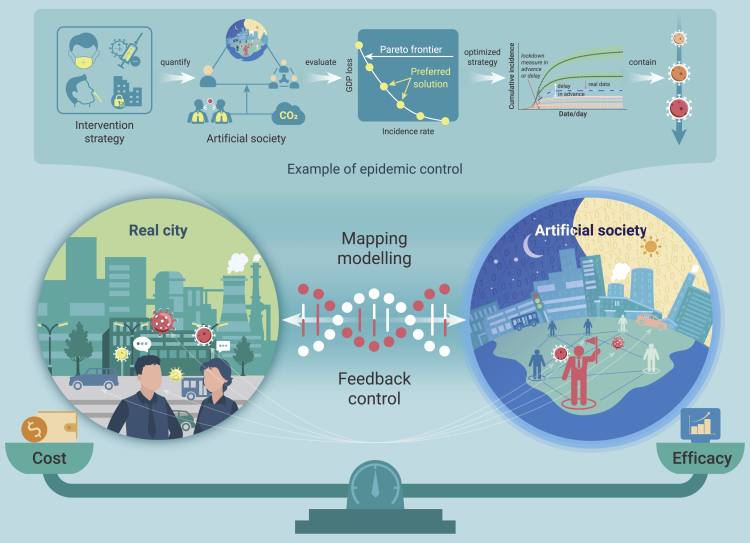
Strategy evaluation and optimization in response to troubling urban issues has become a challenging issue due to increasing social uncertainty, unreliable predictions, and poor decision-making. To address this problem, we propose a universal computational experiment framework with a fine-grained artificial society that is integrated with data-based models. The purpose of the framework is to evaluate the consequences of various combinations of strategies geared towards reaching a Pareto optimum with regards to efficacy versus costs. As an example, by modeling coronavirus 2019 mitigation, we show that Pareto frontier nations could achieve better economic growth and more effective epidemic control through the analysis of real-world data. Our work suggests that a nation's intervention strategy could be optimized based on the measures adopted by Pareto frontier nations through large-scale computational experiments. Our solution has been validated for epidemic control, and it can be generalized to other urban issues as well.
由于社会不确定性增加、预测不可靠以及决策不佳,针对棘手的城市问题进行策略评估和优化已成为一个具有挑战性的问题。为了解决这个问题,我们提出了一个通用的计算实验框架,该框架具有一个与基于数据的模型集成的细粒度人工社会。该框架的目的是评估各种策略组合在功效与成本方面达到帕累托最优的后果。例如,通过对2019年冠状病毒缓解措施进行建模,我们表明,通过对现实世界数据的分析,处于帕累托前沿的国家可以实现更好的经济增长和更有效的疫情控制。我们的工作表明,一个国家的干预策略可以通过大规模计算实验,根据帕累托前沿国家采取的措施进行优化。我们的解决方案已在疫情控制方面得到验证,并且也可以推广到其他城市问题。