Zorlular Melis, Uzer Tuğba
Department of Psychology, TED University, Ziya Gokalp Blv. No:48, 06420 Ankara, Turkey.
Curr Psychol. 2022 Sep 22:1-10. doi: 10.1007/s12144-022-03796-3.
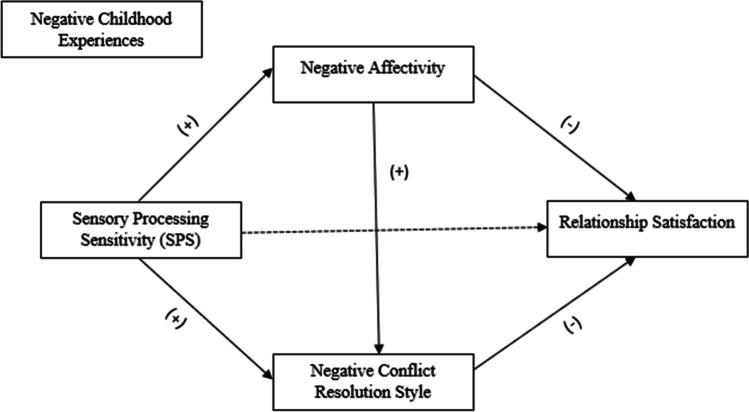
Very few studies have investigated the relationship between sensory processing sensitivity (SPS) and interpersonal variables; none has particularly focused on romantic relationship satisfaction. In the context of romantic relationships, this study aimed to identify whether SPS is a risk factor (hypothesizing that traits make individuals more vulnerable to the effects of adverse environments) or a susceptibility marker (hypothesizing that traits make individuals more susceptible to the effects of both nourishing and adverse environments). To understand this, we tested whether an increased level of SPS is associated with a decreased level of romantic relationship satisfaction through negative affectivity and conflict resolution styles. Furthermore, we tested whether these proposed relationships intensified when the childhood environment was negative. A total of 206 unmarried young adults who had been in a romantic relationship for at least two years completed the measures of SPS, childhood environment, negative affectivity, conflict resolution styles, and relationship satisfaction. The results indicated that negative affectivity and negative conflict resolution styles mediated the association between SPS and satisfaction in a relationship; however, childhood environment did not moderate these relationships. These findings suggest that beyond childhood factors, SPS is an independent risk factor for developing negative outcomes in romantic relationships. This study also significantly contributes to the literature by revealing the possible mechanisms between SPS and romantic relationship satisfaction.
极少有研究调查过感觉加工敏感性(SPS)与人际变量之间的关系;没有一项研究特别关注过浪漫关系满意度。在浪漫关系的背景下,本研究旨在确定SPS是一个风险因素(假设这些特质会使个体更容易受到不利环境的影响)还是一个易感性标记(假设这些特质会使个体更容易受到滋养性和不利环境的影响)。为了弄清楚这一点,我们通过消极情感和冲突解决方式来测试SPS水平的提高是否与浪漫关系满意度的降低有关。此外,我们还测试了在童年环境消极时,这些假设的关系是否会增强。共有206名处于浪漫关系中至少两年的未婚青年完成了SPS、童年环境、消极情感、冲突解决方式和关系满意度的测量。结果表明,消极情感和消极的冲突解决方式介导了SPS与关系满意度之间的关联;然而,童年环境并没有调节这些关系。这些发现表明,除了童年因素外,SPS是浪漫关系中产生消极结果的一个独立风险因素。本研究还通过揭示SPS与浪漫关系满意度之间的可能机制,为该文献做出了重要贡献。