
评估针对帕金森病的特定言语和特定计算机化阶梯训练节奏干预:一项交叉、多臂平行研究。
Evaluating a Speech-Specific and a Computerized Step-Training-Specific Rhythmic Intervention in Parkinson's Disease: A Cross-Over, Multi-Arms Parallel Study.
作者信息
Rösch Anne Dorothée, Taub Ethan, Gschwandtner Ute, Fuhr Peter
机构信息
Department of Clinical Neurophysiology/Neurology, Hospital of the University of Basel, Basel, Switzerland.
Department of Neurosurgery, Hospital of the University of Basel, Basel, Switzerland.
出版信息
Front Rehabil Sci. 2022 Jan 14;2:783259. doi: 10.3389/fresc.2021.783259. eCollection 2021.
BACKGROUND
Recent studies suggest movements of speech and gait in patients with Parkinson's Disease (PD) are impaired by a common underlying rhythmic dysfunction. If this being the case, motor deficits in speech and gait should equally benefit from rhythmic interventions regardless of whether it is a speech-specific or step-training-specific approach.
OBJECTIVE
In this intervention trial, we studied the effects of two rhythmic interventions on speech and gait. These rhythmic intervention programs are similar in terms of intensity and frequency (i.e., 3x per week, 45 min-long sessions for 4 weeks in total), but differ regarding therapeutic approach (rhythmic speech vs. rhythmic balance-mobility training).
METHODS
This study is a cross-over, parallel multi-arms, single blind intervention trial, in which PD patients treated with rhythmic speech-language therapy (rSLT; = 16), rhythmic balance-mobility training (rBMT; = 10), or no therapy (NT; = 18) were compared to healthy controls (HC; = 17; matched by age, sex, and education: > 0.82). Velocity and cadence in speech and gait were evaluated at baseline (BL), 4 weeks (4W-T1), and 6 months (6M-T2) and correlated.
RESULTS
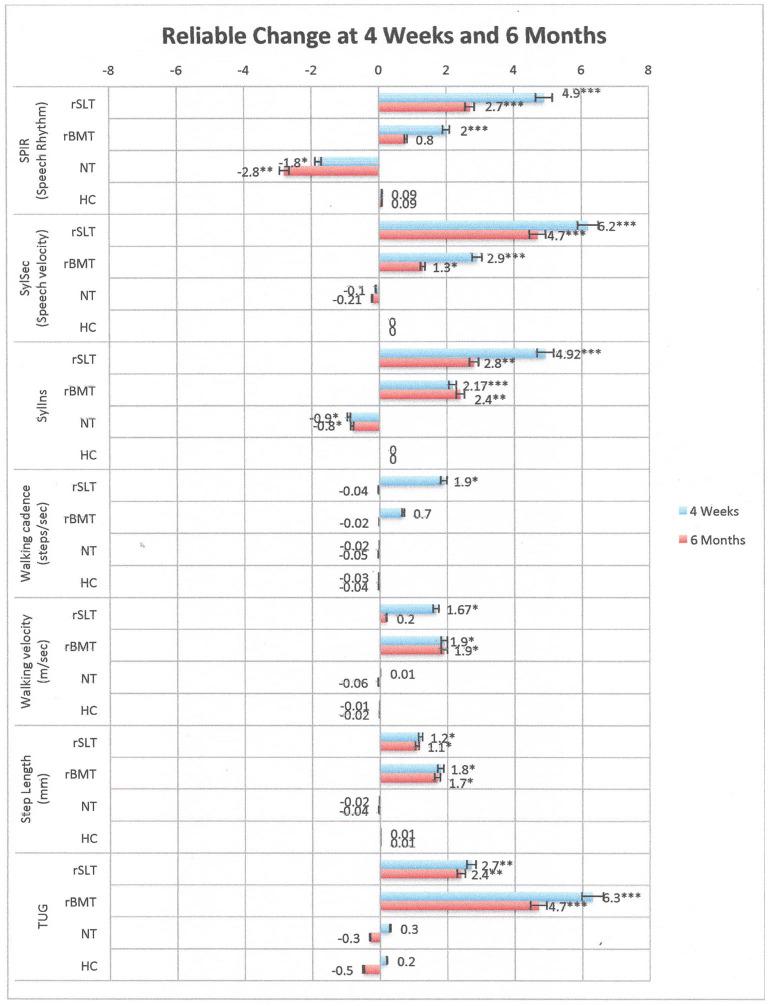
Parameters in speech and gait (i.e., speaking and walking velocity, as well as speech rhythm with gait cadence) were positively correlated across groups ( < 0.01). Statistical analyses involved ANOVA across groups and time, as well as and for within groups analyses. Statistical analyses were amplified using and to calculate true clinically significant changes due to the treatment on a patient individual level. Rhythmic intervention groups improved across variables and time (total Mean Difference: 3.07 [SD 1.8]; 95% CI 0.2-11.36]) compared to the NT group, whose performance declined significantly at 6 months ( < 0.01). HC outperformed rBMT and NT groups across variables and time ( < 0.001); the rSLT performed similarly to HC at 4 weeks and 6 months in speech rhythm and respiration.
CONCLUSIONS
Speech and gait deficits in PD may share a common mechanism in the underlying cortical circuits. Further, rSLT was more beneficial to dysrhythmic PD patients than rBMT, likely because of the nature of the rhythmic cue.
背景
近期研究表明,帕金森病(PD)患者的言语和步态运动受到一种常见的潜在节律性功能障碍的影响。如果情况确实如此,那么言语和步态方面的运动缺陷应该同样能从节律性干预中受益,无论这种干预是针对言语的特定方法还是针对步幅训练的特定方法。
目的
在这项干预试验中,我们研究了两种节律性干预对言语和步态的影响。这些节律性干预方案在强度和频率方面相似(即每周3次,每次45分钟,共进行4周),但在治疗方法上有所不同(节律性言语训练与节律性平衡 - 移动训练)。
方法
本研究是一项交叉、平行多臂、单盲干预试验,将接受节律性言语 - 语言治疗(rSLT;n = 16)、节律性平衡 - 移动训练(rBMT;n = 10)或无治疗(NT;n = 18)的PD患者与健康对照组(HC;n = 17;按年龄、性别和教育程度匹配:r > 0.82)进行比较。在基线(BL)、4周(4W - T1)和6个月(6M - T2)时评估言语和步态的速度及节奏,并进行相关性分析。
结果
各小组之间言语和步态参数(即说话和行走速度,以及言语节奏与步态节奏)呈正相关(p < 0.01)。统计分析包括跨组和跨时间的方差分析,以及组内分析的t检验和F检验。使用效应量和最小临床重要差异来计算个体患者层面因治疗导致的真正具有临床意义的变化,从而增强统计分析。与NT组相比,节律性干预组在各变量和各时间点均有改善(总平均差异:3.07 [标准差1.8];95%可信区间0.2 - 11.36]),而NT组在6个月时表现显著下降(p < 0.01)。HC组在各变量和各时间点的表现均优于rBMT组和NT组(p < 0.001);rSLT组在4周和6个月时的言语节奏和呼吸方面表现与HC组相似。
结论
PD患者的言语和步态缺陷可能在潜在的皮质回路中存在共同机制。此外,rSLT对节律紊乱的PD患者比rBMT更有益,可能是由于节律性提示的性质。


 Zotero 插件