Experimental Hematology Laboratory, Hematology Department, Jules Bordet Institute, Brussels, Belgium.
Hematology Department, Université libre de Bruxelles, Brussels, Belgium.
Front Immunol. 2022 Sep 16;13:913951. doi: 10.3389/fimmu.2022.913951. eCollection 2022.
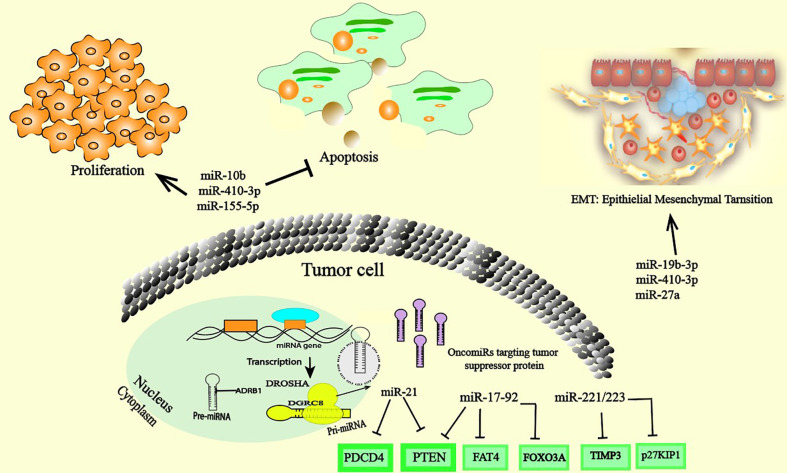
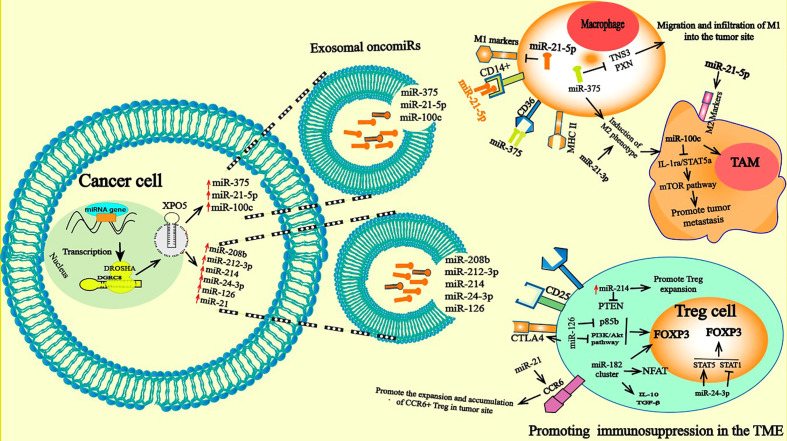
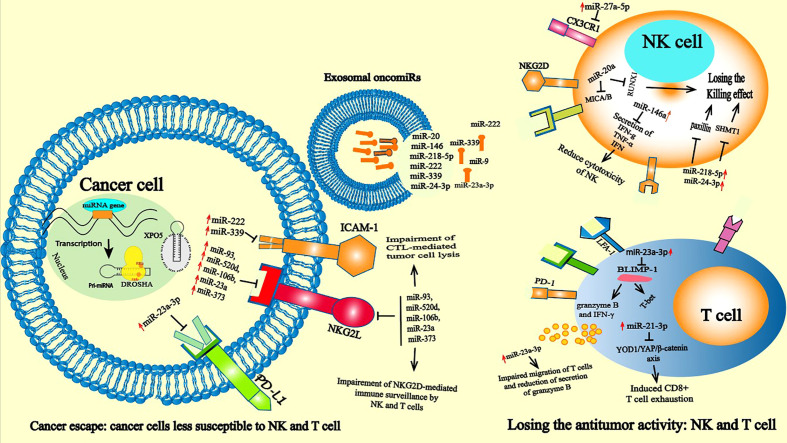
Currently, microRNAs have been established as central players in tumorigenesis, but above all, they have opened an important door for our understanding of immune and tumor cell communication. This dialog is largely due to onco-miR transfer from tumor cells to cells of the tumor microenvironment by exosome. This review outlines recent advances regarding the role of oncomiRs in enhancing cancer and how they modulate the cancer-related immune response in the tumor immune microenvironment. MicroRNAs (miRNAs) are a type of noncoding RNA that are important posttranscriptional regulators of messenger RNA (mRNA) translation into proteins. By regulating gene expression, miRNAs enhance or inhibit cancer development and participate in several cancer biological processes, including proliferation, invasion metastasis, angiogenesis, chemoresistance and immune escape. Consistent with their widespread effects, miRNAs have been categorized as oncogenes (oncomiRs) or tumor suppressor (TS) miRNAs. MiRNAs that promote tumor growth, called oncomiRs, inhibit messenger RNAs of TS genes and are therefore overexpressed in cancer. In contrast, TS miRNAs inhibit oncogene messenger RNAs and are therefore underexpressed in cancer. Endogenous miRNAs regulate different cellular pathways in all cell types. Therefore, they are not only key modulators in cancer cells but also in the cells constituting their microenvironments. Recently, it was shown that miRNAs are also involved in intercellular communication. Indeed, miRNAs can be transferred from one cell type to another where they regulate targeted gene expression. The primary carriers for the transfer of miRNAs from one cell to another are exosomes. Exosomes are currently considered the primary carriers for communication between the tumor and its surrounding stromal cells to support cancer progression and drive immune suppression. Exosome and miRNAs are seen by many as a hope for developing a new class of targeted therapy. This review outlines recent advances in understanding the role of oncomiRs in enhancing cancer and how they promote its aggressive characteristics and deeply discusses the role of oncomiRs in suppressing the anticancer immune response in its microenvironment. Additionally, further understanding the mechanism of oncomiR-related immune suppression will facilitate the use of miRNAs as biomarkers for impaired antitumor immune function, making them ideal immunotherapy targets.
目前,miRNAs 已被确定为肿瘤发生的核心参与者,但最重要的是,它们为我们理解免疫和肿瘤细胞通讯打开了重要的大门。这种对话在很大程度上是由于肿瘤细胞通过外泌体将致癌 miRNA 转移到肿瘤微环境中的细胞。本文综述了关于癌 miRNA 增强癌症的作用以及它们如何调节肿瘤免疫微环境中与癌症相关的免疫反应的最新进展。miRNAs(miRNAs)是一类非编码 RNA,是信使 RNA(mRNA)翻译为蛋白质的重要转录后调节因子。通过调节基因表达,miRNAs 促进或抑制癌症的发展,并参与包括增殖、侵袭转移、血管生成、化疗耐药和免疫逃逸在内的几种癌症生物学过程。与它们广泛的作用一致,miRNAs 被归类为癌基因(oncomiRs)或肿瘤抑制基因(TS)miRNAs。促进肿瘤生长的 miRNA 称为 oncomiRs,抑制 TS 基因的信使 RNA,因此在癌症中过度表达。相反,TS miRNAs 抑制致癌基因的信使 RNA,因此在癌症中表达不足。内源性 miRNAs 在所有细胞类型中调节不同的细胞途径。因此,它们不仅是癌细胞的关键调节剂,也是构成其微环境的细胞的关键调节剂。最近,研究表明 miRNA 也参与细胞间通讯。事实上,miRNAs 可以从一种细胞类型转移到另一种细胞类型,在那里它们调节靶向基因的表达。miRNAs 从一种细胞转移到另一种细胞的主要载体是外泌体。外泌体目前被认为是肿瘤与其周围基质细胞之间通讯的主要载体,以支持癌症进展并驱动免疫抑制。外泌体和 miRNAs 被许多人视为开发新一代靶向治疗的希望。本文综述了关于癌 miRNA 在增强癌症方面的作用以及它们如何促进其侵袭性特征的最新进展,并深入讨论了癌 miRNA 在抑制其微环境中的抗肿瘤免疫反应方面的作用。此外,进一步了解癌 miRNA 相关免疫抑制的机制将有助于将 miRNAs 用作受损抗肿瘤免疫功能的生物标志物,使其成为理想的免疫治疗靶点。