Aegis Sciences Corporation, Nashville, TN, United States of America.
Walgreens, Deerfield, IL, United States of America.
PLoS One. 2022 Oct 3;17(10):e0275150. doi: 10.1371/journal.pone.0275150. eCollection 2022.
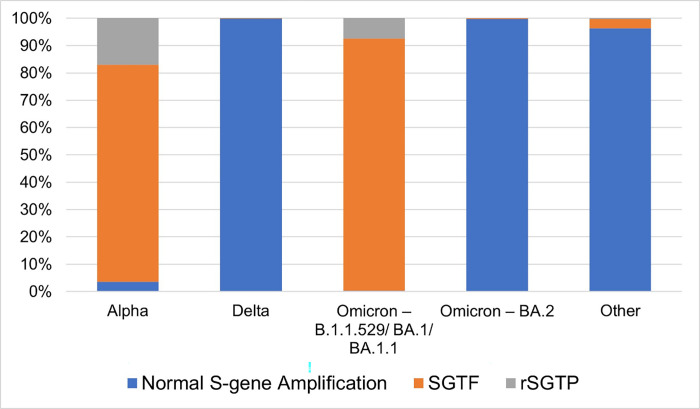
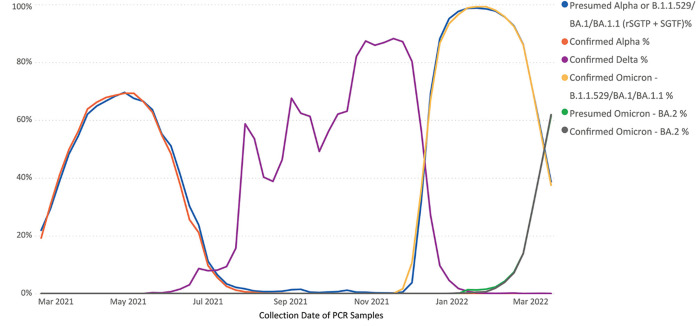
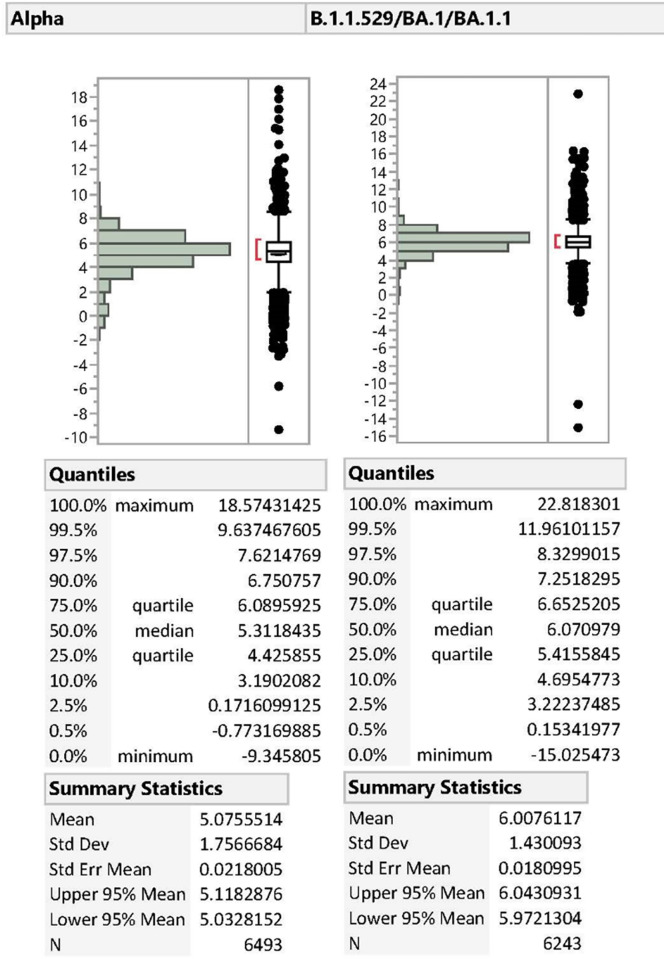
SARS-CoV-2, the virus that causes COVID-19, has many variants capable of rapid transmission causing serious illness. Timely surveillance of new variants is essential for an effective public health response. Ensuring availability and access to diagnostic and molecular testing is key to this type of surveillance. This study utilized reverse transcription polymerase chain reaction (RT-PCR) and whole genome sequencing results from COVID-19-positive patient samples obtained through a collaboration between Aegis Sciences Corporation and Walgreens Pharmacy that has conducted more than 8.5 million COVID-19 tests at ~5,200 locations across the United States and Puerto Rico. Viral evolution of SARS-CoV-2 can lead to mutations in the S-gene that cause reduced or failed S-gene amplification in diagnostic PCR tests. These anomalies, labeled reduced S-gene target performance (rSGTP) and S-gene target failure (SGTF), are characteristic of variants carrying the del69-70 mutation, such as Alpha and Omicron (B.1.1.529, BA.1, and BA.1.1) lineages. This observation has been validated by whole genome sequencing and can provide presumptive lineage data following completion of diagnostic PCR testing in 24-48 hours from collection. Active surveillance of trends in PCR and sequencing results is key to the identification of changes in viral transmission and emerging variants. This study shows that rSGTP and SGTF can be utilized for near real-time tracking and surveillance of SARS-CoV-2 variants, and is superior to the use of SGTF alone due to the significant proportion of Alpha and Omicron (B.1.1.529, BA.1, and BA.1.1) lineages known to carry the del69-70 mutation and observed to have S-gene amplification. Adopting new tools and techniques to both diagnose acute infections and expedite identification of emerging variants is critical to supporting public health.
SARS-CoV-2 是引起 COVID-19 的病毒,它有许多能够快速传播并导致严重疾病的变种。及时监测新变种对于有效的公共卫生应对至关重要。确保诊断和分子检测的可用性和可及性是这种监测的关键。本研究利用了 Aegis Sciences Corporation 与 Walgreens Pharmacy 之间合作获得的 COVID-19 阳性患者样本的逆转录聚合酶链反应(RT-PCR)和全基因组测序结果,该合作在美国和波多黎各的约 5200 个地点进行了超过 850 万次 COVID-19 检测。SARS-CoV-2 的病毒进化可导致 S 基因发生突变,从而导致诊断 PCR 检测中 S 基因扩增减少或失败。这些异常现象,标记为 S 基因靶标性能降低(rSGTP)和 S 基因靶标失败(SGTF),是携带 del69-70 突变的变种的特征,例如 Alpha 和 Omicron(B.1.1.529、BA.1 和 BA.1.1)谱系。这一观察结果已经通过全基因组测序得到了验证,并可以在采集后 24-48 小时内完成诊断 PCR 检测后提供推定的谱系数据。PCR 和测序结果趋势的主动监测是识别病毒传播变化和新出现变种的关键。本研究表明,rSGTP 和 SGTF 可用于实时跟踪和监测 SARS-CoV-2 变种,并且由于已知携带 del69-70 突变并观察到 S 基因扩增的 Alpha 和 Omicron(B.1.1.529、BA.1 和 BA.1.1)谱系比例很大,因此优于单独使用 SGTF。采用新的工具和技术来诊断急性感染并加快识别新出现的变种对于支持公共卫生至关重要。