Faculty of Health Sciences, Klaipeda University, Klaipeda, Lithuania.
Faculty of Sport, Research Centre in Physical Activity, Health and Leisure, University of Porto, Lisbon, Portugal.
Eur J Pediatr. 2022 Dec;181(12):4091-4099. doi: 10.1007/s00431-022-04623-4. Epub 2022 Oct 6.
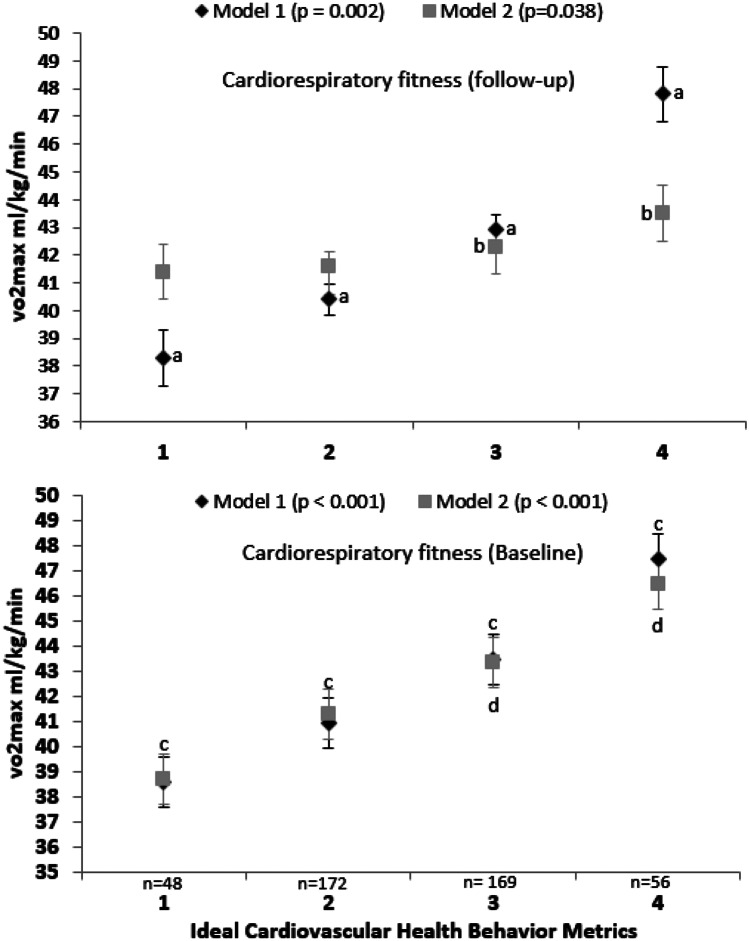
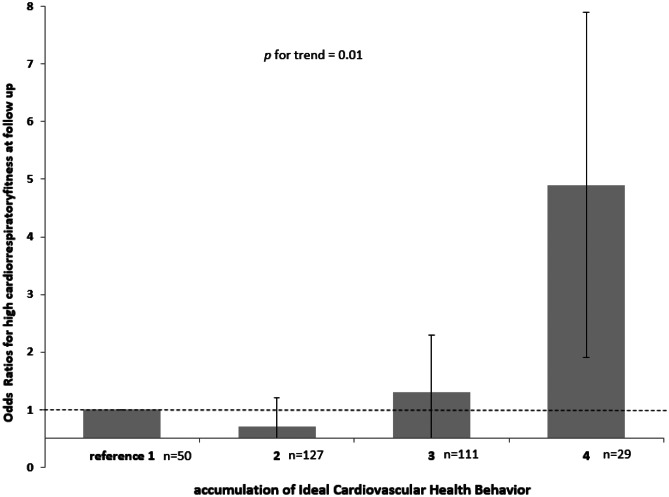
Cardiorespiratory fitness has been substantially associated with health status. However, longitudinal studies on cardiorespiratory fitness and ideal cardiovascular health behavior (ICHB) in adolescents are scarce. The aim of this study was to evaluate the longitudinal association between ICHB (at baseline) and cardiorespiratory fitness (at follow-up). This is a 2-year prospective analysis of 445 adolescents (232 girls) aged 12-18 years. The ICHB was developed by the American Heart Association as meeting the ideal health behaviors for a healthy diet, physical activity, smoking status, and body mass index. ANCOVAS adjusted by age, sex, pubertal stage, socioeconomic status, and cardiorespiratory fitness showed that the higher the number of ICHB metrics accumulated at baseline (from 1 to 4), the higher the cardiorespiratory fitness levels over a 2-year period (p = 0.038). In logistic regressions, after adjusting for potential confounders, the odds ratios for having high cardiorespiratory fitness at follow-up was 4.9 (95% CI, 1.2-20.1, p = 0.02) for those who accumulated all four metrics of ICHB, when compared to those with 1 or less metrics of ICHB. In addition, the higher the number of ICHB metrics accumulated, the higher the likelihood of having a high cardiorespiratory fitness level over a 2-year period (p for trend = 0.01).
We identified a significant association between ICBH and cardiorespiratory fitness in adolescents. Therefore, improving ICBH in adolescence is likely to benefit the cardiorespiratory fitness.
• Smoking status, body mass index, physical activity, and diet are associated to cardiorespiratory fitness in adulthood. • Lifestyle behaviors such as physical activity, smoking, body weight, and healthy diet are individually linked with cardiorespiratory fitness and, however, have not been examined jointly, as combined health behaviors.
• Accumulation of cardiovascular health behavior metrics was positively associated with cardiorespiratory fitness at a 2-year follow-up, in adolescents. • Meeting all the four metrics of ideal cardiovascular health behavior seems important for healthy cardiorespiratory fitness during adolescence.
目的:本研究旨在评估理想心血管健康行为(ICHB)(基线时)与心血管适能(随访时)之间的纵向关联。
方法:这是一项对 445 名 12-18 岁青少年(232 名女孩)进行的为期 2 年的前瞻性分析。ICHB 由美国心脏协会制定,其标准为符合健康饮食、体力活动、吸烟状况和体重指数的理想健康行为。通过年龄、性别、青春期阶段、社会经济地位和心血管适能进行调整的协方差分析显示,基线时积累的 ICHB 指标数量越高(从 1 到 4),在 2 年内的心血管适能水平越高(p=0.038)。在调整了潜在混杂因素后,多因素逻辑回归显示,与 ICHB 指标 1 或更少的个体相比,在随访时具有较高心血管适能的个体,其比值比为 4.9(95%CI,1.2-20.1,p=0.02),这些个体积累了 ICHB 的所有 4 项指标。此外,ICHB 指标积累数量越高,在 2 年内具有较高心血管适能水平的可能性越大(趋势检验的 p=0.01)。
结论:我们发现 ICHB 与青少年的心血管适能之间存在显著关联。因此,改善青少年的 ICHB 可能有益于提高心血管适能。
背景:吸烟状况、体重指数、体力活动和饮食与成年人的心血管适能相关。生活方式行为,如体力活动、吸烟、体重和健康饮食,各自与心血管适能相关,但尚未作为综合健康行为进行联合检查。
新发现:在青少年中,心血管健康行为指标的积累与 2 年后的心血管适能呈正相关。在青少年时期,达到理想心血管健康行为的所有四项指标似乎对健康的心血管适能很重要。