Bolton Marcus J, Arevalo Claudia P, Griesman Trevor, Li Shuk Hang, Bates Paul, Wilson Patrick C, Hensley Scott E
Department of Microbiology, Perelman School of Medicine, University of Pennsylvania, Philadelphia, PA, 19104, USA.
Department of Medicine, Section of Rheumatology, the Knapp Center for Lupus and Immunology, University of Chicago, Chicago, IL 60637, USA.
bioRxiv. 2022 Sep 28:2022.09.27.509738. doi: 10.1101/2022.09.27.509738.
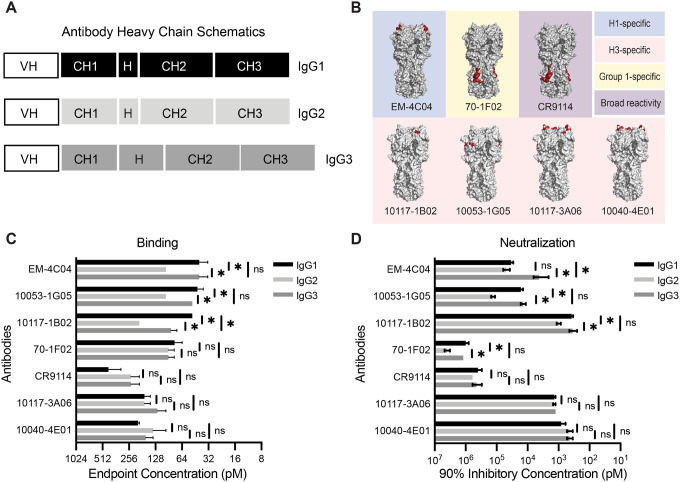
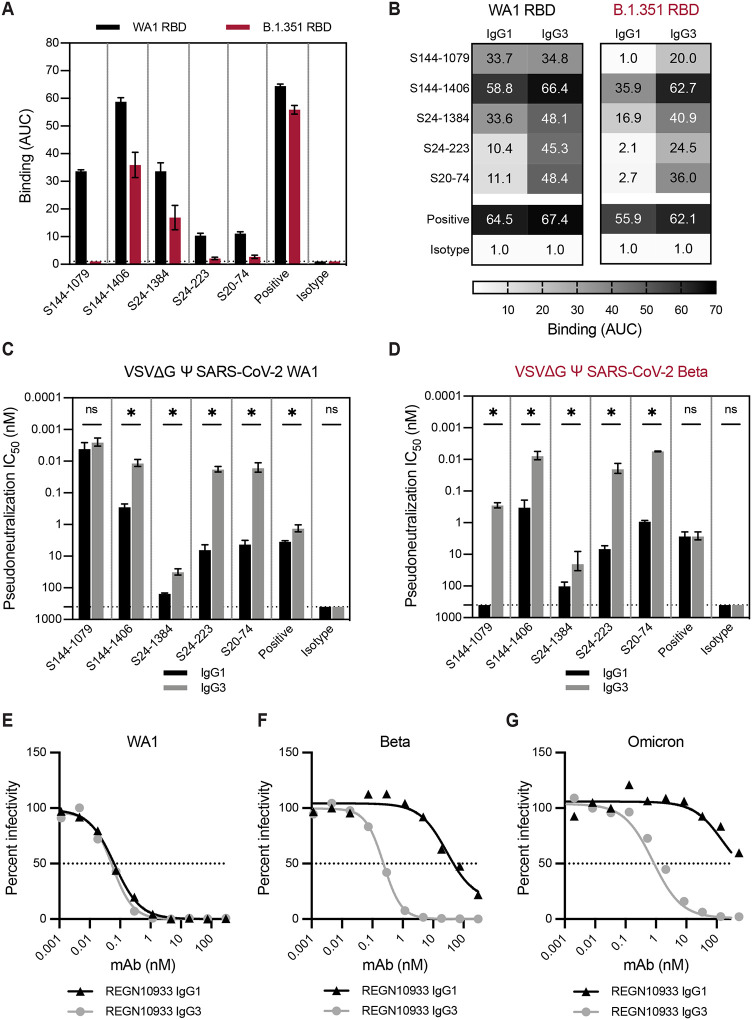
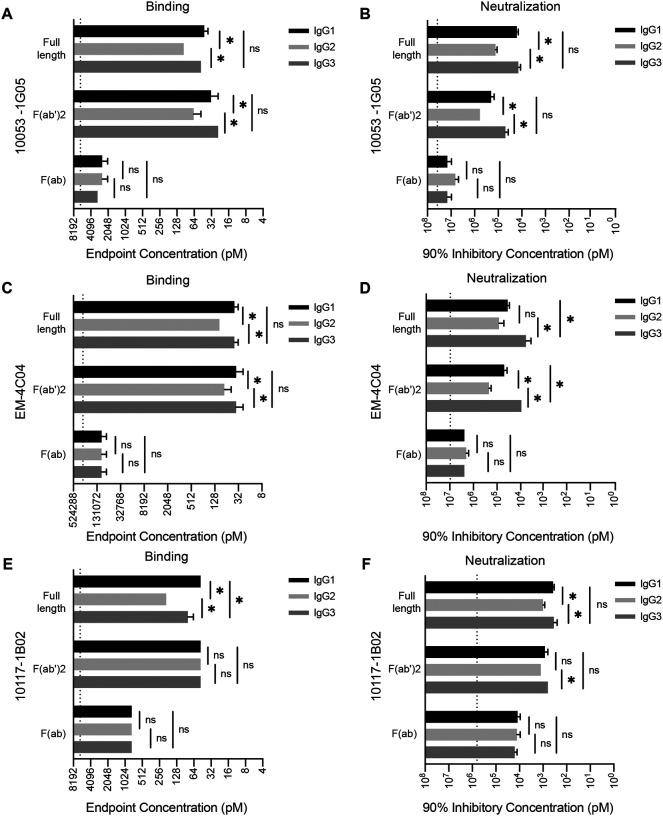
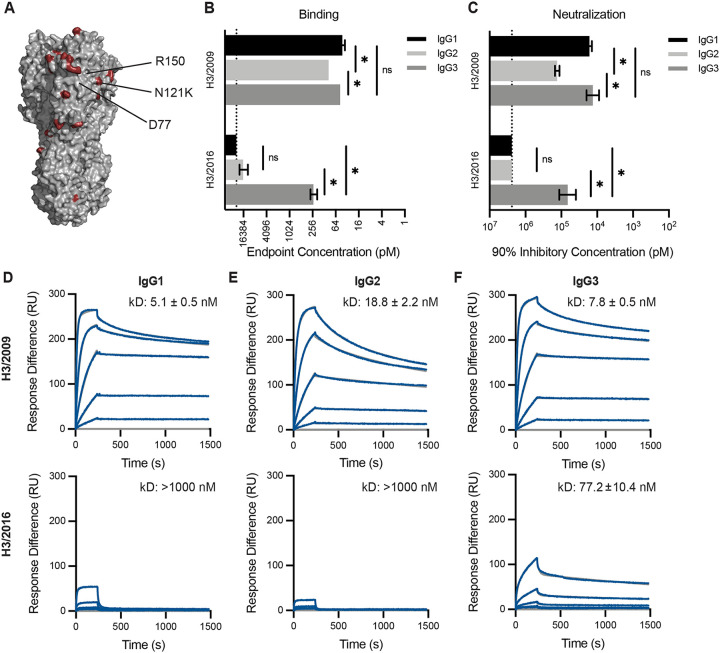
The constant domains of antibodies are important for effector functions, but less is known about how they can affect binding and neutralization of viruses. Here we evaluated a panel of human influenza virus monoclonal antibodies (mAbs) expressed as IgG1, IgG2 or IgG3. We found that many influenza virus-specific mAbs have altered binding and neutralization capacity depending on the IgG subclass encoded, and that these differences result from unique bivalency capacities of the subclasses. Importantly, subclass differences in antibody binding and neutralization were greatest when the affinity for the target antigen was reduced through antigenic mismatch. We found that antibodies expressed as IgG3 bound and neutralized antigenically drifted influenza viruses more effectively. We obtained similar results using a panel of SARS-CoV-2-specific mAbs and the antigenically advanced B.1.351 strain of SARS-CoV-2. We found that a licensed therapeutic mAb retained neutralization breadth against SARS-CoV-2 variants when expressed as IgG3, but not IgG1. These data highlight that IgG subclasses are not only important for fine-tuning effector functionality, but also for binding and neutralization of antigenically drifted viruses.
Influenza viruses and coronaviruses undergo continuous change, successfully evading human antibodies elicited from prior infections or vaccinations. It is important to identify features that allow antibodies to bind with increased breadth. Here we examined the effect that different IgG subclasses have on monoclonal antibody binding and neutralization. We show that IgG subclass is a determinant of antibody breadth, with IgG3 affording increased neutralization of antigenically drifted variants of influenza virus and SARS-CoV-2. Future studies should evaluate IgG3 therapeutic antibodies and vaccination strategies or adjuvants that may skew antibody responses toward broadly reactive isotypes.
抗体的恒定结构域对效应功能很重要,但它们如何影响病毒的结合和中和作用却鲜为人知。在这里,我们评估了一组以IgG1、IgG2或IgG3形式表达的人源流感病毒单克隆抗体(mAb)。我们发现,许多流感病毒特异性mAb的结合和中和能力会因所编码的IgG亚类而改变,并且这些差异源于亚类独特的双价能力。重要的是,当通过抗原错配降低对靶抗原的亲和力时,抗体结合和中和的亚类差异最为明显。我们发现,以IgG3形式表达的抗体能更有效地结合和中和抗原性漂移的流感病毒。使用一组SARS-CoV-2特异性mAb和抗原性进化的SARS-CoV-2 B.1.351毒株,我们也得到了类似的结果。我们发现,一种已获许可的治疗性mAb在以IgG3而非IgG1形式表达时,对SARS-CoV-2变体仍保持中和广度。这些数据表明,IgG亚类不仅对微调效应功能很重要,而且对抗原性漂移病毒的结合和中和也很重要。
流感病毒和冠状病毒不断发生变化,成功逃避先前感染或疫苗接种所引发的人体抗体。识别能使抗体更广泛结合的特征很重要。在这里,我们研究了不同IgG亚类对单克隆抗体结合和中和的影响。我们表明,IgG亚类是抗体广度的一个决定因素,IgG3能增强对流感病毒和SARS-CoV-2抗原性漂移变体的中和作用。未来的研究应评估IgG3治疗性抗体以及可能使抗体反应偏向广泛反应性同种型的疫苗接种策略或佐剂。