Yang Jinyan, Tang Yongjie, Liu Xueqin, Zhang Jinning, Zahoor Khan Muhammad, Mi Siyuan, Wang Chuduan, Yu Ying
Laboratory of Animal Genetics and Breeding, Ministry of Agriculture and Rural Affairs of China, National Engineering Laboratory of Animal Breeding, College of Animal Science and Technology, China Agricultural University, Beijing, China.
Department of Animal Sciences, Faculty of Veterinary and Animal Sciences, University of Agriculture, Dera Ismail Khan, Pakistan.
Front Genet. 2022 Sep 20;13:949850. doi: 10.3389/fgene.2022.949850. eCollection 2022.
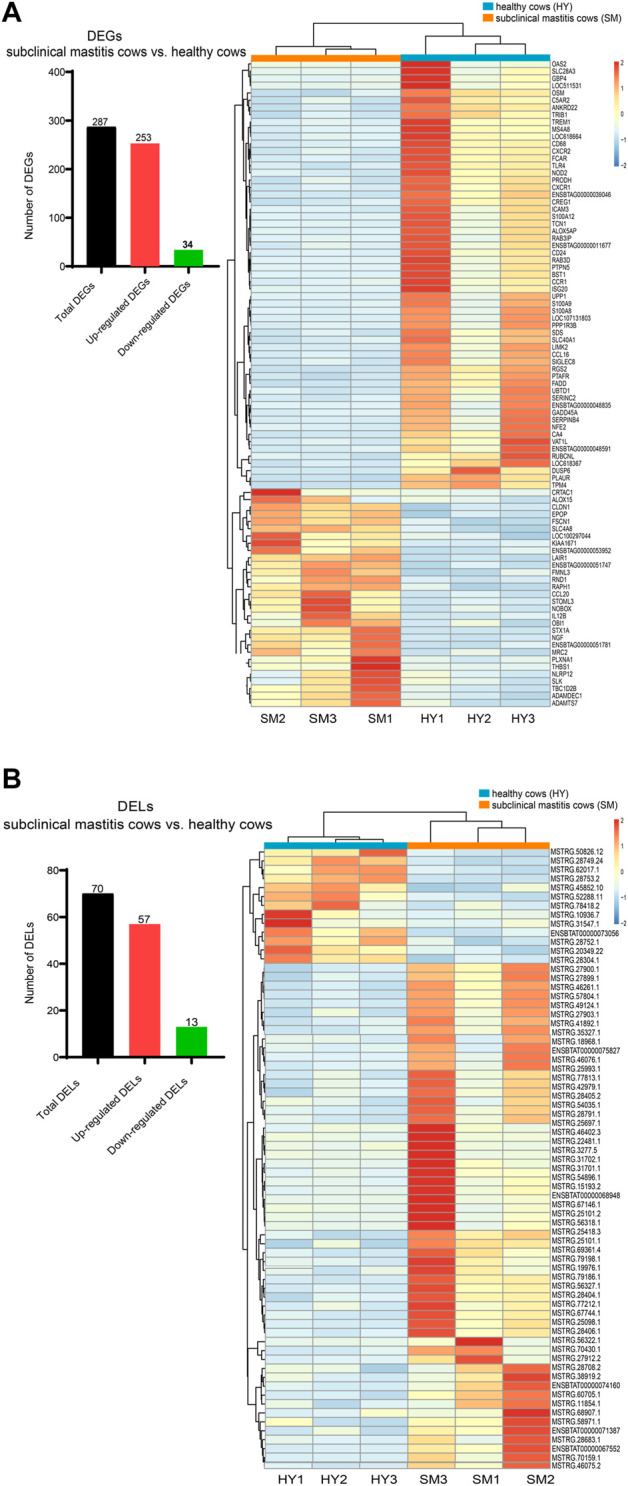
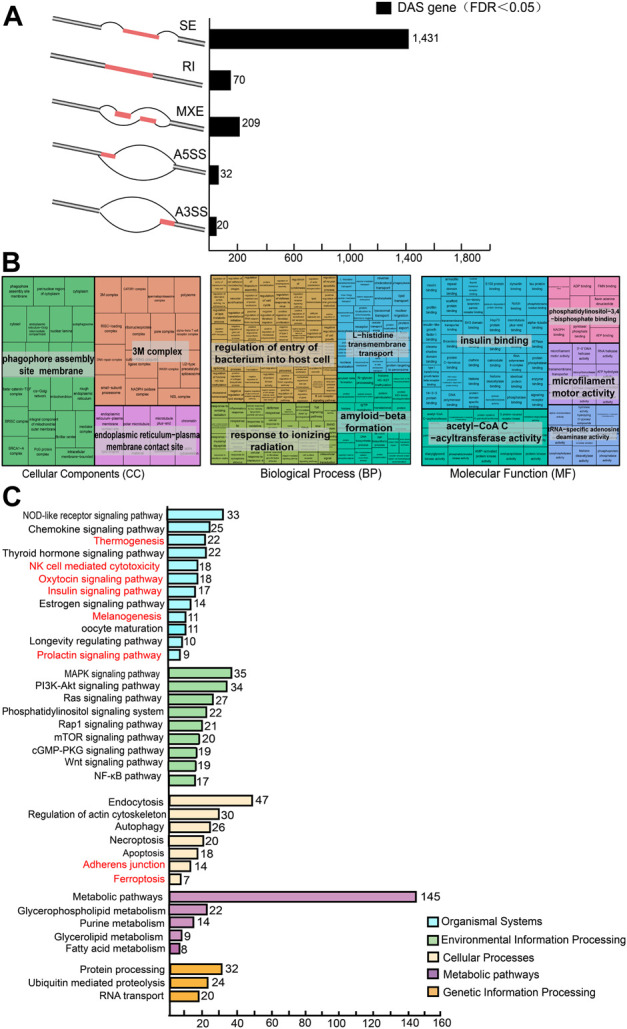
Subclinical bovine mastitis is a pathogenic infection of the breast characterized by a marked decrease in milk production and quality. As it has no obvious clinical symptoms, diagnosis and treatment are challenging. Therefore, searching for biomarkers in cows' peripheral white blood cells is valuable for preventing and treating subclinical mastitis. Thus, in this study, the transcriptome of peripheral blood from healthy and subclinical mastitis cows was characterized to find the regulatory signatures of bovine subclinical mastitis using RNA-seq. A total of 287 differentially expressed genes (DEGs) and 70 differentially expressed lncRNAs (DELs) were detected, and 37 DELs were documented near known Quantitative Trait Loci (QTL) associated with the mastitis of cows. Bioinformatic analysis indicated that lncRNAs MSTRG25101.2, MSTRG.56327.1, and MSTRG.18968.1, which are adjacent to the SCS QTL and SCC QTL, may be candidate lncRNAs that influence the pathogenesis of mastitis in cows by up-regulating the expression of genes , , , and . Moreover, the alternative splicing (AS) pattern of transcriptional sequence differences between healthy cows and subclinical mastitis cows suggested a molecular mechanism of mastitis resistance and susceptibility. A total of 2,212 differential alternative splicing (DAS) events, corresponding to 1,621 unique DAS genes, were identified in both groups and significantly enriched in immune and inflammatory pathways. Of these, 29 DAS genes were subject to regulation by 32 alternative splicing SNPs, showing diverse and specific splicing patterns and events. It is hypothesized that the and splice variants associated with AS SNPs (rs42705933 and rs133847062) may be risk factors for susceptibility to bovine subclinical mastitis. Altogether, these key blood markers associated with resistance to subclinical mastitis and SNPs associated with alternative splicing of genes provide the basis for genetic breeding for resistance to subclinical mastitis in cows.
亚临床型牛乳腺炎是一种乳腺的致病性感染,其特征是产奶量和奶品质显著下降。由于它没有明显的临床症状,诊断和治疗具有挑战性。因此,在奶牛外周血白细胞中寻找生物标志物对于预防和治疗亚临床型乳腺炎具有重要价值。因此,在本研究中,对健康奶牛和亚临床型乳腺炎奶牛的外周血转录组进行了表征,以利用RNA测序找到牛亚临床型乳腺炎的调控特征。共检测到287个差异表达基因(DEGs)和70个差异表达长链非编码RNA(DELs),并且有37个DELs记录在与奶牛乳腺炎相关的已知数量性状位点(QTL)附近。生物信息学分析表明,与体细胞评分QTL和体细胞计数QTL相邻的长链非编码RNA MSTRG25101.2、MSTRG.56327.1和MSTRG.18968.1可能是通过上调基因、、、和的表达来影响奶牛乳腺炎发病机制的候选长链非编码RNA。此外,健康奶牛和亚临床型乳腺炎奶牛之间转录序列差异的可变剪接(AS)模式提示了乳腺炎抗性和易感性的分子机制。在两组中总共鉴定出2212个差异可变剪接(DAS)事件,对应于1621个独特的DAS基因,并且这些事件在免疫和炎症途径中显著富集。其中,29个DAS基因受到32个可变剪接单核苷酸多态性的调控,呈现出多样且特异的剪接模式和事件。据推测,与AS单核苷酸多态性(rs42705933和rs133847062)相关的和剪接变体可能是牛亚临床型乳腺炎易感性的风险因素。总之,这些与亚临床型乳腺炎抗性相关的关键血液标志物以及与基因可变剪接相关的单核苷酸多态性为奶牛抗亚临床型乳腺炎的遗传育种提供了基础。