Zhang Kerui, Qi Xiangyun, Zhu Fuyu, Dong Quanbin, Gou Zhongshan, Wang Fang, Xiao Li, Li Menghuan, Chen Lianmin, Wang Yifeng, Zhang Haifeng, Sheng Yanhui, Kong Xiangqing
Cardiovascular Research Center, The Affiliated Suzhou Hospital of Nanjing Medical University, Suzhou Municipal Hospital, Gusu School, Nanjing Medical University, Suzhou, China.
Department of Cardiology, The First Affiliated Hospital of Nanjing Medical University, Nanjing Medical University, Nanjing, China.
Front Cardiovasc Med. 2022 Sep 20;9:984711. doi: 10.3389/fcvm.2022.984711. eCollection 2022.
Genetic, observational, and clinical intervention studies indicate that circulating levels of remnant cholesterol (RC) are associated with cardiovascular diseases. However, the predictive value of RC for cardiovascular mortality in the general population remains unclear.
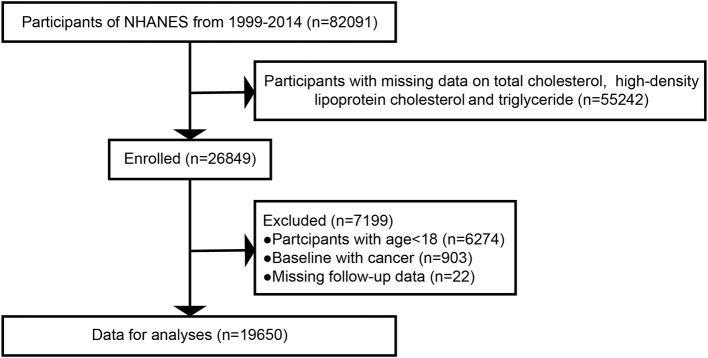
Our study population comprised 19,650 adults in the United States from the National Health and Nutrition Examination Survey (NHANES) (1999-2014). RC was calculated from non-high-density lipoprotein cholesterol (non-HDL-C) minus low-density lipoprotein cholesterol (LDL-C) determined by the Sampson formula. Multivariate Cox regression, restricted cubic spline analysis, and subgroup analysis were applied to explore the relationship of RC with cardiovascular mortality.
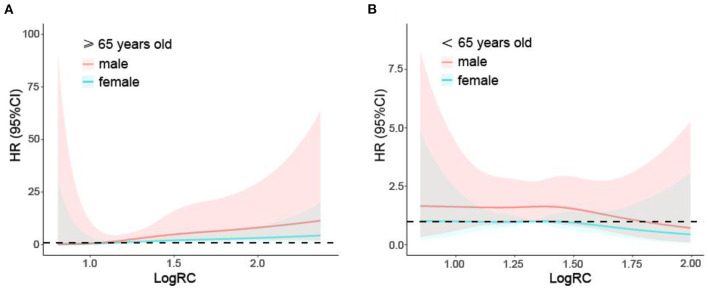
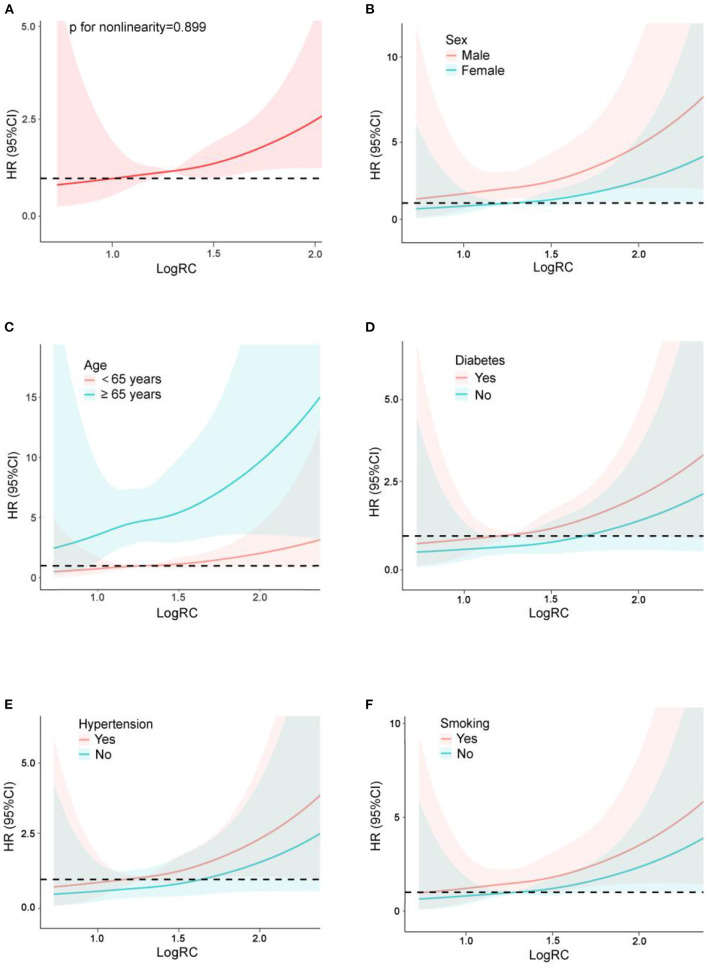
The mean age of the study cohort was 46.4 ± 19.2 years, and 48.7% of participants were male. During a median follow-up of 93 months, 382 (1.9%) cardiovascular deaths occurred. In a fully adjusted Cox regression model, log RC was significantly associated with cardiovascular mortality [hazard ratio (HR) 2.82; 95% confidence interval (CI) 1.17-6.81]. The restricted cubic spline curve indicated that log RC had a linear association with cardiovascular mortality (p for non-linearity = 0.899). People with higher LDL-C (≥130 mg/dL), higher RC [≥25.7/23.7 mg/dL in males/females corresponding to the LDL-C clinical cutoff point (130 mg/dL)] and abnormal HDL-C (<40/50 mg/dL in males/females) levels had a higher risk of cardiovascular mortality (HR 2.18; 95% CI 1.13-4.21 in males and HR 2.19; 95% CI 1.24-3.88 in females) than the reference group (lower LDL-C, lower RC and normal HDL-C levels).
Elevated RC levels were associated with cardiovascular mortality independent of traditional risk factors.
基因、观察性和临床干预研究表明,残余胆固醇(RC)的循环水平与心血管疾病相关。然而,RC对一般人群心血管死亡率的预测价值仍不明确。
我们的研究人群包括来自美国国家健康与营养检查调查(NHANES)(1999 - 2014年)的19650名成年人。RC通过非高密度脂蛋白胆固醇(非HDL - C)减去由桑普森公式确定的低密度脂蛋白胆固醇(LDL - C)来计算。应用多变量Cox回归、受限立方样条分析和亚组分析来探讨RC与心血管死亡率的关系。
研究队列的平均年龄为46.4±19.2岁,48.7%的参与者为男性。在中位随访93个月期间,发生了382例(1.9%)心血管死亡。在完全调整的Cox回归模型中,log RC与心血管死亡率显著相关[风险比(HR)2.82;95%置信区间(CI)1.17 - 6.81]。受限立方样条曲线表明log RC与心血管死亡率呈线性关联(非线性p值 = 0.899)。低密度脂蛋白胆固醇水平较高(≥130 mg/dL)、残余胆固醇水平较高[男性/女性中≥25.7/23.7 mg/dL,对应低密度脂蛋白胆固醇临床切点(130 mg/dL)]以及高密度脂蛋白胆固醇异常(男性/女性中<40/50 mg/dL)的人群,心血管死亡风险高于参考组(较低的低密度脂蛋白胆固醇、较低的残余胆固醇和正常的高密度脂蛋白胆固醇水平)(男性HR 2.18;95% CI 1.13 - 4.21,女性HR 2.19;95% CI 1.24 - 3.88)。
残余胆固醇水平升高与心血管死亡率相关,且独立于传统危险因素。