Department of Paediatrics, University of Melbourne, Melbourne, Victoria, Australia.
Murdoch Children's Research Institute, Melbourne, Victoria, Australia.
J Paediatr Child Health. 2023 Jan;59(1):32-40. doi: 10.1111/jpc.16230. Epub 2022 Oct 7.
To explore the effects of COVID-19 pandemic restrictions varying in severity and duration on health-related behaviours in children aged 5-17 years.
We used data from the Royal Children's Hospital National Child Health Poll, an online cross-sectional survey of Australian caregivers. The survey assessed 1222 caregivers' perceived changes in health-related behaviours (physical activity, sleep, screen-time, diet, outdoor activity, family and peer connectedness) of 2011 children aged 5-17 years in a typical week from June to September 2020 (when jurisdictions experienced varying restriction severity and duration) compared to retrospective reports of behaviour before March 2020 (pre-pandemic). To compare the effects of varying restriction severity in Victoria, New South Wales (NSW) and other states and territories on health-related behaviours binary logistic regression was used, adjusting for caregiver demographics and weighted to reflect Australia's parent population.
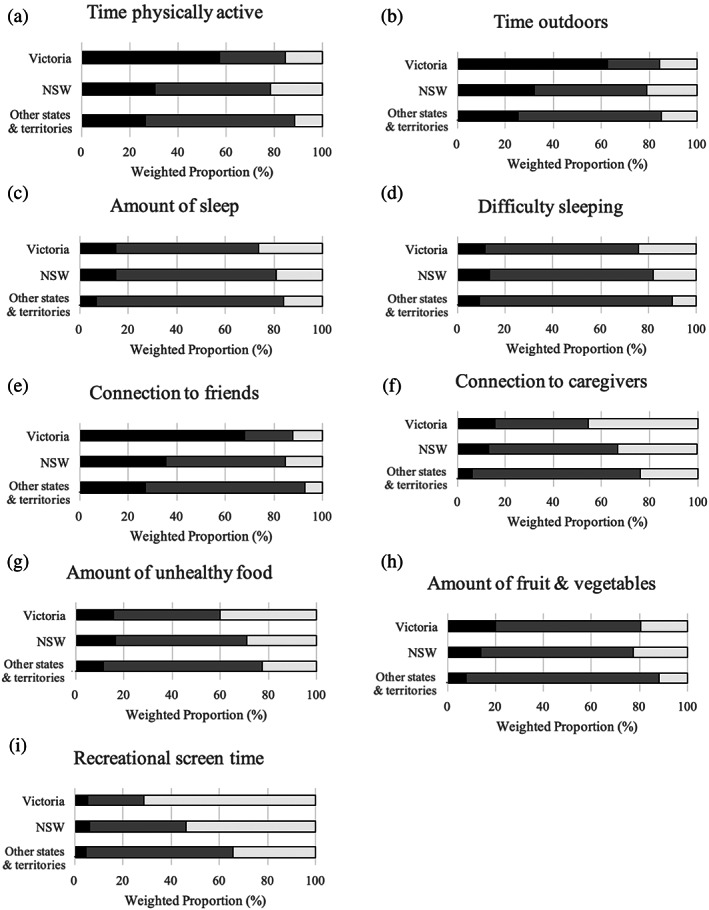
Compared to pre-pandemic, Victoria's restrictions had a greater impact on child health-related behaviours compared to NSW restrictions and an even stronger impact compared to other states and territories which experienced few or no restrictions. A greater proportion of Victorian children reported more recreational screen time (71.3%) than NSW (53.9%) and other states and territories (34.5%) and less physical activity (57.2%) than NSW (30.3%) and other states and territories (26.5%). Victorian children reported less outdoor activity (62.6%) than NSW (32.0%) and other states and territories (25.2%), and less social connectedness (68.0%) than NSW (35.4%) and other states and territories (27.3%).
More severe and longer COVID-19 pandemic restrictions are associated with greater impacts and predominantly more negative impacts to children's health-related behaviours. These should be mitigated through policies and programs to encourage healthier life-styles.
探讨严重程度和持续时间不同的 COVID-19 大流行限制措施对 5-17 岁儿童健康相关行为的影响。
我们使用了来自澳大利亚皇家儿童医院全国儿童健康民意调查的数据,这是一项针对澳大利亚护理人员的在线横断面调查。该调查评估了 2011 名 5-17 岁儿童在 2020 年 6 月至 9 月(当各司法管辖区经历不同的限制严重程度和持续时间)典型一周内的健康相关行为(体力活动、睡眠、屏幕时间、饮食、户外活动、家庭和同伴联系)的变化,与 2020 年 3 月之前(大流行前)的行为回顾报告进行了比较。为了比较维多利亚州、新南威尔士州(新州)和其他州和地区不同限制严重程度对健康相关行为的影响,我们使用了二元逻辑回归,调整了护理人员的人口统计学特征,并进行了加权处理,以反映澳大利亚的父母人口。
与大流行前相比,维多利亚州的限制对儿童健康相关行为的影响大于新州的限制,而与其他经历过很少或没有限制的州和地区相比,影响甚至更大。更多的维多利亚州儿童报告了更多的娱乐性屏幕时间(71.3%),而新州(53.9%)和其他州和地区(34.5%)则较少;较少的新州(57.2%)和其他州和地区(26.5%)的儿童报告有更多的体力活动。维多利亚州的儿童报告户外活动较少(62.6%),新州(32.0%)和其他州和地区(25.2%);社会联系较少(68.0%),新州(35.4%)和其他州和地区(27.3%)。
更严重和持续时间更长的 COVID-19 大流行限制措施与儿童健康相关行为的更大影响有关,主要是更负面的影响。应通过政策和方案来减轻这些影响,鼓励更健康的生活方式。