Departments of Medicine (Division of Artificial Intelligence in Medicine), Imaging, and Biomedical Sciences, Cedars-Sinai Medical Center, Los Angeles, California.
Department of Cardiac Sciences, University of Calgary, Calgary, Alberta, Canada.
J Nucl Med. 2023 Apr;64(4):652-658. doi: 10.2967/jnumed.122.264423. Epub 2022 Oct 7.
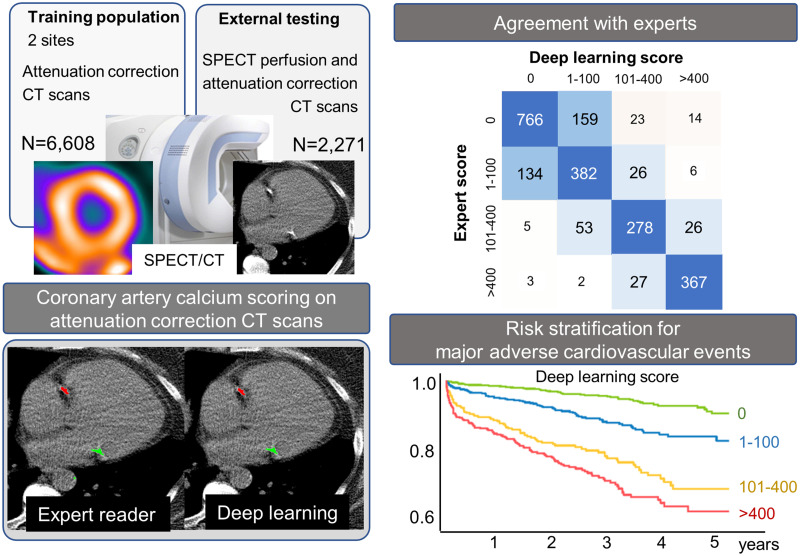
Low-dose ungated CT attenuation correction (CTAC) scans are commonly obtained with SPECT/CT myocardial perfusion imaging. Despite the characteristically low image quality of CTAC, deep learning (DL) can potentially quantify coronary artery calcium (CAC) from these scans in an automatic manner. We evaluated CAC quantification derived with a DL model, including correlation with expert annotations and associations with major adverse cardiovascular events (MACE). We trained a convolutional long short-term memory DL model to automatically quantify CAC on CTAC scans using 6,608 studies (2 centers) and evaluated the model in an external cohort of patients without known coronary artery disease ( = 2,271) obtained in a separate center. We assessed agreement between DL and expert annotated CAC scores. We also assessed associations between MACE (death, revascularization, myocardial infarction, or unstable angina) and CAC categories (0, 1-100, 101-400, or >400) for scores manually derived by experienced readers and scores obtained fully automatically by DL using multivariable Cox models (adjusted for age, sex, past medical history, perfusion, and ejection fraction) and net reclassification index. In the external testing population, DL CAC was 0 in 908 patients (40.0%), 1-100 in 596 (26.2%), 100-400 in 354 (15.6%), and >400 in 413 (18.2%). Agreement in CAC category by DL CAC and expert annotation was excellent (linear weighted κ, 0.80), but DL CAC was obtained automatically in less than 2 s compared with about 2.5 min for expert CAC. DL CAC category was an independent risk factor for MACE with hazard ratios in comparison to a CAC of zero: CAC of 1-100 (2.20; 95% CI, 1.54-3.14; < 0.001), CAC of 101-400 (4.58; 95% CI, 3.23-6.48; < 0.001), and CAC of more than 400 (5.92; 95% CI, 4.27-8.22; < 0.001). Overall, the net reclassification index was 0.494 for DL CAC, which was similar to expert annotated CAC (0.503). DL CAC from SPECT/CT attenuation maps agrees well with expert CAC annotations and provides a similar risk stratification but can be obtained automatically. DL CAC scores improved classification of a significant proportion of patients as compared with SPECT myocardial perfusion alone.
低剂量门控 CT 衰减校正(CTAC)扫描常用于 SPECT/CT 心肌灌注成像。尽管 CTAC 的图像质量通常较差,但深度学习(DL)可以自动对这些扫描进行冠状动脉钙(CAC)定量。我们评估了使用深度学习模型自动定量 CAC 的结果,包括与专家注释的相关性以及与主要不良心血管事件(MACE)的相关性。我们使用 6608 项研究(2 个中心)训练了一个卷积长短期记忆深度学习模型,对另一个中心获得的无已知冠状动脉疾病的患者的外部队列(=2271 例)进行了模型评估。我们评估了深度学习和专家注释 CAC 评分之间的一致性。我们还使用多变量 Cox 模型(根据年龄、性别、既往病史、灌注和射血分数进行调整)和净重新分类指数评估了 CAC 分类(0、1-100、101-400 或>400)与 MACE(死亡、血运重建、心肌梗死或不稳定型心绞痛)之间的相关性,分数由经验丰富的读者手动获得和完全由 DL 自动获得。在外部测试人群中,DL CAC 在 908 例患者中为 0(40.0%),在 596 例患者中为 1-100(26.2%),在 354 例患者中为 100-400(15.6%),在 413 例患者中为>400(18.2%)。DL CAC 和专家注释的 CAC 分类一致性非常好(线性加权κ,0.80),但与专家 CAC 相比,DL CAC 可在不到 2 秒内自动获得。与 CAC 为 0 相比,DL CAC 分类是 MACE 的独立危险因素,风险比分别为:CAC 为 1-100(2.20;95%CI,1.54-3.14;<0.001),CAC 为 101-400(4.58;95%CI,3.23-6.48;<0.001),以及 CAC>400(5.92;95%CI,4.27-8.22;<0.001)。总体而言,DL CAC 的净重新分类指数为 0.494,与专家注释的 CAC(0.503)相似。SPECT/CT 衰减图的 DL CAC 与专家 CAC 注释吻合良好,并提供相似的风险分层,但可自动获得。与单独进行 SPECT 心肌灌注相比,DL CAC 评分可显著改善对患者的分类。