Department of Cardiology, Radboud University Medical Centre, Geert Grooteplein Zuid 10, 6525GA, Nijmegen, The Netherlands.
Department of Cardiology, University Medical Centre Utrecht, Utrecht, The Netherlands.
Clin Drug Investig. 2022 Nov;42(11):977-985. doi: 10.1007/s40261-022-01209-8. Epub 2022 Oct 8.
The Low-Dose Colchicine-2 (LoDoCo2) trial showed that 2-4 years exposure to colchicine 0.5 mg once daily reduced the risk of cardiovascular events in patients with chronic coronary artery disease. The potential effect of years-long exposure to colchicine on renal or liver function and creatine kinase (CK) has not been systematically evaluated and was investigated in this LoDoCo2 substudy.
Blood samples drawn from 1776 participants at the close-out visit of the LoDoCo2 trial were used to measure markers of renal function (creatinine, blood urea nitrogen [BUN]), liver function (alanine aminotransferase [ALT], γ-glutamyl transferase [GGT], bilirubin and albumin), and CK. Renal and liver function as well as hyperCKemia (elevated CK) were categorized to the degree of elevation biomarkers as mild, mild/moderate, moderate/severe, and marked elevations.
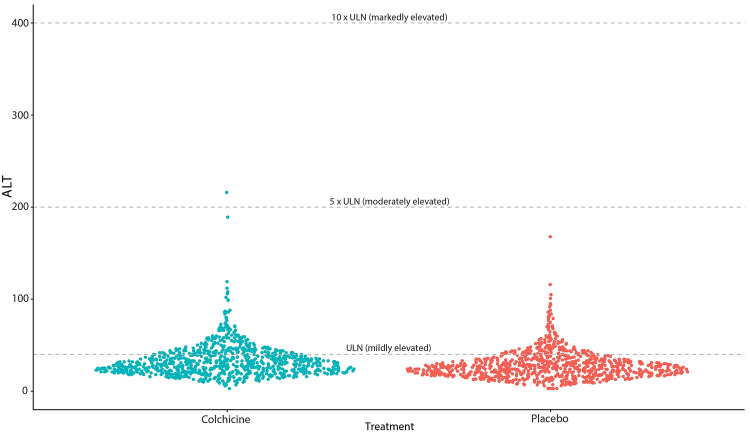
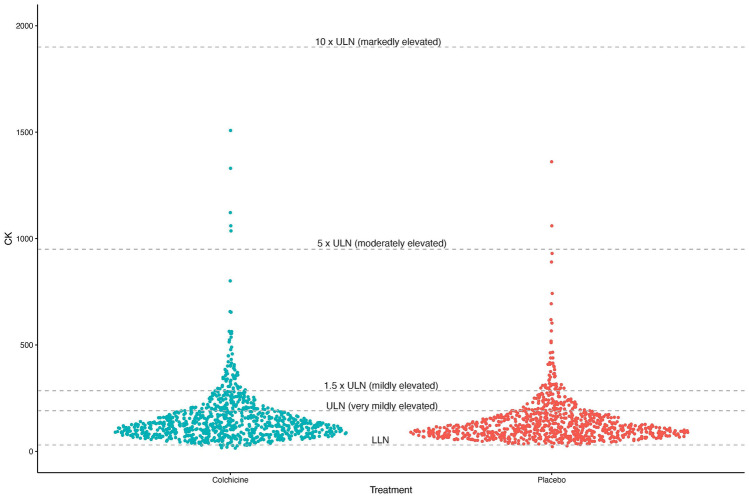
In total, 1776 participants (mean age 66.5 years, 72% male) contributed to this analysis, with a median exposure to trial medication of 32.7 months. Compared with placebo, colchicine was not associated with changes in creatinine and BUN but was associated with elevations in ALT (30 U/L vs. 26 U/L; p < 0.01) and CK (123 U/L vs. 110 U/L; p < 0.01). Most elevations in ALT and CK were mild in both treatment groups. There were no moderate to marked ALT elevations (> 5-10 × upper limit of normal [ULN]) in both treatment groups, and 6 (0.7%) colchicine-treated vs. 2 (0.2%) placebo-treated participants had moderate to marked CK elevations (> 5-10 × ULN).
In chronic coronary artery disease, 2-4 years of exposure to colchicine 0.5 mg once daily was associated with small elevations in ALT and CK, but was not associated with changes in renal function.
https://www.anzctr.org.au ; ACTRN12614000093684, 24 January 2014.
低剂量秋水仙碱-2(LoDoCo2)试验表明,慢性冠状动脉疾病患者每天服用 0.5 毫克秋水仙碱 2-4 年可降低心血管事件的风险。尚未系统评估多年来接触秋水仙碱对肾功能或肝功能和肌酸激酶(CK)的潜在影响,并在这项 LoDoCo2 子研究中进行了调查。
从 LoDoCo2 试验结束时的 1776 名参与者中抽取血样,用于测量肾功能标志物(肌酐、血尿素氮[BUN])、肝功能标志物(丙氨酸氨基转移酶[ALT]、γ-谷氨酰转移酶[GGT]、胆红素和白蛋白)和 CK。肾功能和肝功能以及高 CK 血症(CK 升高)根据标志物升高程度分为轻度、轻度/中度、中度/重度和显著升高。
共有 1776 名参与者(平均年龄 66.5 岁,72%为男性)参与了这项分析,中位试验药物暴露时间为 32.7 个月。与安慰剂相比,秋水仙碱与肌酐和 BUN 无变化相关,但与 ALT(30 U/L 与 26 U/L;p < 0.01)和 CK(123 U/L 与 110 U/L;p < 0.01)升高相关。两组治疗中,ALT 和 CK 的大多数升高均为轻度。两组均无中度至重度 ALT 升高(>5-10×正常值上限[ULN]),6(0.7%)例秋水仙碱治疗与 2(0.2%)例安慰剂治疗患者出现中度至重度 CK 升高(>5-10×ULN)。
在慢性冠状动脉疾病中,每天服用 0.5 毫克秋水仙碱 2-4 年与 ALT 和 CK 略有升高相关,但与肾功能变化无关。
https://www.anzctr.org.au;ACTRN12614000093684,2014 年 1 月 24 日。