Sun Qi, Gao Ning, Xia Weiliang
Division of Hepatobiliary and Pancreatic Surgery, Department of Surgery, First Affiliated Hospital, School of Medicine, Zhejiang University, Hangzhou, China.
Key Laboratory of Combined Multi-organ Transplantation, Ministry of Public Health, First Affiliated Hospital, School of Medicine, Zhejiang University, Hangzhou, China.
Front Nutr. 2022 Sep 23;9:964805. doi: 10.3389/fnut.2022.964805. eCollection 2022.
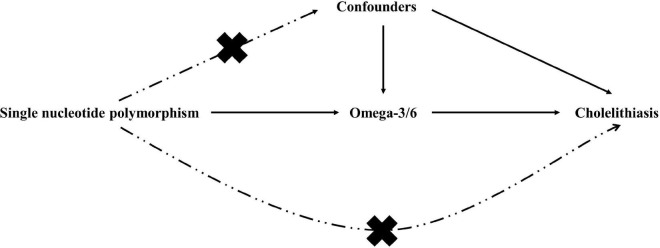
Omega-3 and omega-6 may be protective factors for cholelithiasis. However, this relationship has not yet been demonstrated clearly. Therefore, we attempted to identify these causal relationships.
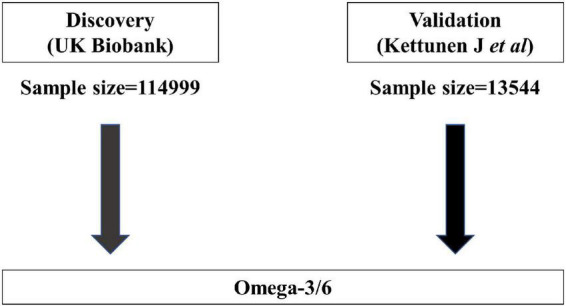
The omega-3/6 fatty acid discovery dataset was obtained from UK Biobank and contained 114,999 individuals. The validation set was derived from an independent genome-wide association study (GWAS) and contained 13,544 individuals. The cholelithiasis dataset was derived from FinnGen and contained 19,023 cases and 195,144 controls. The inverse variance weighting (IVW) method was used as the main method of analysis in this study. Multiple methods of analysis were also used in the repeated methods, including the MR-Egger, weighted median, MR-pleiotropic residual sum (MR-PRESSO), outliers, and maximum likelihood methods. In addition, we used multiple sensitivity analyses to identify the potential pleiotropy.
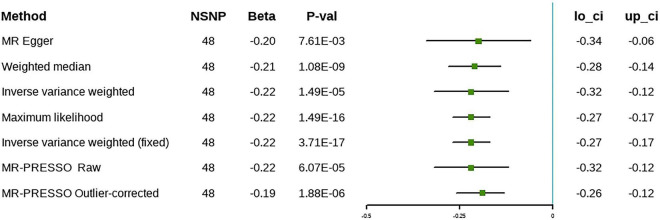
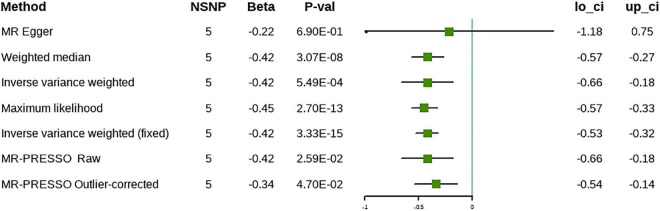
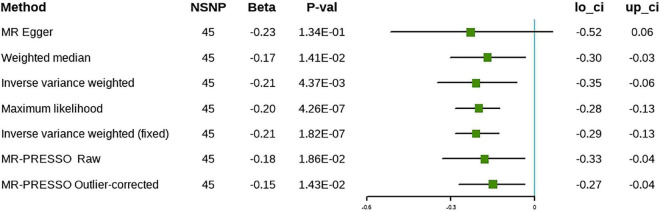
In the discovery stage, the results of the random effect IVW analysis showed that higher omega-3 levels were correlated inversely with the risk of cholelithiasis (β = -0.22, 95% CI [-0.32 to -0.12], = 1.49 × 10). When the replication analysis was performed using another set of instrumental variables (IVs), the causal relationship between omega-3 fatty acids and cholelithiasis remained stable (β = -0.42, 95% CI [-0.66 to -0.18], = 5.49 × 10), except for the results obtained using the MR-Egger method, which were not significant. The results of the IVW approach showed that each SD increase in omega-6 levels was associated negatively with the risk of cholelithiasis, both in the discovery (β = -0.21, 95% CI [-0.35 to -0.06], = 4.37 × 10) and the validation phases (β = -0.21, 95% CI [-0.40 to -0.02], = 3.44 × 10).
The results of our MR study suggest that omega-3/6 is associated with cholelithiasis risk. Attention to the risk of cholelithiasis in individuals with low serum omega-3/6 levels is necessary.
ω-3脂肪酸和ω-6脂肪酸可能是胆结石的保护因素。然而,这种关系尚未得到明确证实。因此,我们试图确定这些因果关系。
ω-3/6脂肪酸发现数据集来自英国生物银行,包含114,999名个体。验证集来自一项独立的全基因组关联研究(GWAS),包含13,544名个体。胆结石数据集来自芬兰基因库,包含19,023例病例和195,144名对照。本研究采用逆方差加权(IVW)方法作为主要分析方法。在重复分析中还使用了多种分析方法,包括MR-Egger法、加权中位数法、MR-多效性残差和(MR-PRESSO)法、离群值法和最大似然法。此外,我们进行了多次敏感性分析以识别潜在的多效性。
在发现阶段,随机效应IVW分析结果显示,较高的ω-3水平与胆结石风险呈负相关(β = -0.22,95%CI[-0.32至-0.12],P = 1.49×10⁻¹⁰)。当使用另一组工具变量(IVs)进行重复分析时,ω-3脂肪酸与胆结石之间的因果关系保持稳定(β = -0.42,95%CI[-0.66至-0.18],P = 5.49×10⁻⁴),但使用MR-Egger方法得到的结果不显著。IVW方法的结果显示,在发现阶段(β = -0.21,95%CI[-0.35至-0.06],P = 4.37×10⁻⁴)和验证阶段(β = -0.21,95%CI[-0.40至-0.02],P = 3.44×10⁻²),ω-6水平每增加一个标准差都与胆结石风险呈负相关。
我们的孟德尔随机化(MR)研究结果表明,ω-3/6与胆结石风险相关。有必要关注血清ω-3/6水平低的个体患胆结石的风险。