He Kang, Liang Weitao, Liu Sen, Bian Longrong, Xu Yi, Luo Cong, Li Yifan, Yue Honghua, Yang Cuiwei, Wu Zhong
Department of Cardiovascular Surgery, West China Hospital of Sichuan University, Chengdu, China.
Center for Biomedical Engineering, School of Information Science and Technology, Fudan University, Shanghai, China.
Front Cardiovasc Med. 2022 Sep 23;9:1001883. doi: 10.3389/fcvm.2022.1001883. eCollection 2022.
Postoperative atrial fibrillation (POAF) is often associated with serious complications. In this study, we collected long-term single-lead electrocardiograms (ECGs) of patients with preoperative sinus rhythm to build statistical models and machine learning models to predict POAF.
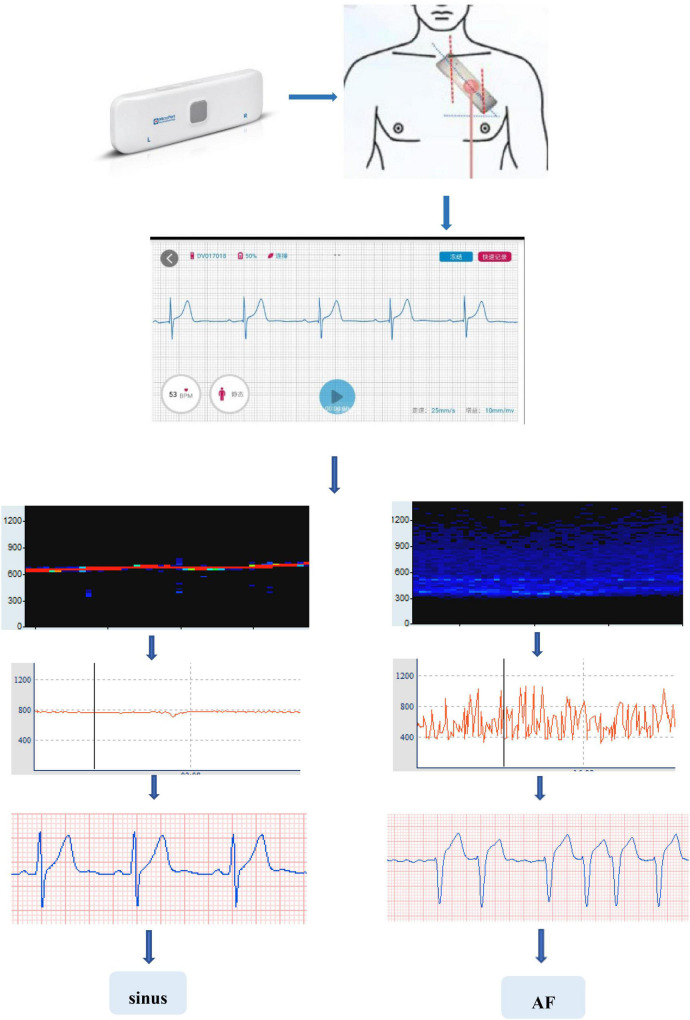
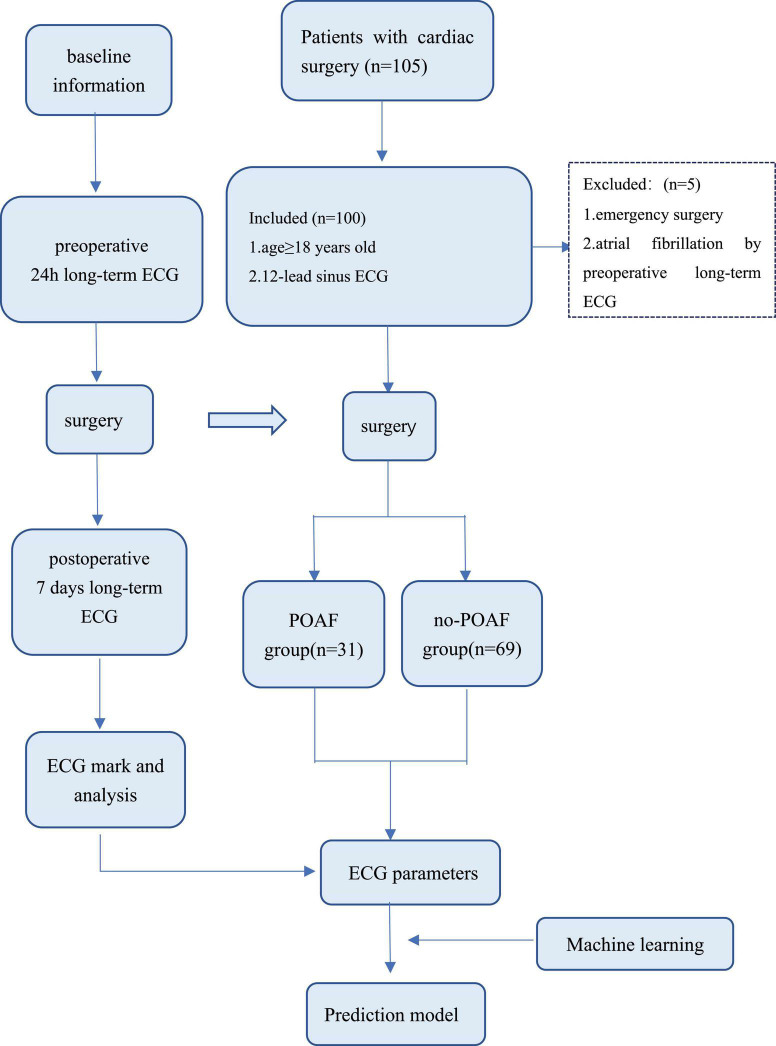
All patients with preoperative sinus rhythm who underwent cardiac surgery were enrolled and we collected long-term ECG data 24 h before surgery and 7 days after surgery by single-lead ECG. The patients were divided into a POAF group a no-POAF group. A clinical model and a clinical + ECG model were constructed. The ECG parameters were designed and support vector machine (SVM) was selected to build a machine learning model and evaluate its prediction efficiency.
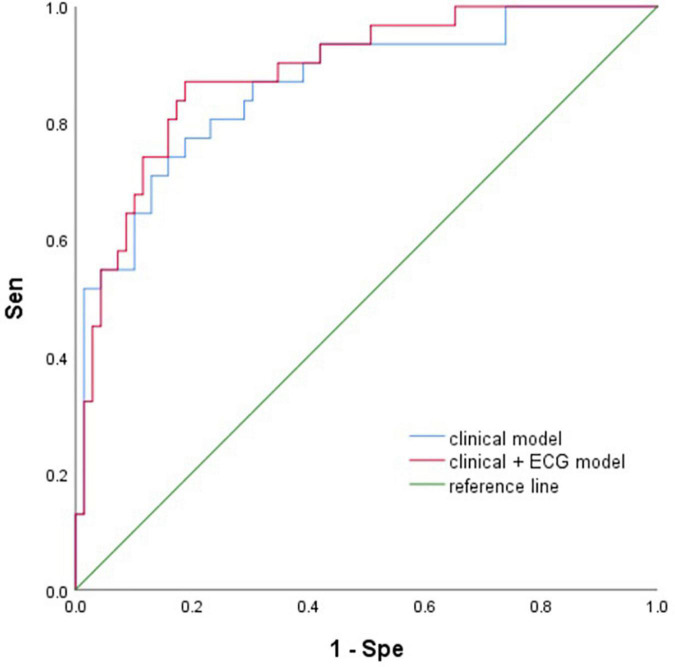
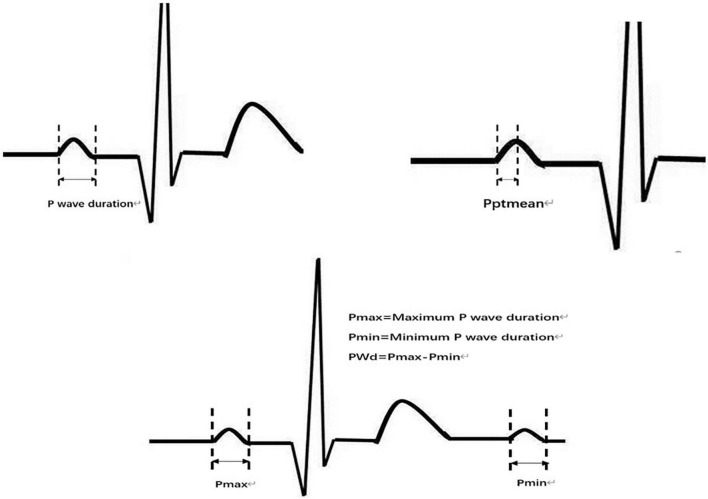
A total of 100 patients were included. The detection rate of POAF in long-term ECG monitoring was 31% and that in conventional monitoring was 19%. We calculated 7 P-wave parameters, Pmax (167 ± 31 ms vs. 184 ± 37 ms, = 0.018), Pstd (15 ± 7 vs. 19 ± 11, = 0.031), and PWd (62 ± 28 ms vs. 80 ± 35 ms, = 0.008) were significantly different. The AUC of the clinical model (sex, age, LA diameter, GFR, mechanical ventilation time) was 0.86. Clinical + ECG model (sex, age, LA diameter, GFR, mechanical ventilation time, Pmax, Pstd, PWd), AUC was 0.89. In the machine learning model, the accuracy (Ac) of the train set and test set was above 80 and 60%, respectively.
Long-term ECG monitoring could significantly improve the detection rate of POAF. The clinical + ECG model and the machine learning model based on P-wave parameters can predict POAF.
术后心房颤动(POAF)常伴有严重并发症。在本研究中,我们收集了术前窦性心律患者的长期单导联心电图(ECG),以建立统计模型和机器学习模型来预测POAF。
纳入所有术前窦性心律且接受心脏手术的患者,通过单导联心电图收集术前24小时和术后7天的长期ECG数据。将患者分为POAF组和非POAF组。构建临床模型和临床+ECG模型。设计ECG参数并选择支持向量机(SVM)建立机器学习模型并评估其预测效率。
共纳入100例患者。长期ECG监测中POAF的检出率为31%,传统监测中为19%。我们计算了7个P波参数,Pmax(167±31毫秒对184±37毫秒,P = 0.018)、Pstd(15±7对19±11,P = 0.031)和PWd(62±28毫秒对80±35毫秒,P = 0.008)有显著差异。临床模型(性别、年龄、左心房直径、肾小球滤过率、机械通气时间)的AUC为0.86。临床+ECG模型(性别、年龄、左心房直径、肾小球滤过率、机械通气时间、Pmax、Pstd、PWd)的AUC为0.89。在机器学习模型中,训练集和测试集的准确率(Ac)分别高于80%和60%。
长期ECG监测可显著提高POAF的检出率。基于P波参数的临床+ECG模型和机器学习模型可预测POAF。