Li Runzhi, Zan Yang, Sui Kaiwen, Zhu Shu
Institute of Immunology, CAS Key Laboratory of Innate Immunity and Chronic Disease, School of Basic Medical Sciences, Division of Life Science and Medicine, University of Science and Technology of China, Hefei 230027, China.
School of Data Science, University of Science and Technology of China, Hefei 230026, China.
Precis Clin Med. 2022 Sep 10;5(3):pbac022. doi: 10.1093/pcmedi/pbac022. eCollection 2022 Sep.
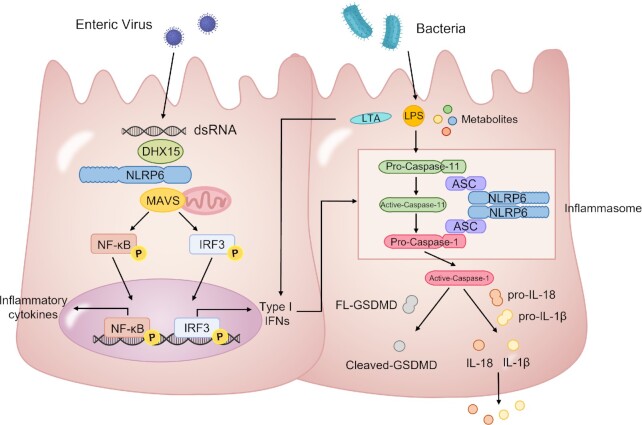
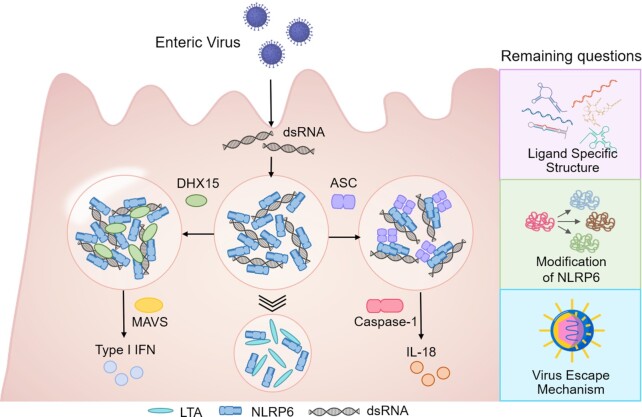
NLRP6, a Nod-like receptor family member, has been shown to affect intestinal homeostasis and microbial colonization through organizing a huge protein complex called inflammasome. NLRP6 inflammasome promotes the cleavage and secretion of inflammatory cytokines or the cleavage of pore-forming Gasdermin D to initiate the inflammatory cell death called pyroptosis, which plays important roles in responding to pathogen invasion. However, questions about the ligand(s) that trigger NLRP6 inflammasome activation, or the mechanisms that how a ligand triggers NLRP6 inflammasome assembly, are emerging. In this mini-review, we summarize the current understandings of ligand recognition of NLRP6, the role of liquid-liquid phase separation in NLRP6 inflammasome assembly, and potential links with human health and diseases.
NLRP6是Nod样受体家族成员,已被证明可通过组织一种名为炎性小体的巨大蛋白质复合物来影响肠道稳态和微生物定植。NLRP6炎性小体促进炎性细胞因子的切割和分泌,或促进形成孔道的Gasdermin D的切割,从而引发称为细胞焦亡的炎性细胞死亡,这在应对病原体入侵中发挥重要作用。然而,关于触发NLRP6炎性小体激活的配体,或配体触发NLRP6炎性小体组装的机制等问题正在出现。在本综述中,我们总结了目前对NLRP6配体识别的理解、液-液相分离在NLRP6炎性小体组装中的作用,以及与人类健康和疾病的潜在联系。