Department of Rehabilitation and Sports Medicine, Second Medical Faculty, Charles University and University Hospital Motol, Prague, Czech Republic.
Department of Health and Human Kinetics, Ohio Wesleyan University, Delaware, OH, United States of America.
PLoS One. 2022 Oct 10;17(10):e0275389. doi: 10.1371/journal.pone.0275389. eCollection 2022.
The diaphragm changes position and respiratory excursions during postural loading. However, it is unclear how it reacts to lifting a load while breath-holding or breathing with simultaneous voluntary contraction of the abdominal muscles (VCAM). This study analyzed diaphragm motion in healthy individuals during various postural-respiratory situations.
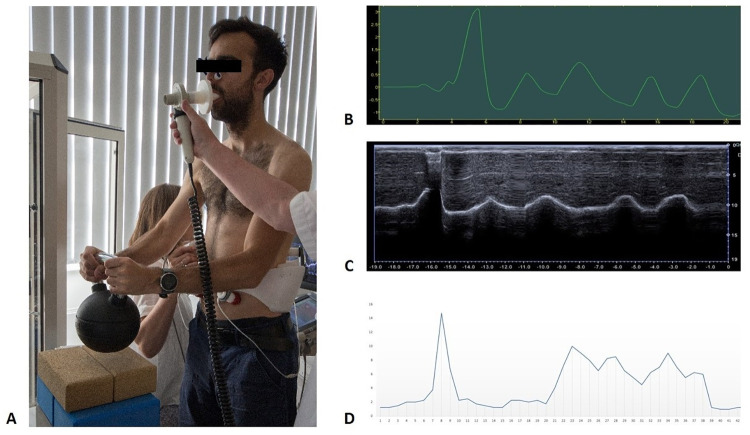
31 healthy participants underwent examination of the diaphragm using M-mode ultrasonography, spirometry, and abdominal wall tension (AWT) measurements. All recordings were performed simultaneously during three consecutive scenarios, i.e., 1. Lifting a load without breathing; 2. Lifting a load and breathing naturally; 3. Lifting a load and breathing with simultaneous VCAM.
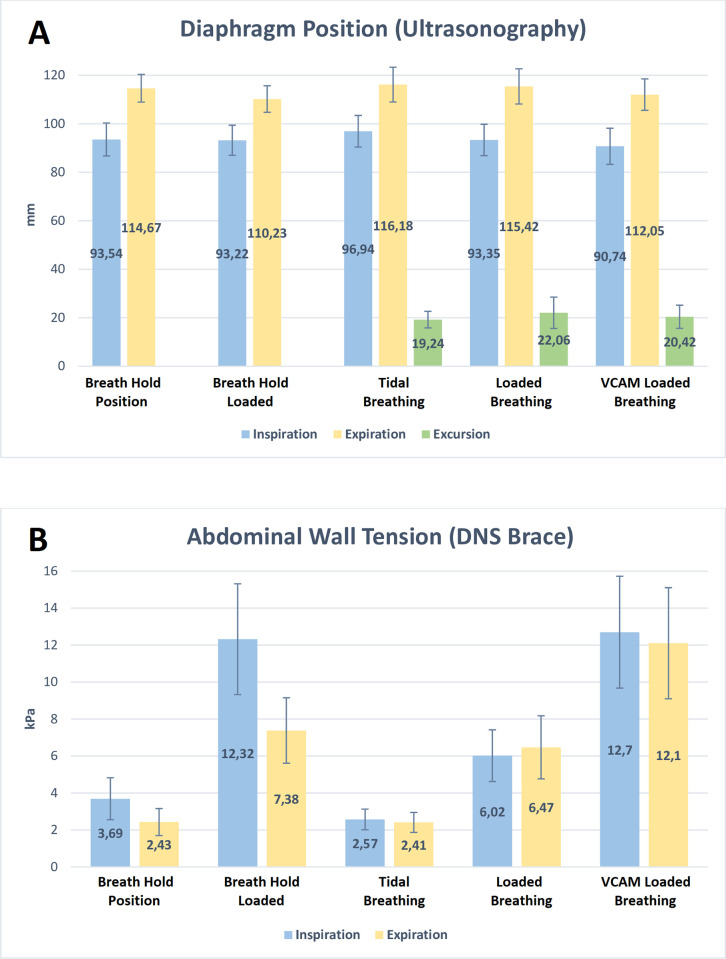
Using paired-samples t-tests, lifting a load without breathing displaced the diaphragm's expiratory position more caudally (P < .001), with no change noted in the inspiratory position (P = .373). During lifting a load breathing naturally, caudal displacement of the diaphragm's inspiratory position was presented (P < .001), with no change noted in the expiratory position (P = 0.20) compared to tidal breathing. Total diaphragm excursion was greater when loaded (P = .002). Lifting a load and breathing with VCAM demonstrated no significant changes in diaphragm position for inspiration, expiration, or total excursion compared to natural loaded breathing. For all scenarios, AWT measures were greater when lifting a load (P < .001).
In healthy individuals, caudal displacement and greater excursions of the diaphragm occurred when lifting a load. The postural function of the diaphragm is independent of its respiratory activity and is not reduced by the increase in AWT.
膈肌在体位负荷时会改变位置和呼吸运动。然而,目前尚不清楚在屏气或同时进行腹式肌肉主动收缩(VCAM)的情况下,当举起负荷时,膈肌会如何反应。本研究分析了健康个体在各种体位呼吸情况下膈肌的运动。
31 名健康参与者接受了膈肌的 M 模式超声检查、肺功能检查和腹壁张力(AWT)测量。在连续三个场景中同时进行所有记录,即 1. 不呼吸时举起负荷;2. 举起负荷时自然呼吸;3. 举起负荷时同时进行 VCAM 呼吸。
使用配对样本 t 检验,不呼吸时举起负荷使膈肌的呼气位置更向尾侧移位(P <.001),吸气位置没有变化(P =.373)。在自然呼吸时举起负荷,膈肌的吸气位置向尾侧移位(P <.001),与潮式呼吸相比,呼气位置没有变化(P = 0.20)。当加载时,总膈肌运动幅度更大(P =.002)。与自然负荷呼吸相比,进行 VCAM 呼吸时,膈肌的吸气、呼气或总运动位置没有明显变化。对于所有场景,举起负荷时 AWT 测量值更大(P <.001)。
在健康个体中,举起负荷时,膈肌会向尾侧移位并增加运动幅度。膈肌的姿势功能与其呼吸活动无关,并且不会因 AWT 的增加而降低。