Institute of Interdisciplinary Research, Department of Exact and Natural Sciences - CERNESIM Centre, Alexandru Ioan Cuza University of Iasi, 11 Carol I, 700506, Iasi, Romania.
Faculty of Chemistry, Alexandru Ioan Cuza University of Iasi, 11 Carol I, 700506, Iasi, Romania.
Sci Rep. 2022 Oct 10;12(1):16988. doi: 10.1038/s41598-022-21435-6.
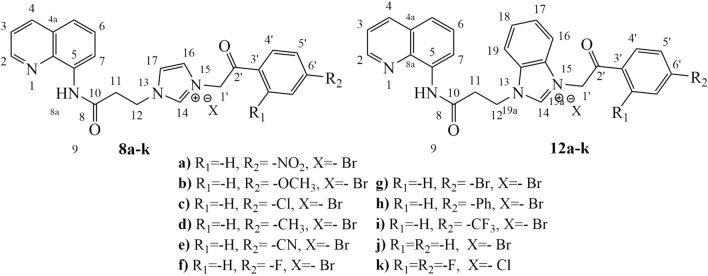
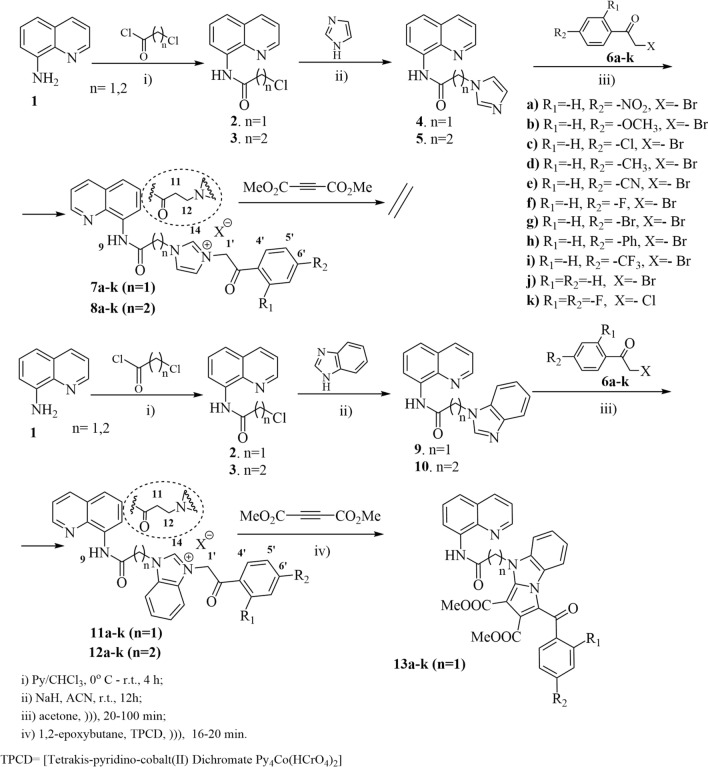
Two new classes of hybrid quinoline-imidazole/benzimidazole derivatives (the hybrid QIBS salts and QIBC cycloadducts) were designed and synthesized to evaluate their anticancer and antimicrobial activity. The strategy adopted for synthesis is straight and efficient, in four steps: N-acylation, N-alkylation, quaternization and a Huisgen 3 + 2 cycloaddition. The in vitro single-dose anticancer assay of forty six hybrid quinoline-benzimidazole compounds reveal that one QIBS salt (11h), has an excellent quasi nonselective activity against all type of cancer cell with an excellent PGI in the area of 90-100% and very good lethality. Three others quinoline-imidazole/benzimidazole hybrids (8h, 12h, 12f) has an excellent selective activity against some cancer cell lines: breast cancer MDA-MB-468 and Leukemia HL-60 TB). The five-dose assay screening confirms that compound 11h possesses excellent anti-proliferative activity, with GI in the range of nano-molar, against some cancer cell lines: Leukemia HL-60 TB, Leukemia K-526, Leukemia RPMI-8226, Breast cancer MDA-MB-468, Lung cancer HOP-92 and Ovarian cancer IGROV1. The antibacterial assay indicates that three hybrid QIBS salts (12f, 12c, 12d) have an excellent activity against Gram-negative bacteria E. coli (superior to control Gentamicin) while against Gram-positive bacteria S. aureus only one compound 8i (R = -CF3) exhibits a significant activity (superior to control Gentamicin). The MIC assay indicates that two other compounds (11h, 12h) are biologically active to a very low concentration, in the range of nano-molar. We believe that all these excellent assets related to anticancer and antibacterial activities, make from our hybrid quinoline-imidazole/benzimidazole compounds bearing a phenyl group (R = -CH) in the para (4)-position of the benzoyl moiety a good candidate for future drug developing.
两类新型的喹啉-咪唑/苯并咪唑杂合体(QIBS 盐和 QIBC 环加成物)被设计和合成,以评估它们的抗癌和抗菌活性。合成采用的策略直接有效,分四步进行:N-酰化、N-烷基化、季铵化和 Huisgen 3+2 环加成。对 46 种喹啉-苯并咪唑杂合体化合物的体外单剂量抗癌测定表明,一种 QIBS 盐(11h)对所有类型的癌细胞具有极好的准非选择性活性,在 90-100%的区域内具有极好的 PGIs,并且具有很好的致死率。另外三种喹啉-咪唑/苯并咪唑杂合体(8h、12h、12f)对一些癌细胞系具有极好的选择性活性:乳腺癌 MDA-MB-468 和白血病 HL-60 TB。五剂量测定筛选证实,化合物 11h 对一些癌细胞系具有极好的抗增殖活性,其 GI 处于纳摩尔范围内,包括白血病 HL-60 TB、白血病 K-526、白血病 RPMI-8226、乳腺癌 MDA-MB-468、肺癌 HOP-92 和卵巢癌 IGROV1。抗菌测定表明,三种 QIBS 盐(12f、12c、12d)对革兰氏阴性菌 E. coli 具有极好的活性(优于对照品庆大霉素),而对革兰氏阳性菌 S. aureus,只有一种化合物 8i(R=-CF3)表现出显著的活性(优于对照品庆大霉素)。MIC 测定表明,另外两种化合物(11h、12h)对非常低的浓度具有生物活性,处于纳摩尔范围内。我们认为,所有这些与抗癌和抗菌活性相关的优良特性,使得我们的带有苯基(R=-CH)的喹啉-咪唑/苯并咪唑杂合体化合物成为未来药物开发的一个很好的候选物。