Department of Medical Physics, Hospital Sant Joan de Reus, IISPV, Tarragona, Spain.
Universitat Rovira i Virgili (URV), Tarragona, Spain.
Med Phys. 2022 Dec;49(12):7404-7416. doi: 10.1002/mp.16016. Epub 2022 Oct 27.
The Agility multileaf collimator (MLC) mounted in Elekta linear accelerators features some unique design characteristics, such as large leaf thickness, eccentric curvature at the leaf tip, and defocused leaf sides ('tilting'). These characteristics offer several advantages but modeling them in treatment planning systems (TPSs) is challenging.
The goals of this study were to investigate the challenges faced when modeling the Agility in two commercial TPSs (Monaco and RayStation) and to explore how the implemented MLC models could be improved in the future.
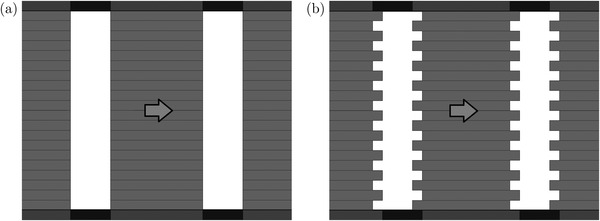
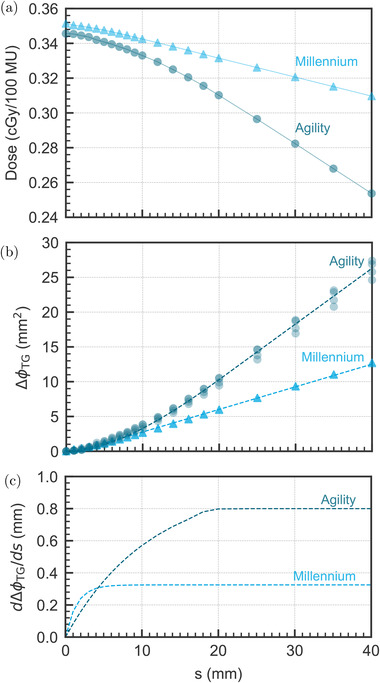
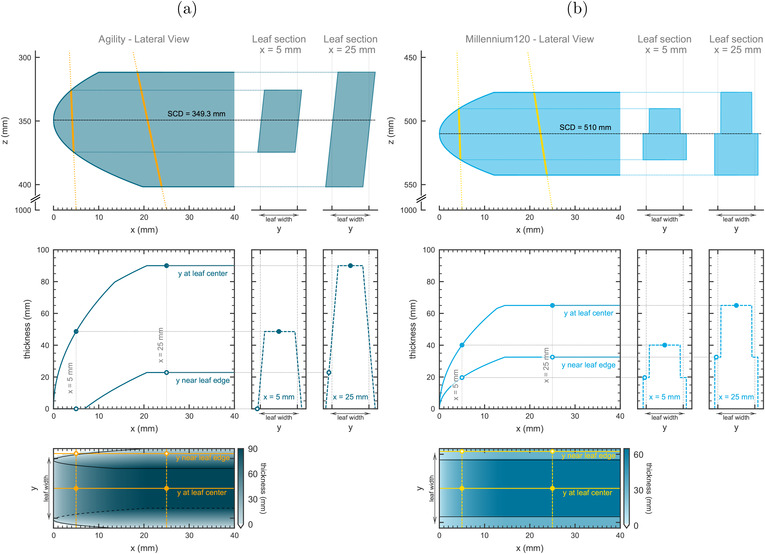
Four linear accelerators equipped with the Agility, located at different centers, were used for the study. Three centers use the RayStation TPS and the other one uses Monaco. For comparison purposes, data from four Varian linear accelerators with the Millennium 120 MLC were also included. Average doses measured with asynchronous sweeping gap tests were used to characterize and compare the characteristics of the Millennium and the Agility MLCs and to assess the MLC model in the TPSs. The FOURL test included in the ExpressQA package, provided by Elekta, was also used to evaluate the tongue-and-groove with radiochromic films. Finally, raytracing was used to investigate the impact of the MLC geometry and to understand the results obtained for each MLC.
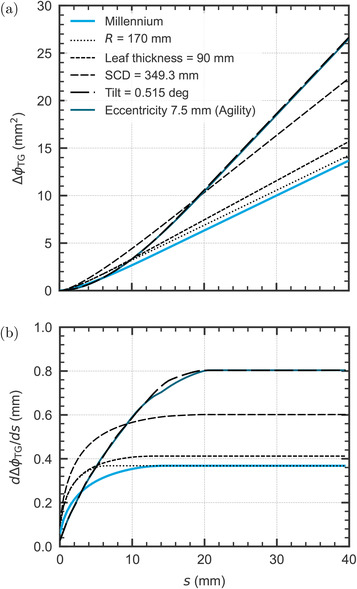
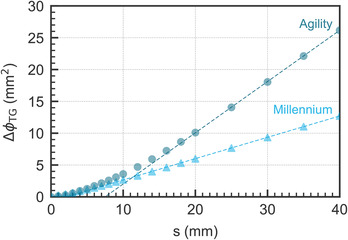
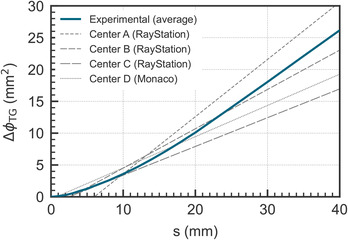
The geometry of the Agility produces dosimetric effects associated with the rounded leaf end up to a distance 20 mm away from the leaf tip end measured at the isocenter plane. This affects the tongue-and-groove shadowing, which progressively increases along the distance to the tip end. The RayStation and Monaco TPSs did not account for this effect, which made trade-offs in the MLC parameters necessary and greatly varied the final MLC parameters used by different centers. Raytracing showed that these challenging leaf tip effects were directly related to the MLC geometry and that the characteristics mainly responsible for the large leaf tip effects of the Agility were its tilting design and its small source-to-collimator distance.
The MLC models implemented in RayStation and Monaco could not accurately reproduce the leaf tip effects for the Agility. Therefore, trade-offs are needed and the optimal MLC parameters are dependent on the specific characteristics of treatment plans. Refining the MLC models for the Agility to better approximate the measured leaf tip and tongue-and-groove effects would extend the validity of the MLC model, reduce the variability in the MLC parameters used by the community, and facilitate the standardization of the MLC configuration process.
安装在 Elekta 直线加速器上的 Agility 多叶准直器 (MLC) 具有一些独特的设计特点,例如较大的叶片厚度、叶片尖端的偏心曲率和非聚焦的叶片侧面(“倾斜”)。这些特点提供了几个优势,但在治疗计划系统 (TPS) 中建模它们具有挑战性。
本研究的目的是研究在两个商业 TPS(Monaco 和 RayStation)中对 Agility 进行建模时面临的挑战,并探讨未来如何改进实施的 MLC 模型。
研究使用了四台位于不同中心的配备有 Agility 的直线加速器。其中三个中心使用 RayStation TPS,另一个使用 Monaco。为了进行比较,还包括了来自配备有 Millennium 120 MLC 的四台 Varian 直线加速器的数据。使用异步扫隙测试测量的平均剂量用于对 Millennium 和 Agility MLC 的特性进行特征描述和比较,并评估 TPS 中的 MLC 模型。Elekta 提供的 ExpressQA 软件包中的 FOURL 测试也用于评估带有放射色迹胶片的齿状缝隙。最后,射线追踪用于研究 MLC 几何形状的影响,并了解每个 MLC 的结果。
Agility 的几何形状会在距叶片尖端末端 20mm 的等中心平面处产生与叶片末端圆形相关的剂量效应。这会影响齿状缝隙的阴影,其沿着末端距离逐渐增加。RayStation 和 Monaco TPS 没有考虑到这一影响,这使得在 MLC 参数方面需要进行权衡,并导致不同中心使用的最终 MLC 参数有很大差异。射线追踪表明,这些具有挑战性的叶片尖端效应与 MLC 几何形状直接相关,而导致 Agility 叶片尖端效应较大的主要因素是其倾斜设计和较小的源到准直器距离。
RayStation 和 Monaco 中实施的 MLC 模型无法准确再现 Agility 的叶片尖端效应。因此,需要进行权衡,最佳的 MLC 参数取决于治疗计划的具体特征。改进 Agility 的 MLC 模型以更好地近似测量的叶片尖端和齿状缝隙效应将扩展 MLC 模型的有效性,减少社区中使用的 MLC 参数的可变性,并促进 MLC 配置过程的标准化。