School of Pharmacy and Pharmaceutical Science, Shandong First Medical University & Shandong Academy of Medical Sciences, Jinan, Shandong, China.
Center for Regenerative Sports Medicine, Steadman Philippon Research Institute, Vail, CO, USA.
J Cachexia Sarcopenia Muscle. 2022 Dec;13(6):3137-3148. doi: 10.1002/jcsm.13101. Epub 2022 Oct 11.
Fibro-adipogenic progenitors (FAPs) in the muscles have been found to interact closely with muscle progenitor/stem cells (MPCs) and facilitate muscle regeneration at normal conditions. However, it is not clear how FAPs may interact with MPCs in aged muscles. Senolytics have been demonstrated to selectively eliminate senescent cells and generate therapeutic benefits on ageing and multiple age-related disease models.
By studying the muscles and primary cells of age matched WT mice and Zmpste24 (Z24 ) mice, an accelerated ageing model for Hutchinson-Gilford progeria syndrome (HGPS), we examined the interaction between FAPs and MPCs in progeria-aged muscle, and the potential effect of senolytic drug fisetin in removing senescent FAPs and improving the function of MPCs.
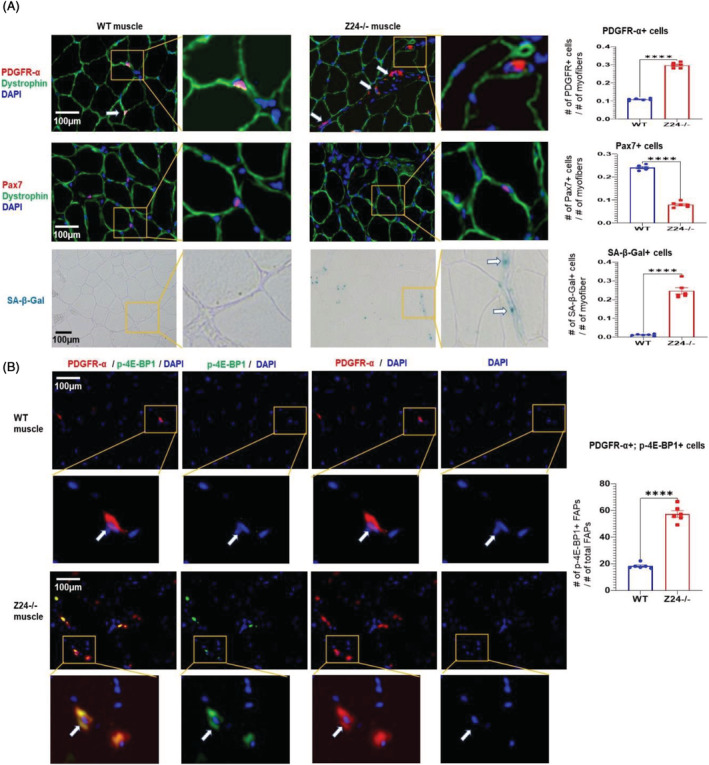
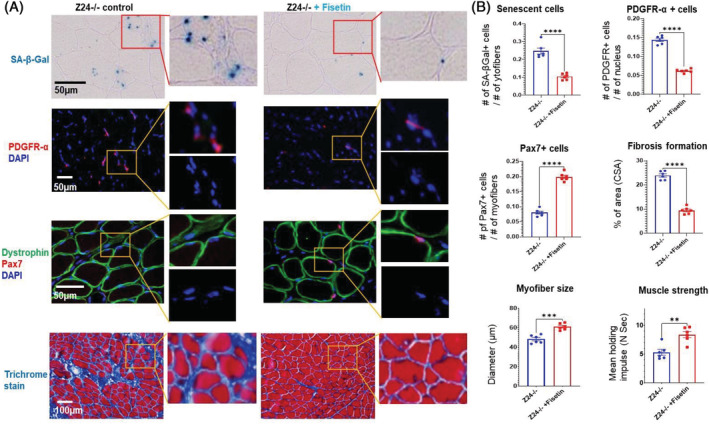
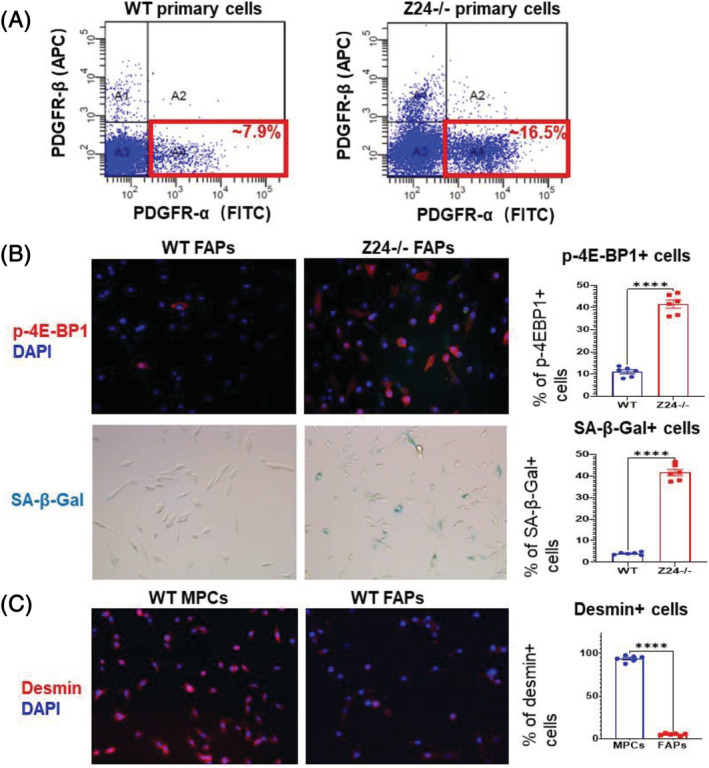
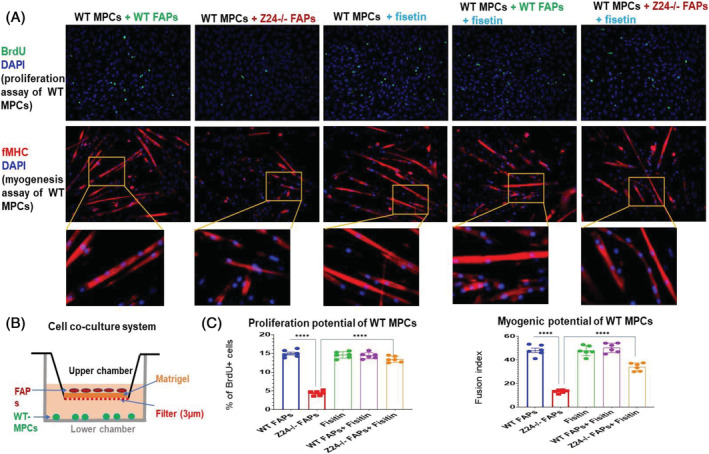
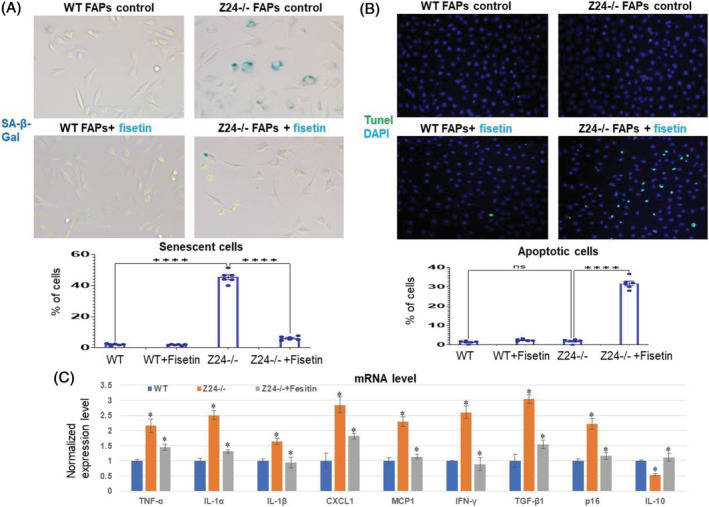
We observed that, compared with muscles of WT mice, muscles of Z24 mice contained a significantly increased number of FAPs (2.4-fold; n > =6, P < 0.05) and decreased number of MPCs (2.8-fold; n > =6, P < 0.05). FAPs isolated from Z24 muscle contained about 44% SA-β-gal+ senescent cells, in contrast to about 3.5% senescent cells in FAPs isolated from WT muscle (n > =6, P < 0.001). The co-culture of Z24 FAPs with WT MPCs resulted in impaired proliferation and myogenesis potential of WT MPCs, with the number of BrdU positive proliferative cells being reduced for 3.3 times (n > =6, P < 0.001) and the number of myosin heavy chain (MHC)-positive myotubes being reduced for 4.5 times (n > =6, P < 0.001). The treatment of the in vitro co-culture system of Z24 FAPs and WT MPCs with the senolytic drug fisetin led to increased apoptosis of Z24 FAPs (14.5-fold; n > =6, P < 0.001) and rescued the impaired function of MPCs by increasing the number of MHC-positive myotubes for 3.1 times (n > =6, P < 0.001). Treatment of Z24 mice with fisetin in vivo was effective in reducing the number of senescent FAPs (2.2-fold, n > =6, P < 0.05) and restoring the number of muscle stem cells (2.6-fold, n > =6, P < 0.05), leading to improved muscle pathology in Z24 mice.
These results indicate that the application of senolytics in the progeria-aged muscles can be an efficient strategy to remove senescent cells, including senescent FAPs, which results in improved function of muscle progenitor/stem cells. The senescent FAPs can be a potential novel target for therapeutic treatment of progeria ageing related muscle diseases.
已发现肌肉中的纤维脂肪祖细胞(FAPs)与肌肉祖细胞/干细胞(MPCs)密切相互作用,并在正常情况下促进肌肉再生。然而,目前尚不清楚 FAPs 如何在衰老肌肉中与 MPCs 相互作用。衰老细胞清除剂已被证明可选择性地消除衰老细胞,并在衰老和多种与年龄相关的疾病模型中产生治疗益处。
通过研究年龄匹配的 WT 小鼠和 Zmpste24(Z24)小鼠的肌肉和原代细胞,我们研究了早衰症肌肉中 FAPs 和 MPCs 之间的相互作用,以及衰老细胞清除剂非瑟酮在消除衰老 FAPs 和改善 MPCs 功能方面的潜在作用。
与 WT 小鼠的肌肉相比,我们观察到 Z24 小鼠的肌肉中 FAPs 的数量显著增加(2.4 倍;n>6,P<0.05),而 MPCs 的数量减少(2.8 倍;n>6,P<0.05)。从 Z24 肌肉中分离出的 FAPs 中含有约 44%的 SA-β-gal+衰老细胞,而从 WT 肌肉中分离出的 FAPs 中含有约 3.5%的衰老细胞(n>6,P<0.001)。Z24 FAPs 与 WT MPCs 的共培养导致 WT MPCs 的增殖和成肌潜能受损,BrdU 阳性增殖细胞的数量减少了 3.3 倍(n>6,P<0.001),肌球蛋白重链(MHC)阳性肌管的数量减少了 4.5 倍(n>6,P<0.001)。用衰老细胞清除剂非瑟酮处理 Z24 FAPs 和 WT MPCs 的体外共培养系统,导致 Z24 FAPs 的凋亡增加(14.5 倍;n>6,P<0.001),并通过增加 MHC 阳性肌管的数量来恢复 MPCs 的受损功能,增加了 3.1 倍(n>6,P<0.001)。体内用非瑟酮处理 Z24 小鼠可有效减少衰老 FAPs 的数量(2.2 倍,n>6,P<0.05)并恢复肌肉干细胞的数量(2.6 倍,n>6,P<0.05),从而改善 Z24 小鼠的肌肉病理。
这些结果表明,衰老细胞清除剂在早衰症肌肉中的应用可以是一种有效的策略,可用于清除衰老细胞,包括衰老的 FAPs,从而改善肌肉祖细胞/干细胞的功能。衰老的 FAPs 可能成为治疗早衰症相关肌肉疾病的一个有潜力的新靶点。