Division of General Medical Sciences, Department of Medicine, Washington University School of Medicine in St. Louis, St Louis, Missouri.
Institute for Informatics, Washington University in St. Louis, St Louis, Missouri.
JAMA Health Forum. 2022 Sep 2;3(9):e223398. doi: 10.1001/jamahealthforum.2022.3398.
The Medicare Shared Savings Program provides financial incentives for accountable care organizations (ACOs) to reduce costs of care. The structure of the shared savings program may not adequately adjust for challenges associated with caring for patients with high medical complexity and social needs, a population disproportionately made up of racial and ethnic minority groups. If so, ACOs serving racial and ethnic minority groups may be more likely to exit the program, raising concerns about the equitable distribution of potential benefits from health care delivery reform efforts.
To evaluate whether ACOs with a high proportion of beneficaries of racial and ethnic minority groups are more likely to exit the Medicare Shared Savings Program and identify characteristics associated with this disparity.
DESIGN, SETTING, AND PARTICIPANTS: This retrospective observational cohort study used secondary data on Medicare Shared Savings Program ACOs from January 2012 through December 2018. Bivariate and multivariate cross-sectional regression analyses were used to understand whether ACO racial and ethnic composition was associated with program exit, and how ACOs with a high proportion of beneficaries of racial and ethnic minority groups differed in characteristics associated with program exit.
Racial and ethnic composition of an ACO's beneficiaries.
Shared savings program exit before 2018.
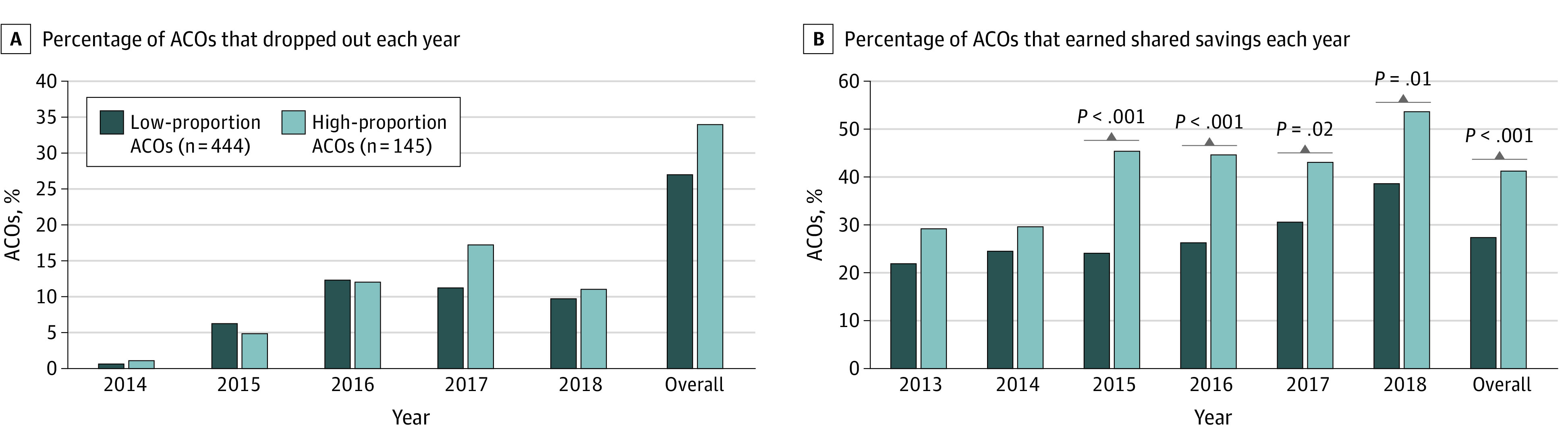
The study included 589 Medicare Shared Savings Program ACOs. The ACOs in the highest quartile of proportion of beneficaries of racial and ethnic minority groups were designated high-proportion ACOs (145 [25%]), and those in the lowest 3 quartiles were designated low-proportion ACOs (444 [75%]). In unadjusted analysis, a 10-percentage point increase in the proportion of beneficiaries of racial and ethnic minority groups was associated with a 1.12-fold increase in the odds of an ACO exit (95% CI, 1.00-1.25; P = .04). In adjusted analysis, there were significant associations among high-proportion ACOs between characteristics such as patient comorbidities, disability, and clinician composition and a higher likelihood of exit.
The study results suggest that ACOs that served a higher proportion of beneficaries of racial and ethnic minority groups were more likely to exit the Medicare Shared Savings Program, partially because of serving patients with greater disease severity and complexity. These findings raise concerns about how current payment reform efforts may differentially affect racial and ethnic minority groups.
医疗保险共享储蓄计划为问责制医疗保健组织(ACO)提供了降低医疗成本的经济激励。共享储蓄计划的结构可能无法充分调整与照顾高医疗复杂性和社会需求患者相关的挑战,而这些患者主要由少数族裔群体组成。如果是这样,为少数族裔群体服务的 ACO 可能更有可能退出该计划,这引发了对医疗保健提供改革努力潜在利益公平分配的担忧。
评估具有较高比例受益于少数族裔群体的 ACO 是否更有可能退出医疗保险共享储蓄计划,并确定与这种差异相关的特征。
设计、设置和参与者:这是一项使用 2012 年 1 月至 2018 年 12 月医疗保险共享储蓄计划 ACO 的二次数据的回顾性观察队列研究。使用双变量和多变量横断面回归分析来了解 ACO 的种族和民族构成是否与计划退出相关,以及种族和民族构成受益于少数族裔群体比例较高的 ACO 在与计划退出相关的特征方面有何不同。
ACO 受益人的种族和民族构成。
2018 年之前共享储蓄计划退出。
这项研究包括 589 个医疗保险共享储蓄计划 ACO。受益于少数族裔群体比例最高的 ACO 被指定为高比例 ACO(145[25%]),而受益于比例最低的 3 个四分位数的 ACO 被指定为低比例 ACO(444[75%])。在未调整分析中,受益于少数族裔群体比例每增加 10 个百分点,ACO 退出的几率就会增加 1.12 倍(95%CI,1.00-1.25;P=0.04)。在调整分析中,在高比例 ACO 之间存在显著关联,特征包括患者合并症、残疾和临床医生构成与更高的退出可能性之间存在关联。
研究结果表明,为受益于少数族裔群体比例较高的 ACO 更有可能退出医疗保险共享储蓄计划,部分原因是为病情更严重和复杂的患者提供服务。这些发现引发了对当前支付改革努力如何可能对少数族裔群体产生不同影响的担忧。