Department of Counseling & Educational Psychology, New Mexico State University, 1780 E University Ave, Las Cruces, NM, 88003, USA.
Department of Psychology, Syracuse University, 414 Huntington Hall, Syracuse, NY, 13244, USA.
BMC Public Health. 2022 Oct 12;22(1):1908. doi: 10.1186/s12889-022-14315-1.
Research indicates that tailored programming for sexual and gender minority (SGM; e.g., lesbian, gay, bisexual, transgender, queer) people, compared to non-tailored programming, is effective for reducing the disproportionate health burden SGM people experience relative to the general population. However, the availability of SGM-tailored programming is often over-reported and inconsistent across behavioral health (i.e., substance use and mental health) facilities in the United States (U.S.).
Using panel analysis, the National Survey of Substance Abuse Treatment Services (N-SSATS), and the National Mental Health Services Survey (N-MHSS), this study examines structural stigma and government funding as two structural determinants affecting the availability of SGM-tailored programming in the U.S.
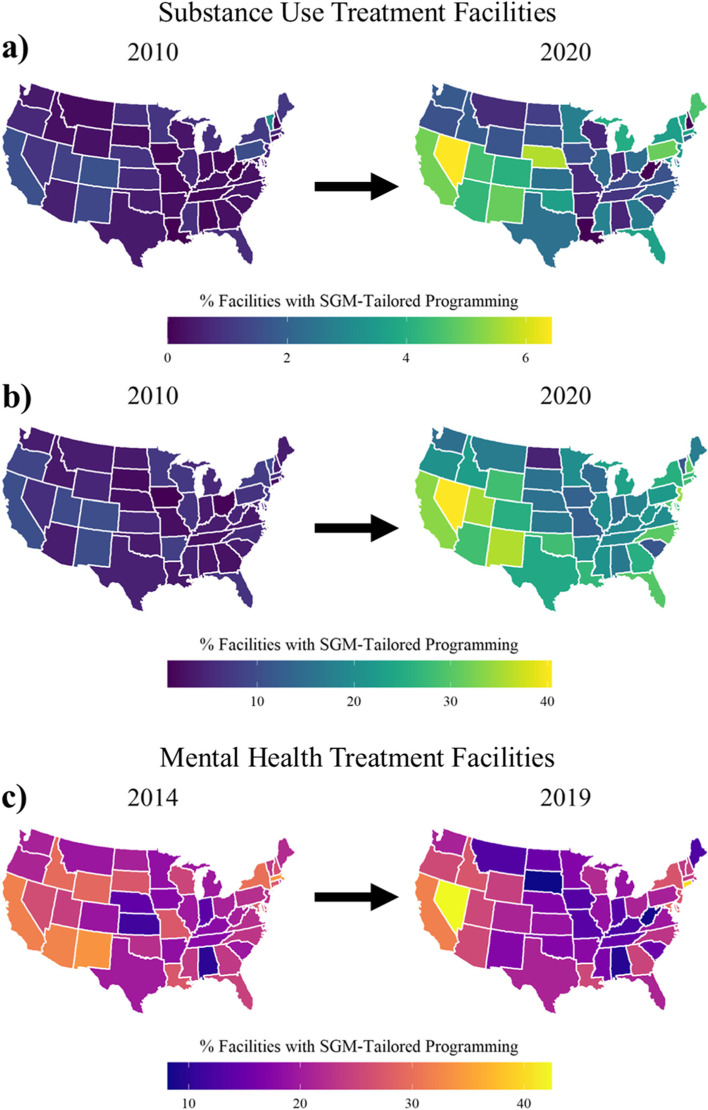
Results indicated that from 2010 to 2020, reductions in structural stigma (i.e., increases in state-level supportive SGM policies) were positively associated with increases in the proportion of substance use treatment facilities offering SGM-tailored programming. This effect was significant after controlling for over-reporting of SGM-tailored programming and time- and state-specific heterogeneity. On average, the effect of reduced structural stigma resulted in approximately two new SGM-tailored programs in the short term and about 31 new SGM-tailored programs in the long term across U.S. substance use treatment facilities. Structural stigma did not predict the availability of SGM-tailored programming in mental health treatment facilities. Government funding was not significant in either data set. However, without correcting for over-reporting, government funding became a significant predictor of the availability of SGM-tailored programming at substance use treatment facilities.
Because SGM-tailored programming facilitates access to healthcare and the current study found longitudinal associations between structural stigma and the availability of SGM-tailored programming in substance use treatment facilities, our findings support claims that reducing structural stigma increases access to behavioral health treatment specifically and healthcare generally among SGM people. This study's findings also indicate the importance of correcting for over-reporting of SGM-tailored programming, raising concerns about how respondents perceive the N-SSATS and N-MHSS questions about SGM-tailored programming. Implications for future research using the N-SSATS and N-MHSS data and for public health policy are discussed.
研究表明,与非定制化项目相比,针对性少数群体(SGM;例如,女同性恋、男同性恋、双性恋、跨性别、酷儿)的定制项目更有效,可以减少 SGM 人群相对于一般人群所经历的不成比例的健康负担。然而,在美国(U.S.),行为健康(即药物使用和心理健康)设施中,SGM 定制项目的可用性往往被过度报告且不一致。
本研究使用面板分析、国家药物滥用治疗服务调查(N-SSATS)和国家心理健康服务调查(N-MHSS),考察了结构性污名和政府资金这两个结构性决定因素对 SGM 定制项目在美国可用性的影响。
结果表明,从 2010 年到 2020 年,结构性污名的减少(即支持 SGM 的州级政策的增加)与提供 SGM 定制项目的药物使用治疗设施比例的增加呈正相关。在控制 SGM 定制项目的过度报告以及时间和州特定异质性后,这种效应具有统计学意义。平均而言,结构性污名的减少效应导致美国药物使用治疗设施中短期内新增约 2 个新的 SGM 定制项目,长期内新增约 31 个新的 SGM 定制项目。结构性污名并不能预测心理健康治疗设施中 SGM 定制项目的可用性。政府资金在两个数据集中均不显著。然而,如果不纠正过度报告,政府资金将成为药物使用治疗设施中 SGM 定制项目可用性的一个显著预测因素。
由于 SGM 定制项目有助于获得医疗保健,而本研究发现结构性污名与药物使用治疗设施中 SGM 定制项目的可用性之间存在纵向关联,因此我们的研究结果支持减少结构性污名可增加 SGM 人群获得行为健康治疗服务、进而普遍获得医疗保健的观点。本研究的结果还表明,纠正 SGM 定制项目的过度报告非常重要,这引发了人们对受访者如何看待 N-SSATS 和 N-MHSS 关于 SGM 定制项目的问题的关注。讨论了未来使用 N-SSATS 和 N-MHSS 数据以及公共卫生政策的研究的意义。