Department of Endocrinology, Metabolism and Diabetes, Kindai University Faculty of Medicine, Osaka, Japan.
J Diabetes Investig. 2023 Jan;14(1):48-57. doi: 10.1111/jdi.13926. Epub 2022 Oct 13.
AIMS/INTRODUCTION: In the development of type 1 diabetes, metabolites are significantly altered and might be involved in β-cell destruction and protection. We aimed to identify new metabolic markers of β-cell destruction in type 1 diabetes patients.
A total of 33 participants were recruited for this cross-sectional observational study: 23 with type 1 diabetes, seven with type 2 diabetes and three healthy controls. Those with type 1 diabetes were further subdivided into three groups: new-onset, microsecretors and complete lack of endogenous insulin in type 1 diabetes.
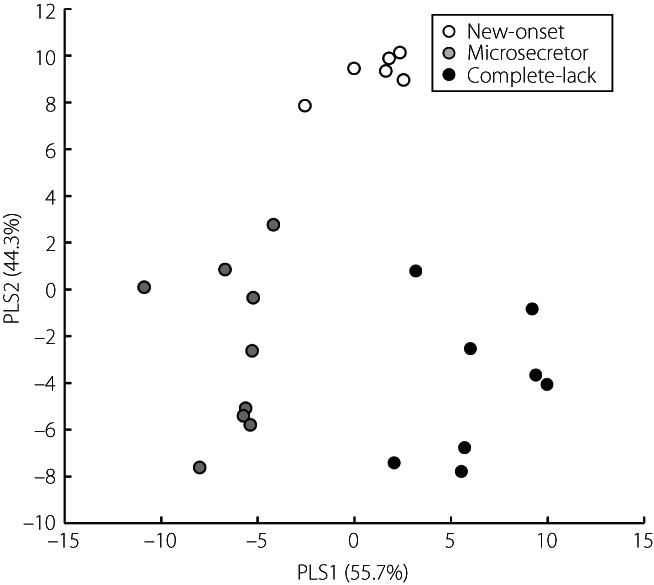
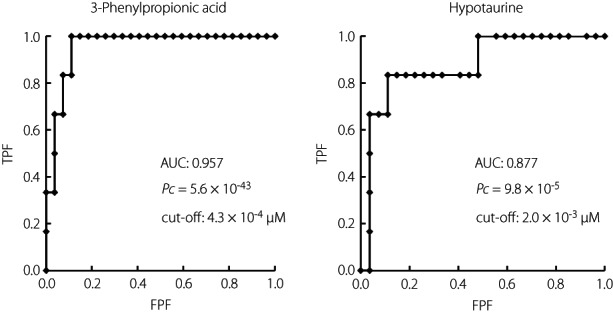
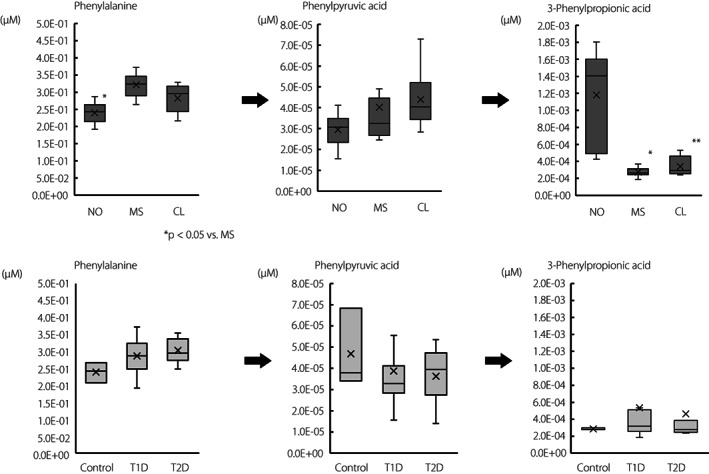
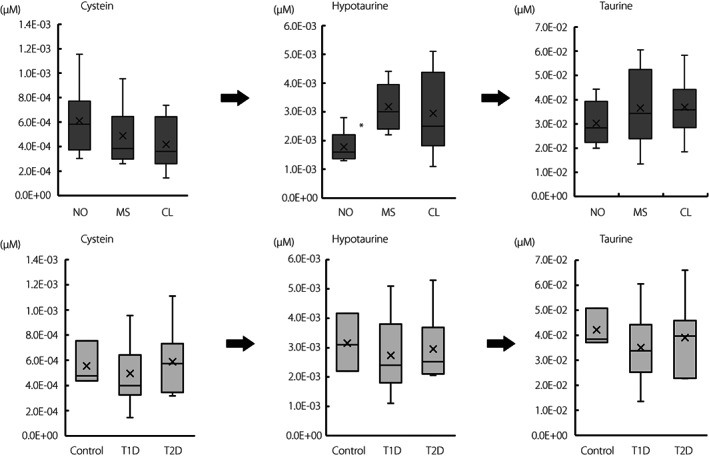
Metabolomic analysis identified a total of 737 peaks, and partial least square analysis was successful in discriminating between the three groups of type 1 diabetes. Among the factor loadings discriminating type 1 diabetes, 3-phenylpropionic acid (r = 0.80, P = 4.7E ) and hypotaurine (r = -0.484, P = 1.9E ) strongly contributed to identifying new-onset type 1 diabetes, and 5-methylcytosine to identifying complete-lack type 1 diabetes (r = 0.586, P = 6.5E ). Reporter operating characteristics analysis, including all type 1 diabetes, type 2 diabetes and healthy controls, showed that high 3-phenylpropionic acid (Pc <0.0001) and low hypotaurine (Pc <0.0001) were useful for identifying new-onset type 1 diabetes, and high 5-methylcytosine (Pc = 0.002) for the complete-lack type 1 diabetes.
In the present study, metabolic signatures were shown to be useful in identifying type 1 diabetes at different clinical stages, and 3-phenylpropionic acid and hypotaurine are novel biomarkers for identifying new-onset type 1 diabetes, suggesting the involvement of the gut bacterial environment, anti-oxidant mechanisms through the hypotaurine-taurine pathway and methylated deoxyribonucleic acid fragmentation in the process of β-cell destruction.
目的/引言:在 1 型糖尿病的发展过程中,代谢物发生了显著改变,可能与β细胞破坏和保护有关。本研究旨在鉴定 1 型糖尿病患者β细胞破坏的新代谢标志物。
本横断面观察性研究共纳入 33 名参与者:23 名 1 型糖尿病患者、7 名 2 型糖尿病患者和 3 名健康对照者。1 型糖尿病患者进一步分为三组:新发、微量分泌和完全缺乏内源性胰岛素的 1 型糖尿病。
代谢组学分析共鉴定出 737 个峰,偏最小二乘分析成功区分了三组 1 型糖尿病患者。在区分 1 型糖尿病的因子负荷中,3-苯丙酸(r=0.80,P=4.7E-8)和高半胱氨酸(r=-0.484,P=1.9E-5)强烈有助于识别新发 1 型糖尿病,5-甲基胞嘧啶有助于识别完全缺乏内源性胰岛素的 1 型糖尿病(r=0.586,P=6.5E-5)。包括所有 1 型糖尿病、2 型糖尿病和健康对照者的受试者工作特征分析显示,高 3-苯丙酸(Pc<0.0001)和低高半胱氨酸(Pc<0.0001)有助于识别新发 1 型糖尿病,高 5-甲基胞嘧啶(Pc=0.002)有助于识别完全缺乏内源性胰岛素的 1 型糖尿病。
本研究表明,代谢特征可用于鉴定不同临床阶段的 1 型糖尿病,3-苯丙酸和高半胱氨酸是鉴定新发 1 型糖尿病的新型生物标志物,提示肠道细菌环境、通过高半胱氨酸-牛磺酸途径的抗氧化机制以及甲基化脱氧核糖核酸片段化参与了β细胞破坏过程。