Department of Cardiology, Erasmus Medical Center, Rotterdam, The Netherlands.
Department of Physiology, Amsterdam Cardiovascular Sciences Heart Failure and Arrhythmia, Amsterdam UMC, Vrije Universiteit Amsterdam, Amsterdam, The Netherlands.
Cardiovasc Drugs Ther. 2023 Dec;37(6):1243-1248. doi: 10.1007/s10557-022-07382-4. Epub 2022 Oct 13.
The presence of atrial fibrillation (AF) in heart failure (HF) patients with reduced ejection fraction is common and associated with an increased risk of stroke, hospitalization and mortality. Recent research findings indicate that a reduction in nicotinamide adenine dinucleotide (NAD) levels results in mitochondrial dysfunction, DNA damage and consequently cardiomyocyte impairment in experimental and clinical HF and AF. The HF-AF ENERGY trial aims to investigate the cardioprotective effects of the NAD precursor nicotinamide riboside (NR) treatment in ischemic heart disease patients diagnosed with AF.
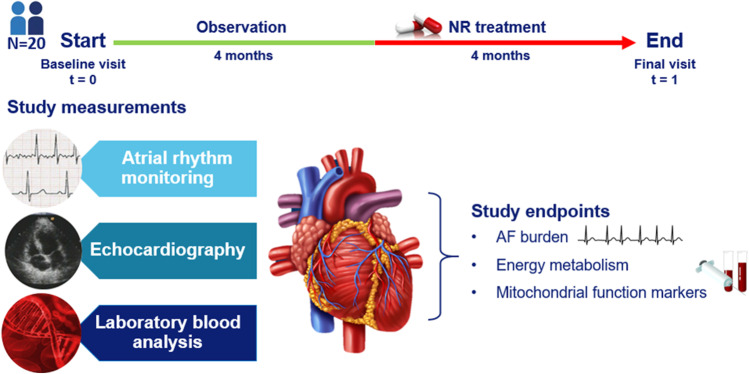
The HF-AF ENERGY trial is a prospective intervention study. The study consists of a (retrospective) 4 months observation period and a 4 months intervention period. The cardioprotective effect of NR on AF burden is investigated by remote monitoring software of implantable cardiac defibrillators (ICDs), which enables continuous atrial rhythm monitoring detection. Cardiac dimension and function are examined by echocardiography. Laboratory blood analysis is performed to determine mitochondrial function markers and energy metabolism. All the study parameters are assessed at two fixed time points (pre- and post-treatment). Pre- and post-treatment outcomes are compared to determine the effects of NR treatment on AF burden, mitochondrial function markers and energy metabolism.
The HF-AF ENERGY trial investigates the cardioprotective effects of NR on AF burden and whether NR normalizes blood-based mitochondrial function markers and energy metabolites of the NAD metabolome in ischemic heart disease patients diagnosed with AF. The study outcomes elucidate whether NAD metabolism can be used as a future therapy for HF patients with AF.
心力衰竭(HF)合并射血分数降低的房颤(AF)患者较为常见,且其发生卒中、住院和死亡的风险增加。最近的研究结果表明,烟酰胺腺嘌呤二核苷酸(NAD)水平降低可导致实验性和临床 HF 及 AF 中的线粒体功能障碍、DNA 损伤,进而导致心肌细胞损伤。HF-AF ENERGY 试验旨在研究烟酰胺核糖(NR)作为 NAD 前体对诊断为 AF 的缺血性心脏病患者的心脏保护作用。
HF-AF ENERGY 试验是一项前瞻性干预研究。该研究包括 4 个月的回顾性观察期和 4 个月的干预期。通过植入式心脏除颤器(ICD)的远程监测软件来研究 NR 对 AF 负荷的心脏保护作用,该软件可以实现连续的心房节律监测检测。通过超声心动图检查心脏的大小和功能。通过实验室血液分析确定线粒体功能标志物和能量代谢。所有研究参数均在两个固定时间点(治疗前和治疗后)进行评估。治疗前后的结果进行比较,以确定 NR 治疗对 AF 负荷、线粒体功能标志物和能量代谢的影响。
HF-AF ENERGY 试验旨在研究 NR 对 AF 负荷的心脏保护作用,以及 NR 是否能使缺血性心脏病合并 AF 患者的血液线粒体功能标志物和 NAD 代谢组中的能量代谢物恢复正常。该研究结果阐明了 NAD 代谢是否可作为 HF 合并 AF 患者的未来治疗方法。