Institute of Psychology, University of Münster, Münster, Germany.
Otto-Creutzfeldt-Center for Cognitive and Behavioral Neuroscience, University of Münster, Münster, Germany.
J Vis. 2022 Oct 4;22(11):9. doi: 10.1167/jov.22.11.9.
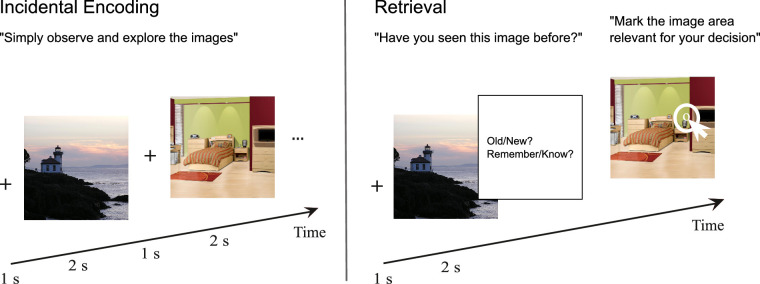
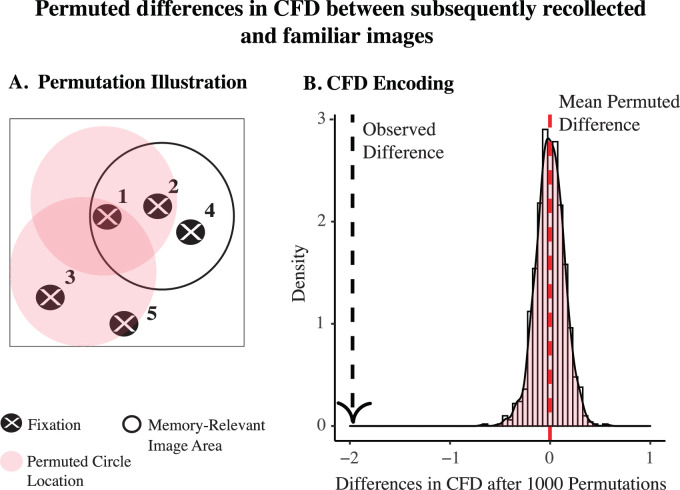
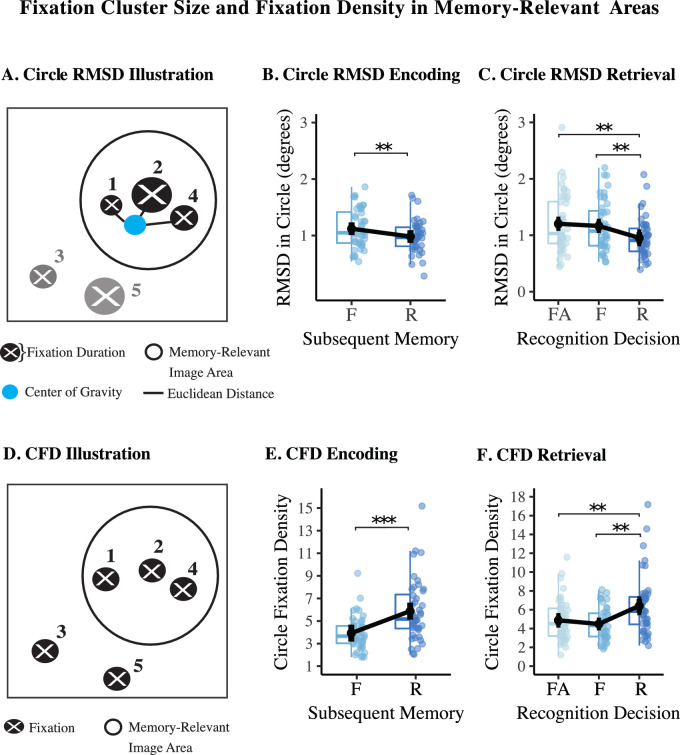
Our visual memories of complex scenes often appear as robust, detailed records of the past. Several studies have demonstrated that active exploration with eye movements improves recognition memory for scenes, but it is unclear whether this improvement is due to stronger feelings of familiarity or more detailed recollection. We related the extent and specificity of fixation patterns at encoding and retrieval to different recognition decisions in an incidental memory paradigm. After incidental encoding of 240 real-world scene photographs, participants (N = 44) answered a surprise memory test by reporting whether an image was new, remembered (indicating recollection), or just known to be old (indicating familiarity). To assess the specificity of their visual memories, we devised a novel report procedure in which participants selected the scene region that they specifically recollected, that appeared most familiar, or that was particularly new to them. At encoding, when considering the entire scene,subsequently recollected compared to familiar or forgotten scenes showed a larger number of fixations that were more broadly distributed, suggesting that more extensive visual exploration determines stronger and more detailed memories. However, when considering only the memory-relevant image areas, fixations were more dense and more clustered for subsequently recollected compared to subsequently familiar scenes. At retrieval, the extent of visual exploration was more restricted for recollected compared to new or forgotten scenes, with a smaller number of fixations. Importantly, fixation density and clustering was greater in memory-relevant areas for recollected versus familiar or falsely recognized images. Our findings suggest that more extensive visual exploration across the entire scene, with a subset of more focal and dense fixations in specific image areas, leads to increased potential for recollecting specific image aspects.
我们对复杂场景的视觉记忆通常表现为对过去的稳健、详细记录。多项研究表明,通过眼球运动进行主动探索可以改善对场景的识别记忆,但尚不清楚这种改善是由于更强烈的熟悉感还是更详细的回忆。我们将编码和检索时注视模式的程度和特异性与偶然记忆范式中的不同识别决策联系起来。在对 240 张真实场景照片进行偶然编码后,参与者(N=44)通过报告图像是新的、记住的(表示回忆)还是只是旧的(表示熟悉)来回答一个意外的记忆测试。为了评估他们视觉记忆的特异性,我们设计了一种新的报告程序,其中参与者选择他们具体回忆、看起来最熟悉或对他们来说特别新的场景区域。在编码时,当考虑整个场景时,与熟悉或遗忘的场景相比,随后回忆的场景显示出更多、更广泛分布的注视,这表明更广泛的视觉探索决定了更强和更详细的记忆。然而,当只考虑与记忆相关的图像区域时,与随后熟悉的场景相比,随后回忆的场景的注视更加密集和聚类。在检索时,与新的或遗忘的场景相比,回忆的场景的视觉探索范围更受限制,注视次数更少。重要的是,与熟悉或错误识别的图像相比,在与记忆相关的区域中,注视密度和聚类更大。我们的研究结果表明,在整个场景中进行更广泛的视觉探索,并在特定图像区域中进行更集中和密集的注视,增加了回忆特定图像方面的可能性。