Jandee Kasemsak, Thanapop Chamnong
Department of Community Public Health, School of Public Health, Walailak University, Nakhon Sri Thammarat, Thailand.
Center of Excellence in Data Science for Health Study, Walailak University, Nakhon Sri Thammarat, Thailand.
JMIR Hum Factors. 2022 Oct 13;9(4):e37693. doi: 10.2196/37693.
In 2019, COVID-19 spread worldwide, causing a pandemic that has posed unprecedented challenges and pressure for health systems and economies. Food delivery services have become an important medium for consumer food purchases to limit human-to-human contact. Thus, delivery drivers are at high risk of exposure to COVID-19 infection at work. To the best of our knowledge, no studies have analyzed the dimensions of health literacy (HL) regarding COVID-19 prevention in this population.
This study aims to explore the HL status toward COVID-19 prevention and its associated factors among food delivery drivers in southern Thailand.
Following a cross-sectional survey from July to August 2021, Thai food delivery drivers in the upper-south and lower-south regions of southern Thailand were recruited to participate during the compulsory COVID-19 lockdown. An online structured questionnaire was administered verbally and recorded by the interviewer. Univariate and multivariate linear regressions were used to explore independently associated factors.
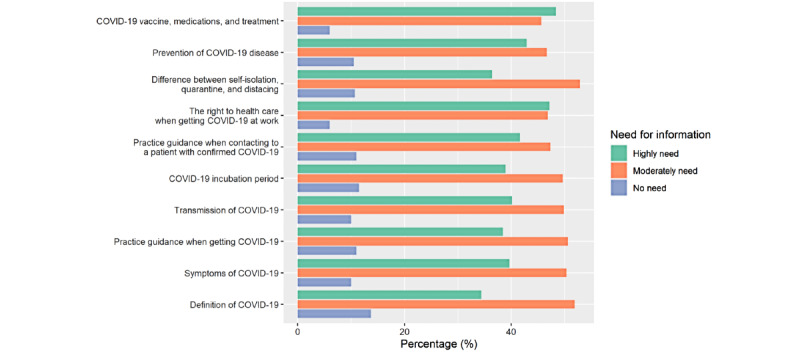
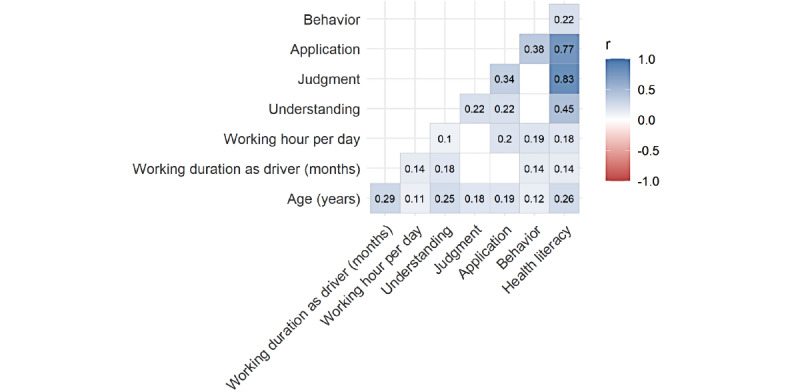
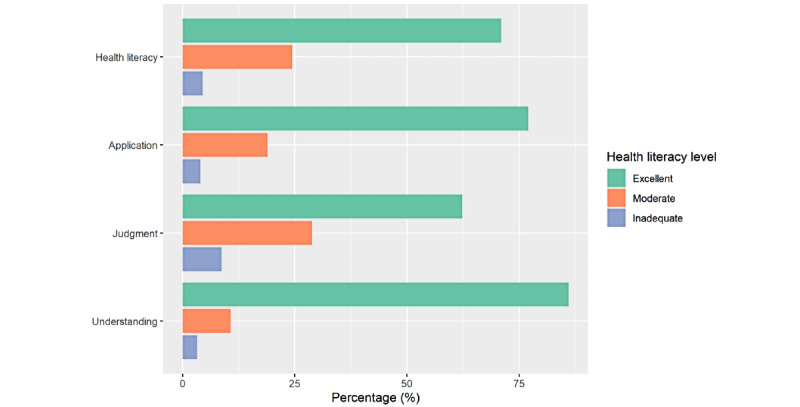
Of 401 drivers, 291 (72.6%) were men. The median age was 31 years (range 19-64 years). The median number of months working as a driver was 12 months, and the median number of working hours was 9 hours per day. The median number of daily food orders was 20, while the median daily income was Thai baht (THB) 600 (US $15.90). Social media (Facebook and Line) was a common source of health information. The most common information required was about the COVID-19 vaccine, medications, and treatment. Most drivers (285/401, 71.1%) had excellent HL levels regarding COVID-19 prevention. Only the practical application of information was statistically correlated with behavior (r=0.38, P<.001). Drivers in the lower south of Thailand were more likely to have excellent HL than other drivers (β=7.03, P<.001). Those who frequently accessed information through YouTube (β=-2.17, P=.01) and relatives (β=-4.19, P<.001) were less likely to have excellent HL levels.
Understanding HL among food delivery drivers would be useful for planning effective interventions that target this population. Conventional health education through social media alone may not be effective at educating people about COVID-19 prevention. Information literacy skills could determine individuals' HL and drivers' behaviors.
2019年,新型冠状病毒肺炎(COVID-19)在全球范围内传播,引发了一场大流行,给卫生系统和经济带来了前所未有的挑战和压力。食品配送服务已成为消费者购买食品以限制人际接触的重要媒介。因此,配送司机在工作中面临感染COVID-19的高风险。据我们所知,尚无研究分析该人群中关于COVID-19预防的健康素养(HL)维度。
本研究旨在探讨泰国南部食品配送司机对COVID-19预防的HL状况及其相关因素。
在2021年7月至8月进行横断面调查后,招募泰国南部上南部和下南部地区的泰国食品配送司机在COVID-19强制封锁期间参与。通过在线结构化问卷进行口头询问,并由访谈者记录。采用单因素和多因素线性回归来探讨独立相关因素。
在401名司机中,291名(72.6%)为男性。中位年龄为31岁(范围19 - 64岁)。担任司机的中位月数为12个月,中位工作时长为每天9小时。每日食品订单的中位数为20单,而日均收入为600泰铢(15.90美元)。社交媒体(脸书和连我)是常见的健康信息来源。最常需要的信息是关于COVID-19疫苗、药物和治疗的信息。大多数司机(285/401,71.1%)在COVID-19预防方面具有优秀的HL水平。只有信息的实际应用与行为在统计学上相关(r = 0.38,P <.001)。泰国南部下南部地区的司机比其他司机更有可能具有优秀的HL(β = 7.03,P <.