Department of Biology, Georgetown University, Washington, District of Columbia, United States of America.
PLoS Comput Biol. 2022 Oct 13;18(10):e1010437. doi: 10.1371/journal.pcbi.1010437. eCollection 2022 Oct.
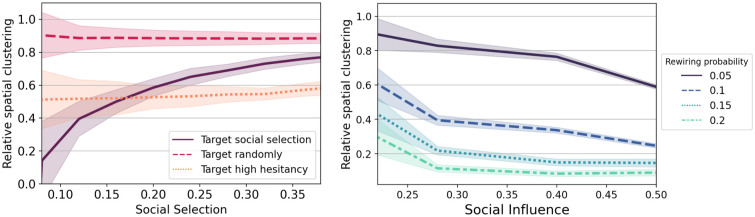
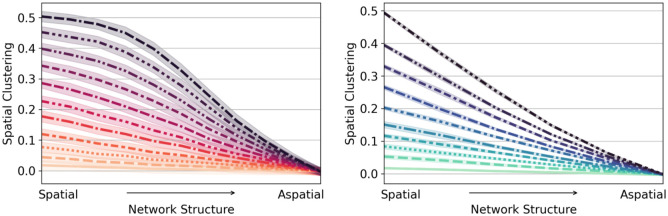
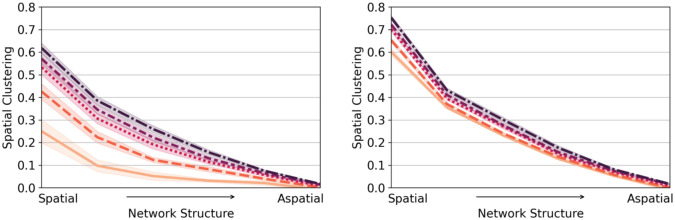
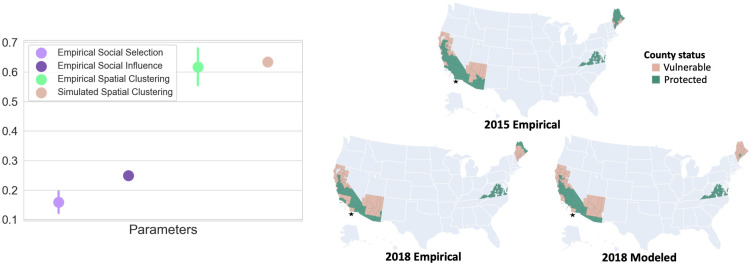
The phenomenon of vaccine hesitancy behavior has gained ground over the last three decades, jeopardizing the maintenance of herd immunity. This behavior tends to cluster spatially, creating pockets of unprotected sub-populations that can be hotspots for outbreak emergence. What remains less understood are the social mechanisms that can give rise to spatial clustering in vaccination behavior, particularly at the landscape scale. We focus on the presence of spatial clustering, and aim to mechanistically understand how different social processes can give rise to this phenomenon. In particular, we propose two hypotheses to explain the presence of spatial clustering: (i) social selection, in which vaccine-hesitant individuals share socio-demographic traits, and clustering of these traits generates spatial clustering in vaccine hesitancy; and (ii) social influence, in which hesitant behavior is contagious and spreads through neighboring societies, leading to hesitant clusters. Adopting a theoretical spatial network approach, we explore the role of these two processes in generating patterns of spatial clustering in vaccination behaviors under a range of spatial structures. We find that both processes are independently capable of generating spatial clustering, and the more spatially structured the social dynamics in a society are, the higher spatial clustering in vaccine-hesitant behavior it realizes. Together, we demonstrate that these processes result in unique spatial configurations of hesitant clusters, and we validate our models of both processes with fine-grain empirical data on vaccine hesitancy, social determinants, and social connectivity in the US. Finally, we propose, and evaluate the effectiveness of two novel intervention strategies to diminish hesitant behavior. Our generative modeling approach informed by unique empirical data provides insights on the role of complex social processes in driving spatial heterogeneity in vaccine hesitancy.
在过去的三十年中,疫苗犹豫行为现象日益增多,危及了群体免疫的维持。这种行为往往在空间上聚集,形成未受保护的亚人群的热点,这些热点可能成为疫情爆发的源头。目前人们对导致疫苗接种行为空间聚集的社会机制仍了解较少,尤其是在景观尺度上。我们关注的是空间聚集的存在,并旨在从机制上理解不同的社会过程如何导致这种现象。特别是,我们提出了两个假设来解释空间聚类的存在:(i)社会选择,在这种情况下,疫苗犹豫者具有共同的社会人口特征,这些特征的聚类导致疫苗犹豫的空间聚类;(ii)社会影响,在这种情况下,犹豫行为具有传染性,并通过邻近社会传播,导致犹豫者的聚集。我们采用理论的空间网络方法,在一系列空间结构下,探索这两个过程在产生疫苗接种行为空间聚类模式中的作用。我们发现这两个过程都能够独立地产生空间聚类,而且社会动态在一个社会中越具有空间结构,疫苗犹豫行为的空间聚类程度就越高。总之,我们证明了这些过程会导致犹豫者聚集的独特空间配置,并通过美国疫苗犹豫、社会决定因素和社会联系的细粒度实证数据验证了我们对这两个过程的模型。最后,我们提出并评估了两种新的干预策略的有效性,以减少犹豫行为。我们的生成模型方法以独特的实证数据为依据,提供了关于复杂社会过程在驱动疫苗犹豫的空间异质性方面的作用的见解。