Department of Gastroenterological Surgery and Oncology, Kitano Hospital Medical Research Institute, 2-4-20, Ogimachi, Kita-ku, Osaka, 530-8480, Japan.
Sci Rep. 2022 Oct 13;12(1):17136. doi: 10.1038/s41598-022-21650-1.
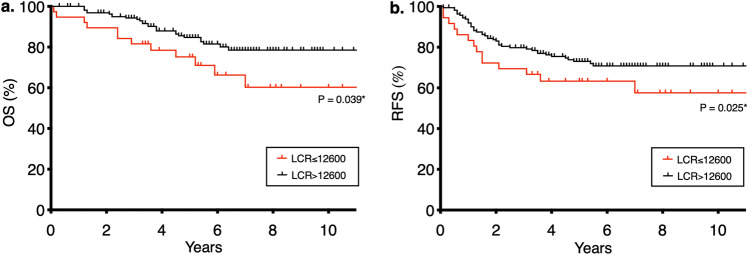
Cancer-related systemic inflammation influences postoperative outcomes in cancer patients. Although the relationship between inflammation-related markers and postoperative outcomes have been investigated in many studies, their clinical significance remains to be elucidated in rectal cancer patients. We focused on the lymphocyte count/C-reactive protein ratio (LCR) and its usefulness in predicting short- and long-term outcomes after rectal cancer surgery. Patients with rectal cancer who underwent curative resection at our institution between 2010 and 2018 were enrolled in this study. We comprehensively compared the effectiveness of 11 inflammation-related markers, including LCR and other clinicopathological characteristics, in predicting postoperative complications and survival. Receiver operating characteristic curve analysis indicated that LCR had the highest area under the curve value for predicting the occurrence of postoperative complications. In the multivariate analysis, male sex (odds ratio [OR]: 2.21, 95% confidence interval [CI] 1.07-4.57, P = 0.031), low tumor location (OR: 2.44, 95% CI 1.23-4.88, P = 0.011), and low LCR (OR: 3.51, 95% CI 1.63-7.58, P = 0.001) were significantly and independently associated with the occurrence of postoperative complications. In addition, multivariate analysis using Cox's proportional hazard regression model for the prediction of survival showed that low LCR (≤ 12,600) was significantly associated with both poor overall survival (hazard ratio [HR]: 2.07, 95% CI 1.03-4.15, P = 0.041) and recurrence-free survival (HR: 2.21, 95% CI 1.22-4.01, P = 0.009). LCR is a useful marker for predicting both short- and long-term postoperative outcomes in rectal cancer patients who underwent curative surgery.
癌症相关的系统性炎症会影响癌症患者的术后结局。尽管许多研究已经探讨了炎症相关标志物与术后结局之间的关系,但它们在直肠癌患者中的临床意义仍有待阐明。我们专注于淋巴细胞计数/ C 反应蛋白比值(LCR)及其在预测直肠癌手术后短期和长期结局方面的作用。本研究纳入了 2010 年至 2018 年间在我院接受根治性切除术的直肠癌患者。我们全面比较了 11 种炎症相关标志物(包括 LCR 和其他临床病理特征)在预测术后并发症和生存方面的有效性。受试者工作特征曲线分析表明,LCR 预测术后并发症发生的曲线下面积最高。多因素分析显示,男性(比值比 [OR]:2.21,95%置信区间 [CI] 1.07-4.57,P=0.031)、肿瘤位置低(OR:2.44,95%CI 1.23-4.88,P=0.011)和低 LCR(OR:3.51,95%CI 1.63-7.58,P=0.001)与术后并发症的发生显著相关。此外,采用 Cox 比例风险回归模型对生存进行多因素分析显示,低 LCR(≤12600)与总生存(风险比 [HR]:2.07,95%CI 1.03-4.15,P=0.041)和无复发生存(HR:2.21,95%CI 1.22-4.01,P=0.009)显著相关。LCR 是预测接受根治性手术的直肠癌患者短期和长期术后结局的有用标志物。