Health Management Research Center, Baqiyatallah University of Medical Sciences, Tehran, Iran.
Department of Health Services Management, Faculty of Health, Baqiyatallah University of Medical Sciences, Tehran, Iran.
BMC Public Health. 2022 Oct 13;22(1):1909. doi: 10.1186/s12889-022-14219-0.
The COVID-19 pandemic is a multi-faceted phenomenon with many political, economic and social consequences. Success in managing and controlling this pandemic depends on the coordinated efforts of many organizations and institutions. Therefore, this study aimed to identify and analyze the actors and stakeholders related to managing and controlling this pandemic in Iran.
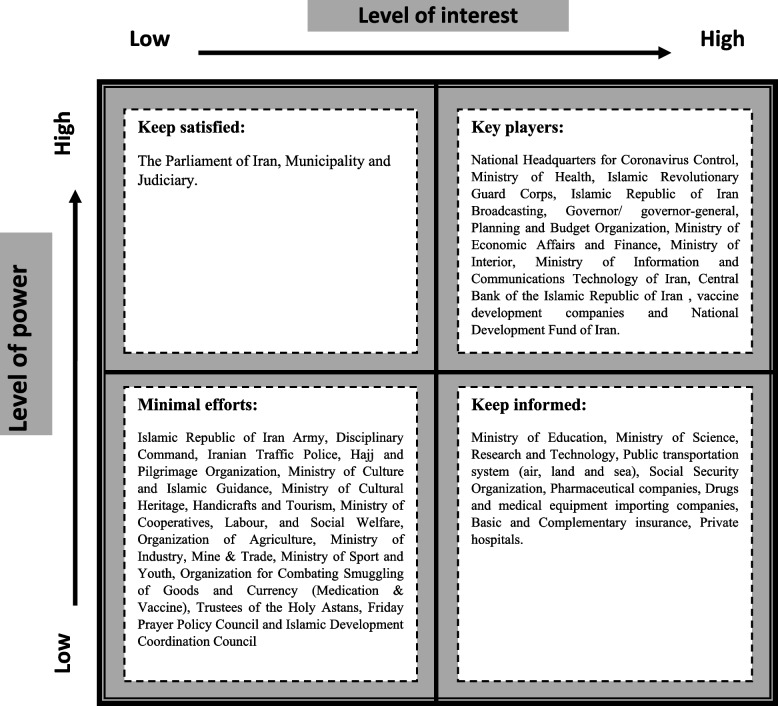
This mix-method stakeholder analysis was conducted in 2021 nationwide as retrospectively. The purposive sampling method was applied when inviting eligible participants to participate in the study. Our study was conducted in two phases. In the qualitative phase, data were collected using a semi-structured interview. An interview guide was developed based on the WHO stakeholder analysis framework. In the quantitative phase, we used a questionnaire developed based on the study framework. Each question was scored on a 5-point Likert scale, with a score greater than 4 was considered as high, 3-4 was considered as moderate, and 1-3 was considered as low. Data were analyzed using framework analysis, WHO stakeholders' analysis framework and MENDELOW matrix. MAXQDA qualitative data analysis software Version 11 and Policy Maker software (Version. 4) were used for data analysis.
A total of 48 stakeholders were identified. Ministry of Health (MoH), National Headquarters for Coronavirus Control (NHCC) had the highest participation level, high supportive position, and knowledge of the subject. The Parliament of Iran (PoI), Islamic Revolutionary Guard Corps (IRGC), and Islamic Republic of Iran Broadcasting (IRIB) had the highest power/influence during the Covid-19 epidemic. Only two stakeholders (6.06%) had high participation, and 18.18% had moderate participation. All stakeholders except for the NHCC and the MoH lacked appropriate knowledge of the subject. Furthermore, only three stakeholders (9.09%) had high power/influence.
Given the multidimensional nature of Covid-19, most institutions and organizations were involved in managing this pandemic. Stakeholders with high power/authority and resources had a low/moderate participation level and a moderate supportive position. Moreover, organizations with a high supportive position and participation had low power/authority and resources to cope with COVID-19.
COVID-19 大流行是一种多方面的现象,具有许多政治、经济和社会后果。成功管理和控制这一大流行病取决于许多组织和机构的协调努力。因此,本研究旨在确定和分析与伊朗管理和控制这一大流行病有关的行为者和利益攸关方。
本混合方法利益攸关方分析于 2021 年在全国范围内进行,回顾性研究。在邀请合格参与者参与研究时,采用了目的性抽样方法。我们的研究分为两个阶段进行。在定性阶段,使用半结构式访谈收集数据。访谈指南是根据世卫组织利益攸关方分析框架制定的。在定量阶段,我们使用了根据研究框架制定的问卷。每个问题都在 5 点李克特量表上进行评分,评分大于 4 被认为是高,3-4 是中等,1-3 是低。使用框架分析、世卫组织利益攸关方分析框架和 MENDELOW 矩阵对数据进行分析。MAXQDA 定性数据分析软件版本 11 和决策者软件(版本 4)用于数据分析。
共确定了 48 个利益攸关方。卫生部(MoH)、国家冠状病毒控制总部(NHCC)的参与度最高,支持度和对主题的了解程度最高。伊朗议会(PoI)、伊斯兰革命卫队(IRGC)和伊朗伊斯兰共和国广播公司(IRIB)在 COVID-19 疫情期间拥有最高的权力/影响力。只有两个利益攸关方(6.06%)的参与度高,18.18%的参与度中等。除 NHCC 和 MoH 外,所有利益攸关方都缺乏对该主题的适当了解。此外,只有三个利益攸关方(9.09%)拥有高权力/影响力。
鉴于 COVID-19 的多维度性质,大多数机构和组织都参与了管理这一大流行病。权力/权威和资源高的利益攸关方的参与度低/中等,支持度中等。此外,支持度高和参与度高的组织拥有应对 COVID-19 的低权力/权威和资源。