Taghizadeh Shahnaz, Zarnag Rahim Khodayari, Farhangi Mahdieh Abbasalizad
Student Research Committee, Faculty of Nutrition, Tabriz University of Medical Sciences, Tabriz, Iran.
Department of Health Policy and Management, School of Management and Medical Informatics, Tabriz University of Medical Sciences, Tabriz, Iran.
Arch Public Health. 2021 Mar 17;79(1):36. doi: 10.1186/s13690-021-00557-9.
Childhood obesity is one of the most serious health challenges and risk factors for various diseases. International health organizations, such as the World Health Organization (WHO), recommend more stakeholder engagement to discuss this health problem. Therefore, this study aims to identify and analyze the stakeholders of childhood obesity prevention (COP) policy making process in Iran.
In this study, semi-structured interviews were conducted with 24 Iranian stakeholders in the field of COP from February 2019 to May 2020. PolicyMaker V.4 and MAXQDA V.10 software were used for the analysis of stakeholders.
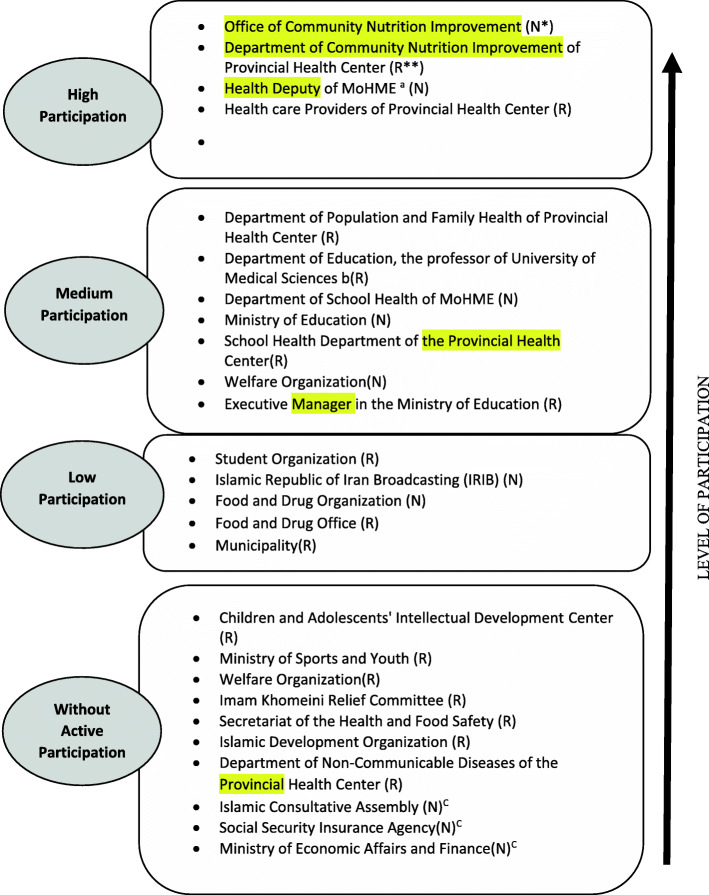
Out of 24 interviewed stakeholders, 17 were active and seven were inactive. The most powerful and supportive stakeholders were the Ministry of Health and Medical Education (MoHME) and the national and regional Offices of Community Nutrition Improvement. Although stakeholders like the Ministry of Sports and Youth, the municipalities, the Secretariat of the Health and Food Safety, the Islamic Republic of Iran Broadcasting (IRIB), and Student Organization were among powerful bodies, they showed the least support for COP policies. The remaining stakeholders showed medium or low support and power in the policy making process.
Disconnect between stakeholders, less attention to prevention strategies, and high advertising of unhealthy foods were among the main challenges facing the COP policies in Iran and worldwide. Insufficient financial resources, little attention to the young people under 18, non-aligned policies of the Student Organization and the IRIB, and insufficient support of COP policies were among the key challenges to be handled.
儿童肥胖是最严重的健康挑战之一,也是多种疾病的风险因素。世界卫生组织(WHO)等国际卫生组织建议更多利益相关者参与讨论这一健康问题。因此,本研究旨在识别和分析伊朗儿童肥胖预防(COP)政策制定过程中的利益相关者。
本研究于2019年2月至2020年5月对24名伊朗儿童肥胖预防领域的利益相关者进行了半结构化访谈。使用PolicyMaker V.4和MAXQDA V.10软件对利益相关者进行分析。
在24名接受访谈的利益相关者中,17名积极参与,7名不活跃。最有影响力且支持力度最大的利益相关者是卫生和医学教育部(MoHME)以及国家和地区社区营养改善办公室。尽管体育和青年部、市政当局、卫生与食品安全秘书处、伊朗伊斯兰共和国广播公司(IRIB)和学生组织等利益相关者属于有影响力的机构,但它们对儿童肥胖预防政策的支持最少。其余利益相关者在政策制定过程中表现出中等或较低的支持度和影响力。
利益相关者之间缺乏联系、对预防策略关注不足以及不健康食品的大量广告宣传是伊朗和全球儿童肥胖预防政策面临的主要挑战。财政资源不足、对18岁以下青少年关注不够、学生组织和IRIB政策不一致以及儿童肥胖预防政策支持不足是需要应对的关键挑战。