Neurology Unit, Department of Clinical and Experimental Sciences, University of Brescia, P.le Spedali Civili 1, 25123, Brescia, Italy.
Neurology Unit, ASST Spedali Civili Brescia, Brescia, Italy.
Alzheimers Res Ther. 2022 Oct 13;14(1):155. doi: 10.1186/s13195-022-01094-5.
In the last decade, non-invasive blood-based and neurophysiological biomarkers have shown great potential for the discrimination of several neurodegenerative disorders. However, in the clinical workup of patients with cognitive impairment, it will be highly unlikely that any biomarker will achieve the highest potential predictive accuracy on its own, owing to the multifactorial nature of Alzheimer's disease (AD) and frontotemporal lobar degeneration (FTLD).
In this retrospective study, performed on 202 participants, we analysed plasma neurofilament light (NfL), glial fibrillary acidic protein (GFAP), and tau phosphorylated at amino acid 181 (p-Tau) concentrations, as well as amyloid β42 to 40 ratio (Aβ/) ratio, using the ultrasensitive single-molecule array (Simoa) technique, and neurophysiological measures obtained by transcranial magnetic stimulation (TMS), including short-interval intracortical inhibition (SICI), intracortical facilitation (ICF), long-interval intracortical inhibition (LICI), and short-latency afferent inhibition (SAI). We assessed the diagnostic accuracy of combinations of both plasma and neurophysiological biomarkers in the differential diagnosis between healthy ageing, AD, and FTLD.
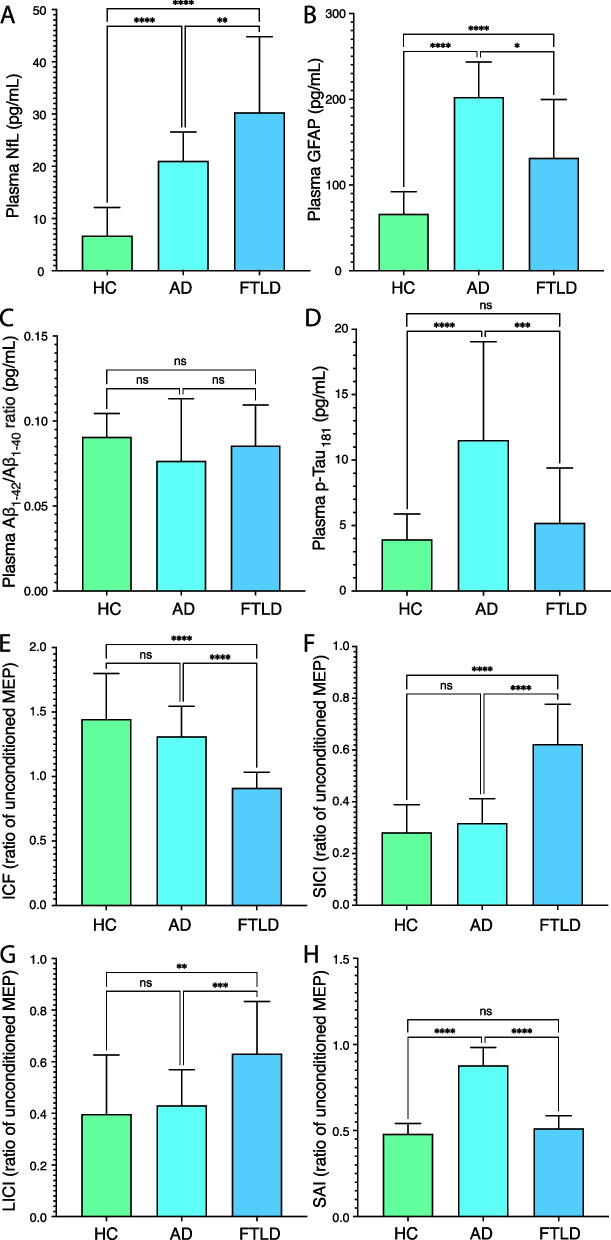
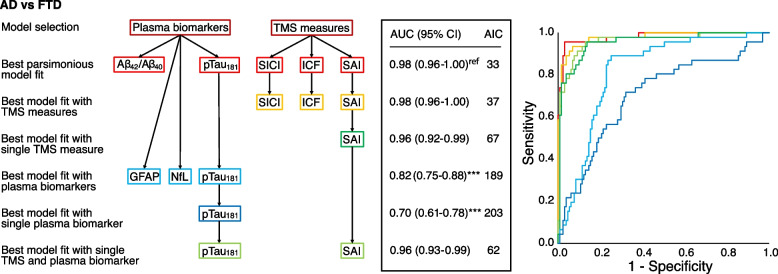
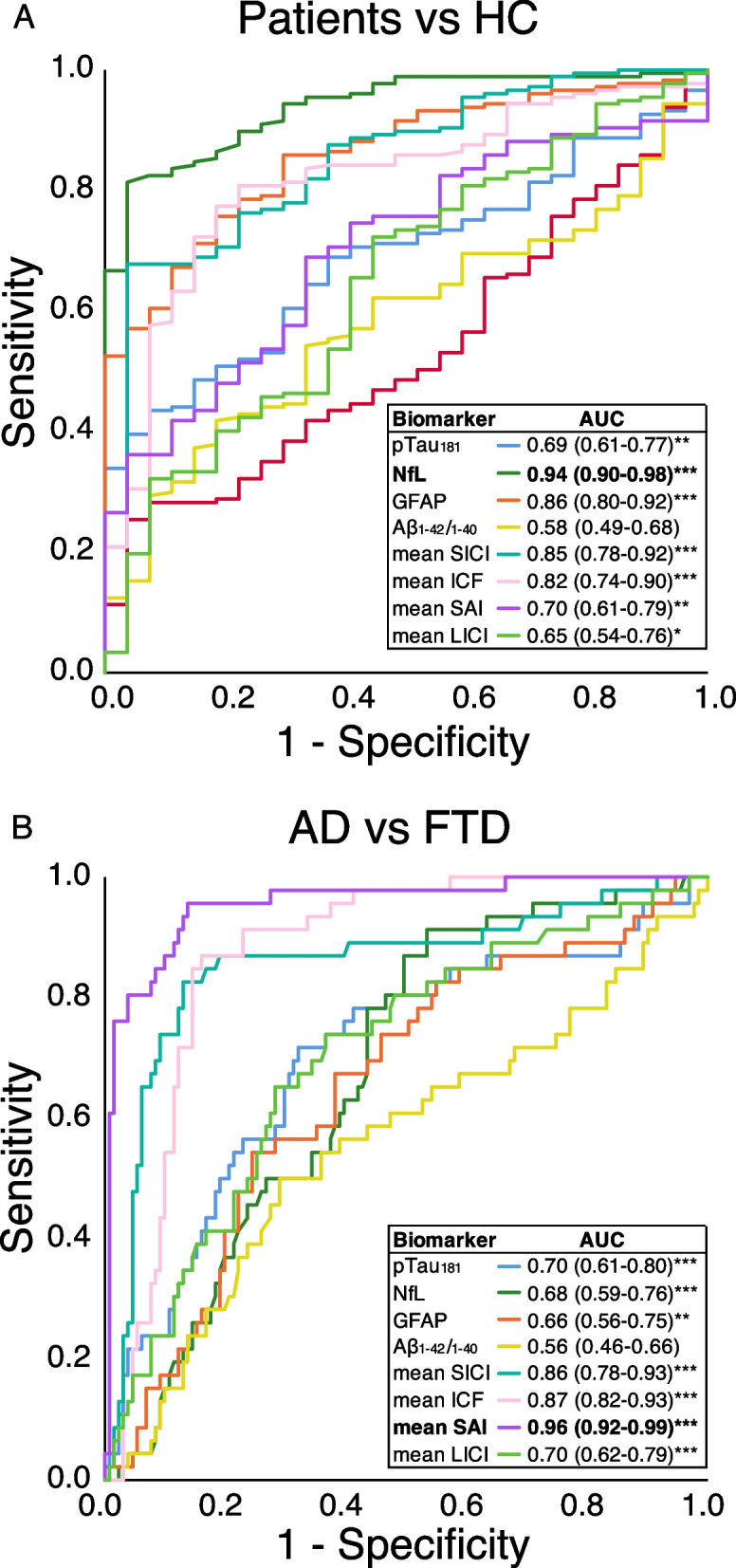
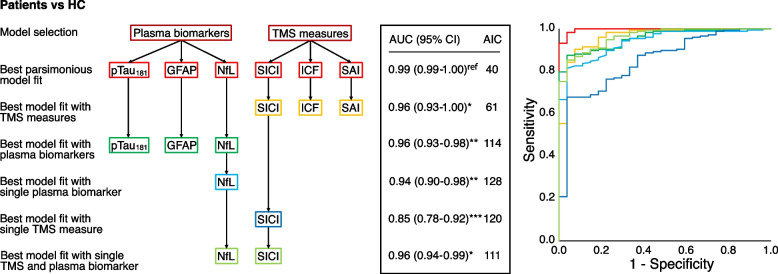
We observed significant differences in plasma NfL, GFAP, and p-Tau levels between the groups, but not for the Aβ/Aβ ratio. For the evaluation of diagnostic accuracy, we adopted a two-step process which reflects the clinical judgement on clinical grounds. In the first step, the best single biomarker to classify "cases" vs "controls" was NfL (AUC 0.94, p < 0.001), whilst in the second step, the best single biomarker to classify AD vs FTLD was SAI (AUC 0.96, p < 0.001). The combination of multiple biomarkers significantly increased diagnostic accuracy. The best model for classifying "cases" vs "controls" included the predictors p-Tau, GFAP, NfL, SICI, ICF, and SAI, resulting in an AUC of 0.99 (p < 0.001). For the second step, classifying AD from FTD, the best model included the combination of Aβ/Aβ ratio, p-Tau, SICI, ICF, and SAI, resulting in an AUC of 0.98 (p < 0.001).
The combined assessment of plasma and neurophysiological measures may greatly improve the differential diagnosis of AD and FTLD.
在过去的十年中,非侵入性的血液生物标志物和神经生理学标志物在区分几种神经退行性疾病方面显示出巨大的潜力。然而,在认知障碍患者的临床评估中,由于阿尔茨海默病(AD)和额颞叶变性(FTLD)的多因素性质,任何单一的生物标志物都不太可能达到最高的预测准确性。
在这项回顾性研究中,我们对 202 名参与者进行了分析,使用超灵敏单分子阵列(Simoa)技术分析了血浆神经丝轻链(NfL)、神经胶质纤维酸性蛋白(GFAP)和磷酸化 tau 氨基酸 181(p-Tau)的浓度,以及使用经颅磁刺激(TMS)获得的神经生理学测量值,包括短间隔皮质内抑制(SICI)、皮质内易化(ICF)、长间隔皮质内抑制(LICI)和短潜伏期传入抑制(SAI)。我们评估了血浆和神经生理学生物标志物联合在健康老化、AD 和 FTLD 之间的鉴别诊断中的诊断准确性。
我们观察到各组之间血浆 NfL、GFAP 和 p-Tau 水平存在显著差异,但 Aβ/Aβ 比值没有差异。为了评估诊断准确性,我们采用了两步法,反映了基于临床的临床判断。在第一步中,分类“病例”与“对照”的最佳单一生物标志物是 NfL(AUC 0.94,p<0.001),而在第二步中,分类 AD 与 FTLD 的最佳单一生物标志物是 SAI(AUC 0.96,p<0.001)。多种生物标志物的联合显著提高了诊断准确性。分类“病例”与“对照”的最佳模型包括预测因子 p-Tau、GFAP、NfL、SICI、ICF 和 SAI,AUC 为 0.99(p<0.001)。对于第二步,从 FTD 中分类 AD,最佳模型包括 Aβ/Aβ 比值、p-Tau、SICI、ICF 和 SAI 的组合,AUC 为 0.98(p<0.001)。
血浆和神经生理学测量的联合评估可能极大地改善 AD 和 FTLD 的鉴别诊断。