Radiotherapy Department, CHU Bordeaux, 33000, Bordeaux, France.
BRIC (BoRdeaux Institute of onCology), UMR1312, INSERM, University of Bordeaux, 33000, Bordeaux, France.
Radiat Oncol. 2022 Oct 13;17(1):165. doi: 10.1186/s13014-022-02133-z.
The first line of treatment for nonfunctioning pituitary adenoma (NFPA) is surgery. Adjuvant radiotherapy or surveillance and new treatment (second surgical operation or salvage radiotherapy) in case of recurrence are options discussed at the multidisciplinary tumor board. The purpose of this study was to evaluate the therapeutic outcome for each option.
The records of 256 patients followed with NFPA between 2007 and 2018 were retrospectively reviewed. Mean age at initial surgery was 55 years [18-86]. Post-operative MRI found a residual tumor in 87% of patients. Mean follow-up was 12.1 years [0.8-42.7].
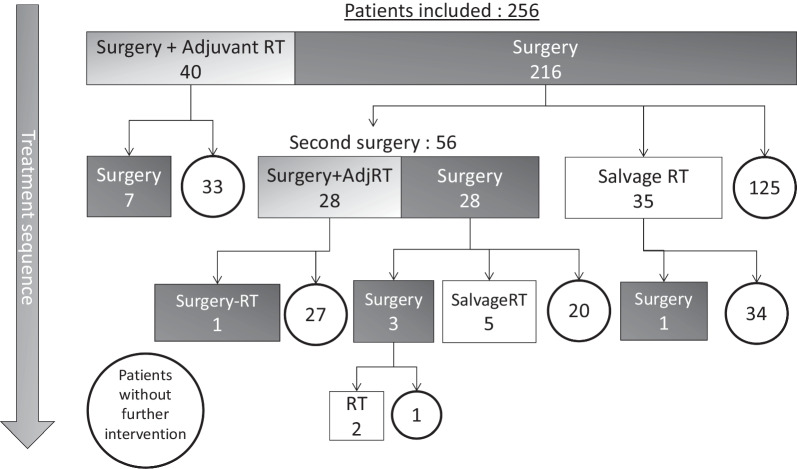
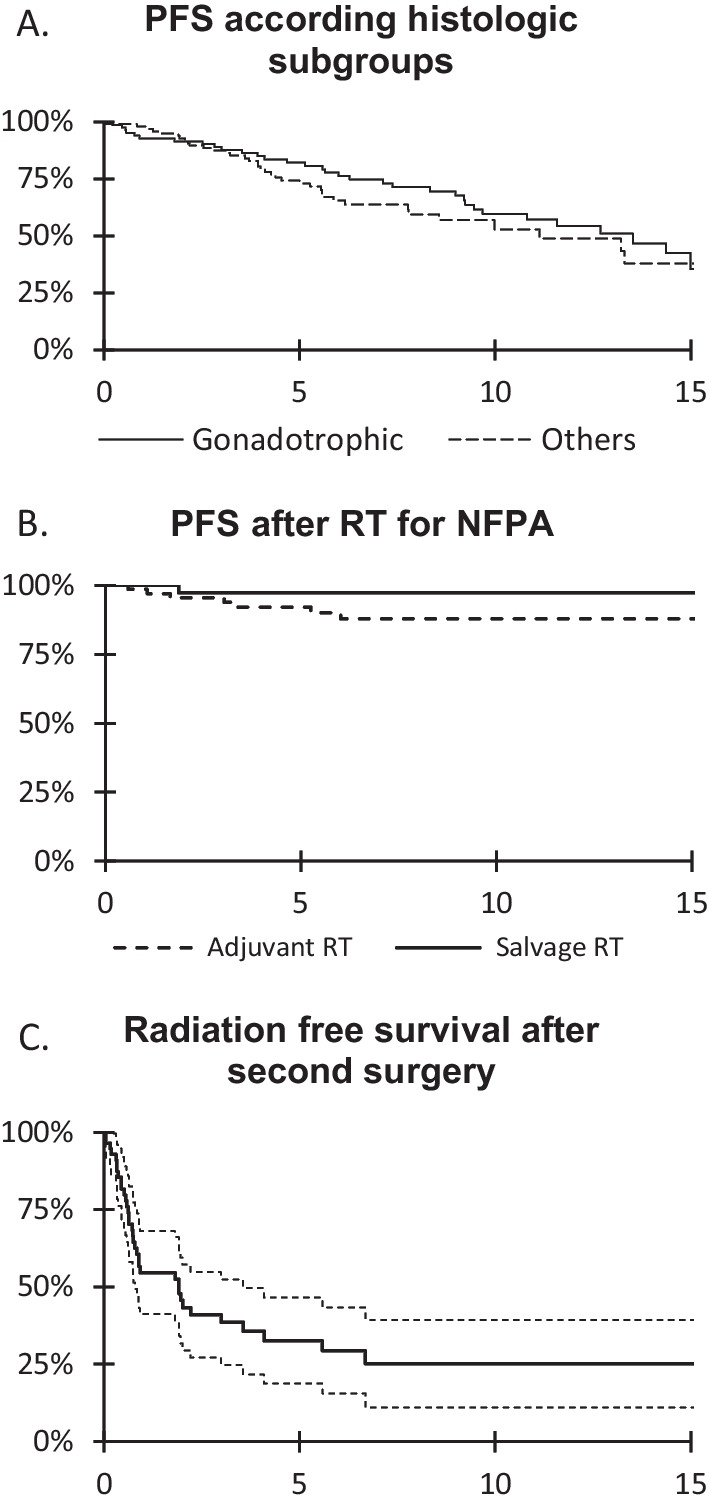
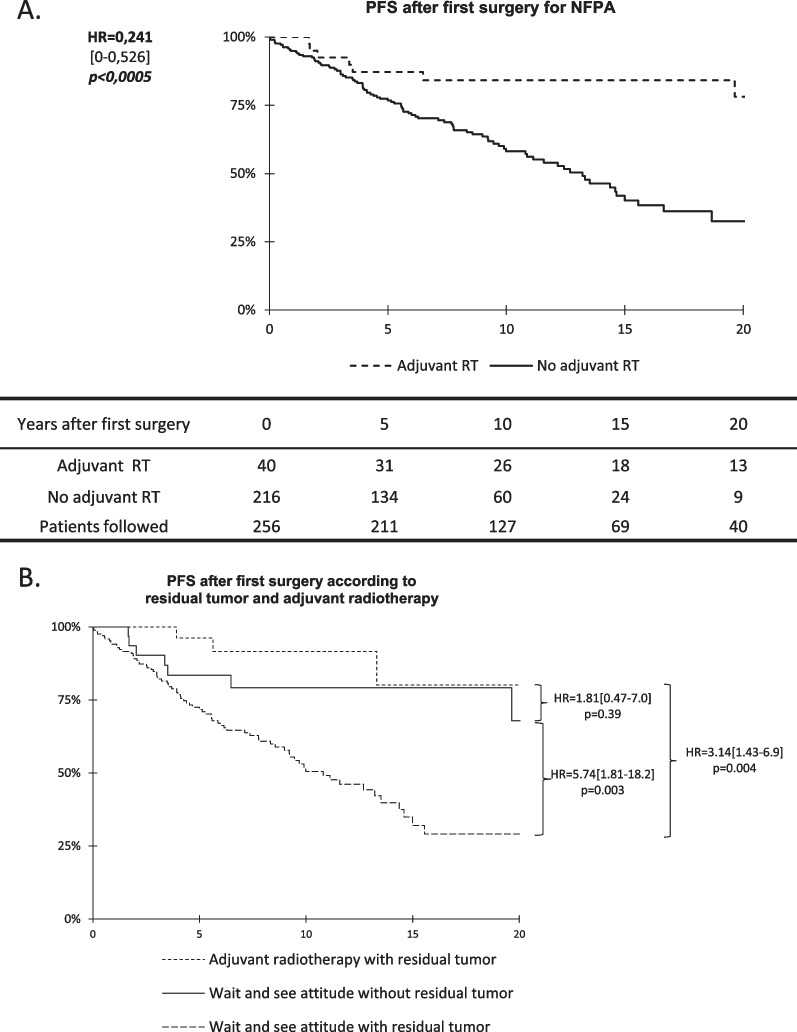
After initial surgery, 40 patients had adjuvant radiotherapy. At 5, 10 and 15 years progression-free survival (PFS) was significantly different after surgery alone (77%, 58% and 40%) compared to surgery and adjuvant radiotherapy (84%, 78% and 78%) (HR = 0.24 [0-0.53] p < 0.0005). Overall, after first, second or third surgical operation, 69 patients had adjuvant radiotherapy and 41 salvage radiotherapy. Five-year PFS was similar for adjuvant (90%) and salvage radiotherapy (97%) (p = 0.62). After a second surgical operation, 62% and 71% of patients were irradiated after 2 and 5 years respectively. The risk of corticotropic and thyrotropic deficiency rates were 38% and 59% after second or third surgical operation and 40% and 73% after radiotherapy. Brain tumors occurred in 4 patients: 1 meningioma present at initial surgery, and after radiotherapy, 1 neurinoma which appeared at 5 years, 1 glioblastoma at 13 years and 1 meningioma at 20 years.
Among patients treated by surgery for NFPA, a "wait-and-see" attitude should be an option since adjuvant radiotherapy is not superior to salvage radiotherapy. However, in case of recurrence or progression, the authors recommended delivery of salvage radiotherapy to avoid a second surgical operation.
治疗无功能性垂体腺瘤(NFPA)的一线治疗方法是手术。在多学科肿瘤委员会讨论了辅助放疗或监测及新治疗(二次手术或挽救性放疗)作为复发的选择。本研究的目的是评估每种选择的治疗结果。
回顾性分析了 2007 年至 2018 年间随访的 256 例 NFPA 患者的记录。初次手术时的平均年龄为 55 岁[18-86 岁]。术后 MRI 发现 87%的患者存在残留肿瘤。平均随访时间为 12.1 年[0.8-42.7 年]。
初次手术后,40 例患者接受辅助放疗。5 年、10 年和 15 年无进展生存率(PFS)在单纯手术组(77%、58%和 40%)与手术和辅助放疗组(84%、78%和 78%)之间差异有统计学意义(HR=0.24[0-0.53]p<0.0005)。总体而言,在初次、二次或三次手术后,69 例患者接受了辅助放疗,41 例患者接受了挽救性放疗。辅助放疗(90%)和挽救性放疗(97%)的 5 年 PFS 相似(p=0.62)。二次手术后,分别有 62%和 71%的患者在 2 年和 5 年后接受放疗。二次或三次手术后,促皮质素和促甲状腺素缺乏率分别为 38%和 59%,放疗后分别为 40%和 73%。4 例患者发生脑肿瘤:1 例脑膜瘤在初次手术时存在,1 例神经瘤在放疗后 5 年出现,1 例胶质母细胞瘤在 13 年出现,1 例脑膜瘤在 20 年出现。
在 NFPA 患者中,手术治疗后“静观其变”的态度应该是一种选择,因为辅助放疗并不优于挽救性放疗。然而,在复发或进展的情况下,作者建议进行挽救性放疗以避免二次手术。