Caspar Valentine, Giraud Nicolas, Charleux Thomas, Beddok Arnaud, Bernard Brieuc, Martin Maelle, Thariat Juliette, Huchet Aymeri, Vendrely Véronique, Dupin Charles
Department of Radiation Oncology, Bordeaux University Hospital, F33000 Bordeaux, France.
Department of Radiation Oncology, Centre d'Imagerie Médicale de Radiothérapie et d'Oncologie de Dordogne, Périgueux, France.
Clin Transl Radiat Oncol. 2024 Dec 15;51:100902. doi: 10.1016/j.ctro.2024.100902. eCollection 2025 Mar.
Nausea is a common symptom in patients irradiated for benign brain tumors. The dorsal vagal complex (DVC) located in the brainstem (BS) has been identified as the center of nausea and vomiting. The objective of our study was to determine an association between mean dose to the DVC and nausea.
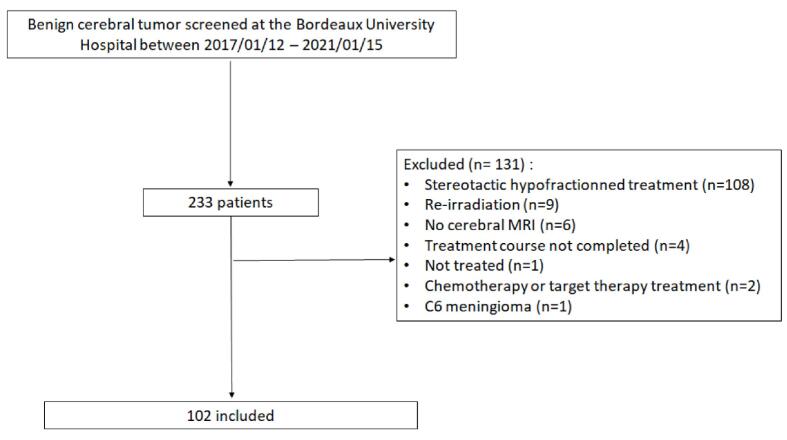
Details of consecutive patients treated for benign brain tumors at the Bordeaux University Hospital using normofractionated intensity modulated radiotherapy technique, without chemotherapy, were accessed. DVC delineation was performed on MRI T1 sequences with gadolinium injection using a reference atlas.
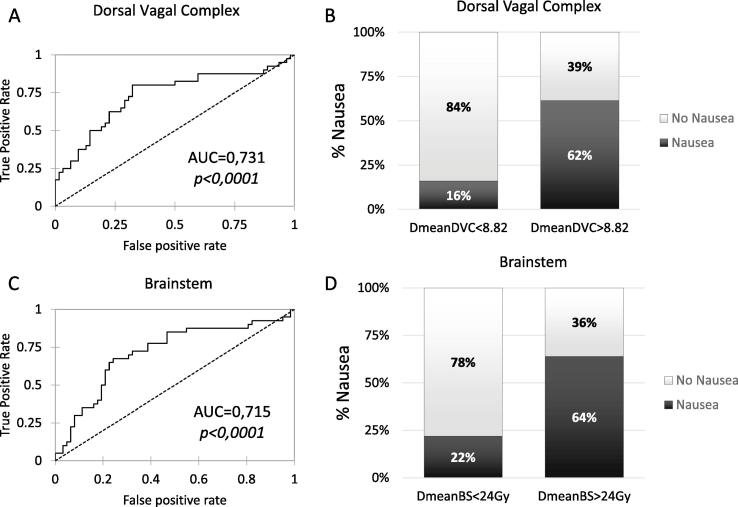
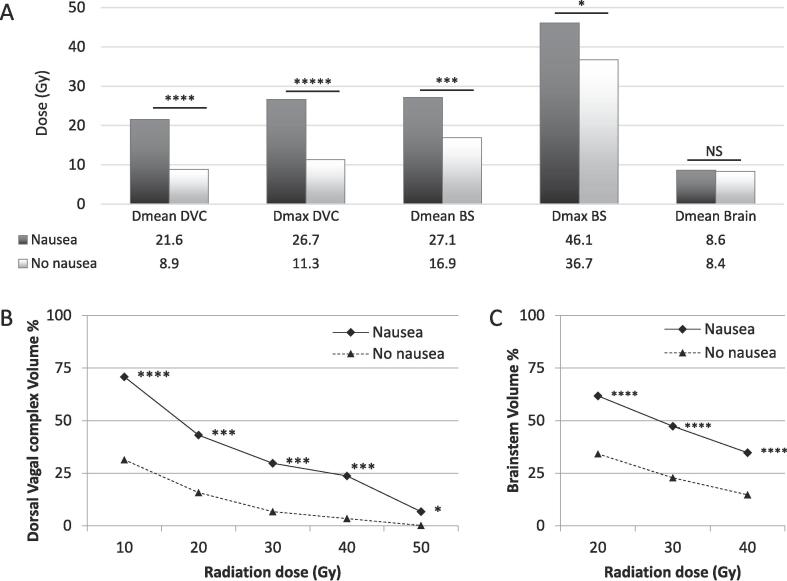
Among 102 patients, 68 were women, and median age was 61.5 years. The tumors treated were primarily meningiomas (80 %) and neurinomas (17 %). The median dose was 54 Gy [48.6-57.6 Gy]. In the overall population, 40 (39.2 %) had nausea, requiring anti-nausea treatment for 23 (57.5 %). Patients with nausea were significantly younger (45.5 versus 63.2 years, p = 0.014).For patients without and with nausea, the mean DVC dose was 8.9 Gy versus 21.6 Gy (p < 10), respectively, and the mean brainstem dose was 16.9 Gy versus 27.1 Gy (p < 10). The optimal threshold for mean DVC dose was 8.82 Gy (AUC = 0.731, p < 10). Patients with DVC receiving less than 8.82 Gy had a 16 % risk to have nausea versus 62 % for patients receiving more than 8.82 Gy (p < 10). The optimal threshold for mean brainstem dose was 24 Gy (AUC = 0.715p < 0.0001).
The mean DVC dose is significantly associated with radiation-induced nausea. A dose constraint below 8.82 Gy to decrease the incidence of radiation-induced nausea needs to be validated by a prospective study.
恶心是接受良性脑肿瘤放射治疗患者的常见症状。位于脑干的迷走神经背核复合体(DVC)已被确定为恶心和呕吐的中枢。我们研究的目的是确定DVC的平均剂量与恶心之间的关联。
获取了在波尔多大学医院使用常规分割调强放射治疗技术、未进行化疗治疗良性脑肿瘤的连续患者的详细信息。使用参考图谱在注射钆的MRI T1序列上进行DVC勾画。
102例患者中,68例为女性,中位年龄为61.5岁。所治疗的肿瘤主要为脑膜瘤(80%)和神经鞘瘤(17%)。中位剂量为54 Gy[48.6 - 57.6 Gy]。在总体人群中,40例(39.2%)出现恶心,其中23例(57.5%)需要进行抗恶心治疗。出现恶心的患者明显更年轻(45.5岁对63.2岁,p = 0.014)。对于未出现恶心和出现恶心的患者,DVC的平均剂量分别为8.9 Gy和21.6 Gy(p < 0.01),脑干的平均剂量分别为16.9 Gy和27.1 Gy(p < 0.01)。DVC平均剂量的最佳阈值为8.82 Gy(AUC = 0.731,p < 0.01)。接受DVC剂量低于8.82 Gy的患者出现恶心的风险为16%,而接受剂量高于8.82 Gy的患者出现恶心的风险为62%(p < 0.01)。脑干平均剂量的最佳阈值为24 Gy(AUC = 0.715,p < 0.0001)。
DVC的平均剂量与放射诱导的恶心显著相关。需要通过前瞻性研究验证低于8.82 Gy的剂量限制以降低放射诱导恶心的发生率。