Cutaneous Physiopathology and Integrated Center of Metabolomics Research, San Gallicano Dermatological Institute (IRCCS), 00144 Rome, Italy.
Cells. 2022 Sep 26;11(19):2999. doi: 10.3390/cells11192999.
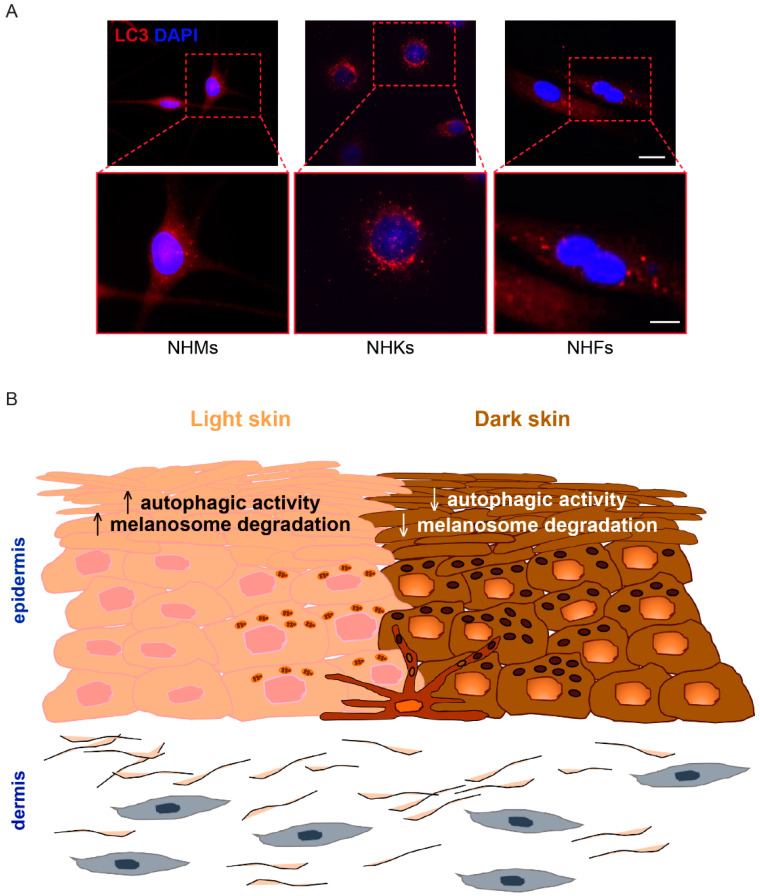
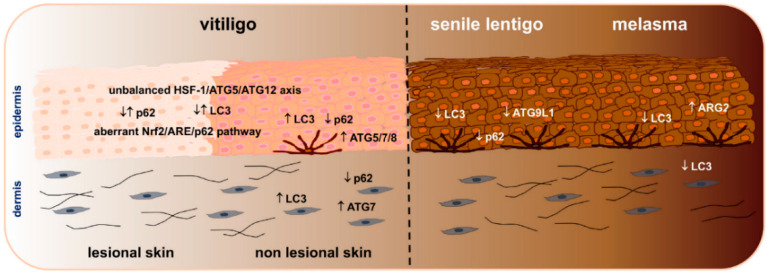
Autophagy is a vital process for cell survival and it preserves homeostasis by recycling or disassembling unnecessary or dysfunctional cellular constituents. Autophagy ameliorates skin integrity, regulating epidermal differentiation and constitutive pigmentation. It induces melanogenesis and contributes to skin color through melanosome turnover. Autophagy activity is involved in skin phenotypic plasticity and cell function maintenance and, if altered, it concurs to the onset and/or progression of hypopigmentary and hyperpigmentary disorders. Overexpression of autophagy exerts a protective role against the intrinsic metabolic stress occurring in vitiligo skin, while its dysfunction has been linked to the tuberous sclerosis complex hypopigmentation. Again, autophagy impairment reduces melanosome degradation by concurring to pigment accumulation characterizing senile lentigo and melasma. Here we provide an updated review that describes recent findings on the crucial role of autophagy in skin pigmentation, thus revealing the complex interplay among melanocyte biology, skin environment and autophagy. Hence, targeting this process may also represent a promising strategy for treating pigmentary disorders.
自噬是细胞存活的重要过程,它通过回收或分解不必要或功能失调的细胞成分来维持细胞内环境的稳定。自噬可以改善皮肤完整性,调节表皮分化和固有色素沉着。它通过黑素小体的周转诱导黑色素生成,并有助于肤色形成。自噬活性参与皮肤表型可塑性和细胞功能维持,如果发生改变,可能会导致色素减退和色素沉着过度疾病的发生和/或进展。自噬的过度表达对白癜风皮肤中发生的内在代谢应激具有保护作用,而其功能障碍与结节性硬化症的色素减退有关。同样,自噬功能障碍通过促进老年斑和黄褐斑的特征性色素沉着,减少黑素小体的降解。在这里,我们提供了一个最新的综述,描述了自噬在皮肤色素沉着中的关键作用的最新发现,从而揭示了黑素细胞生物学、皮肤环境和自噬之间的复杂相互作用。因此,靶向这一过程也可能是治疗色素沉着紊乱的一种有前途的策略。