Department of Emergency Medicine, Seoul National University Boramae Medical Center, Republic of Korea.
Department of Emergency Medicine, Seoul National University Hospital, Republic of Korea.
Am J Emerg Med. 2019 Feb;37(2):183-188. doi: 10.1016/j.ajem.2018.05.007. Epub 2018 May 10.
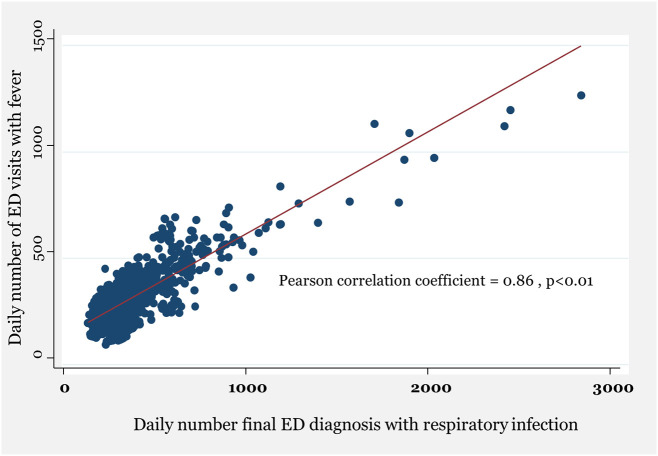
Monitoring and detecting sudden outbreaks of respiratory infectious disease is important. Emergency Department (ED)-based syndromic surveillance systems have been introduced for early detection of infectious outbreaks. The aim of this study was to develop and validate a forecasting model of respiratory infectious disease outbreaks based on a nationwide ED syndromic surveillance using daily number of emergency department visits with fever.
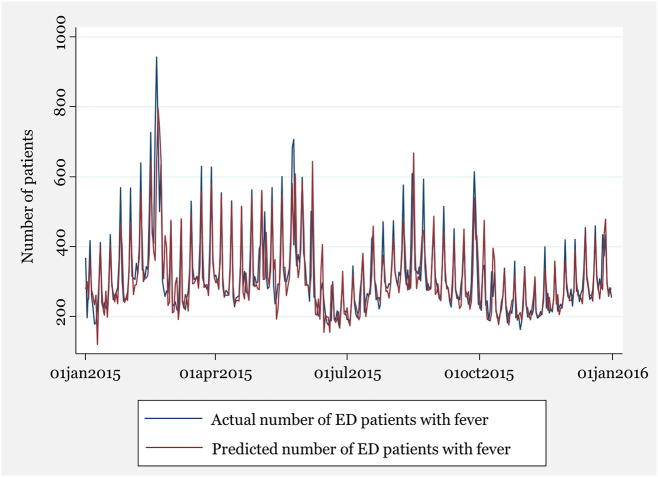
We measured the number of daily ED visits with body temperature ≥ 38.0 °C and daily number of patients diagnosed as respiratory illness by the ICD-10 codes from the National Emergency Department Information System (NEDIS) database of Seoul, Korea. We developed a forecast model according to the Autoregressive Integrated Moving Average (ARIMA) method using the NEDIS data from 2013 to 2014 and validated it using the data from 2015. We defined alarming criteria for extreme numbers of ED febrile visits that exceed the forecasted number. Finally, the predictive performance of the alarm generated by the forecast model was estimated.
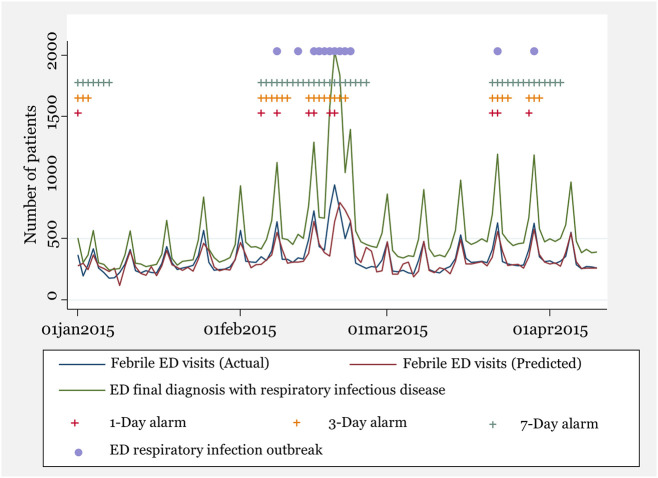
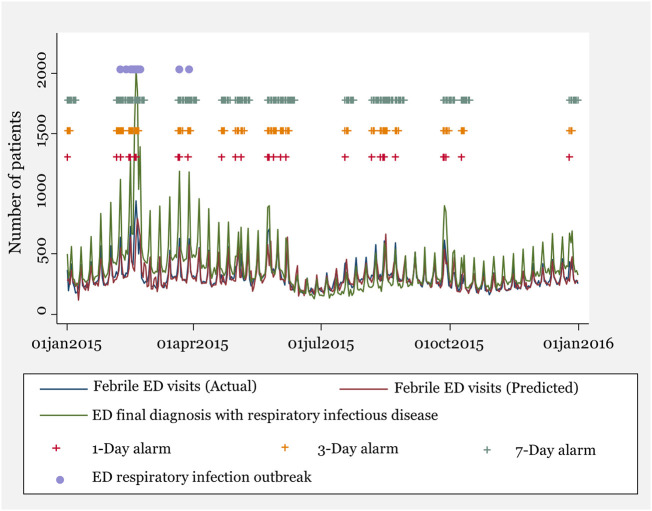
From 2013 to 2015, data of 4,080,766 ED visits were collected. 303,469 (7.4%) were ED visits with fever, and 388,943 patients (9.5%) were diagnosed with respiratory infectious disease. The ARIMA (7.0.7) model was the most suitable model for predicting febrile ED visits the next day. The number of patients with respiratory infectious disease spiked concurrently with the alarms generated by the forecast model.
A forecast model using syndromic surveillance based on the number of ED visits was feasible for early detection of ED respiratory infectious disease outbreak.
监测和发现呼吸道传染病的突然暴发很重要。基于急诊(ED)的症状监测系统已被引入,用于早期发现传染病暴发。本研究旨在开发和验证一种基于全国性 ED 症状监测的呼吸传染病暴发预测模型,该模型使用每日发热急诊就诊人数。
我们测量了韩国国家急诊信息系统(NEDIS)数据库中每日体温≥38.0°C 的急诊就诊人数和每日因 ICD-10 代码诊断为呼吸道疾病的患者人数。我们使用 NEDIS 2013 年至 2014 年的数据,根据自回归综合移动平均(ARIMA)方法开发了一个预测模型,并使用 2015 年的数据对其进行了验证。我们定义了急诊发热就诊人数超过预测数的极端值的报警标准。最后,评估了预测模型生成的警报的预测性能。
2013 年至 2015 年,共收集了 4080766 例急诊就诊数据。303469 例(7.4%)为发热急诊就诊,388943 例(9.5%)被诊断为呼吸道传染病。预测次日发热急诊就诊人数最适合的模型是 ARIMA(7.0.7)模型。呼吸道传染病患者数量与预测模型生成的警报同时激增。
使用基于急诊就诊人数的症状监测的预测模型可用于早期发现急诊呼吸道传染病暴发。