Laboratory of Pain and Signaling, Butantan Institute, São Paulo 05503-900, Brazil.
Center of Excellence in New Target Discovery (CENTD), Instituto Butantan, São Paulo 05503-900, Brazil.
Int J Mol Sci. 2022 Sep 30;23(19):11571. doi: 10.3390/ijms231911571.
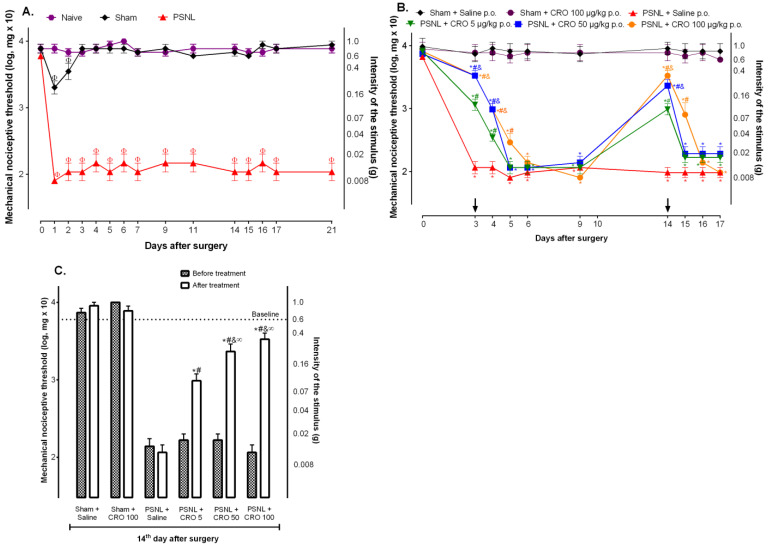
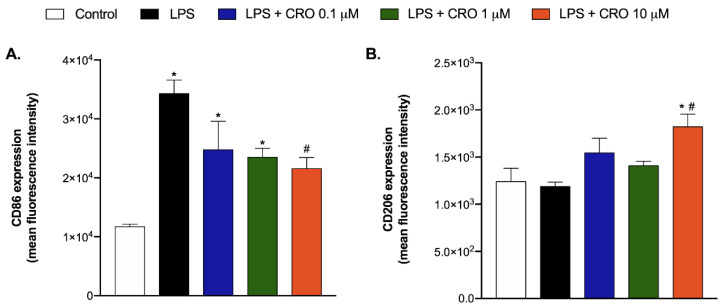
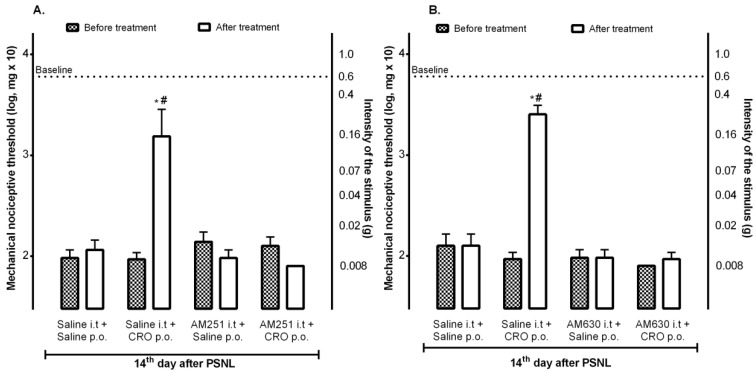
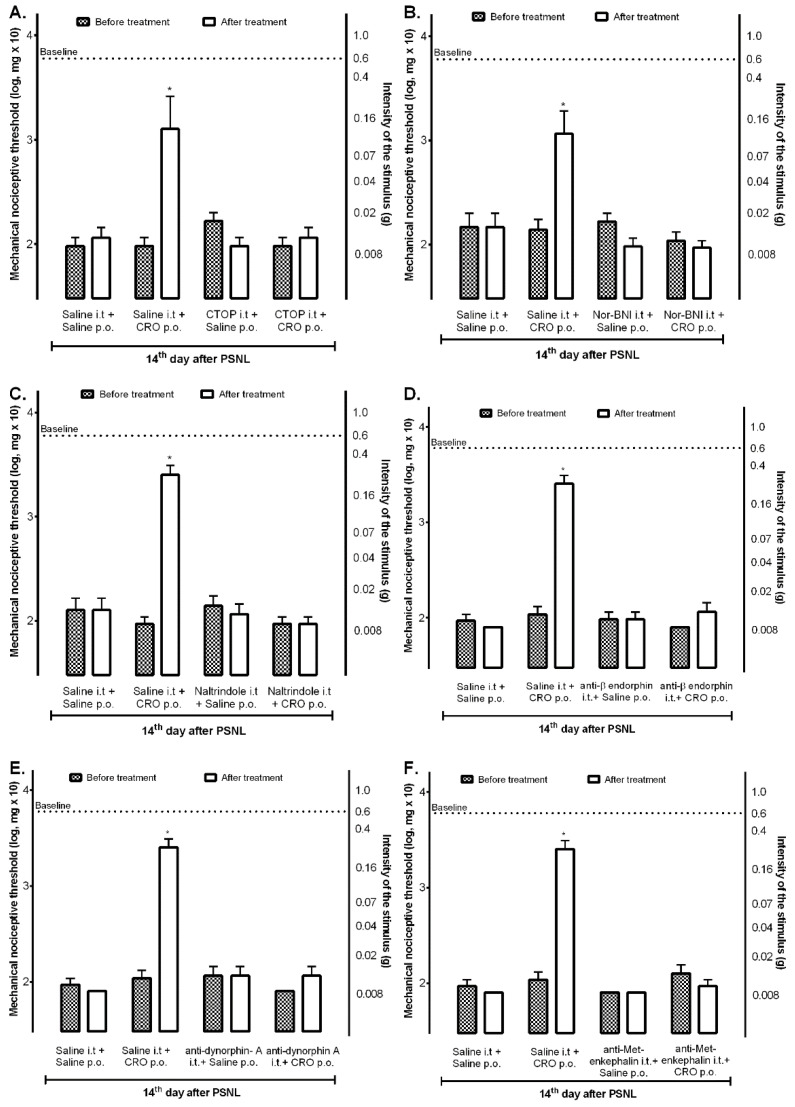
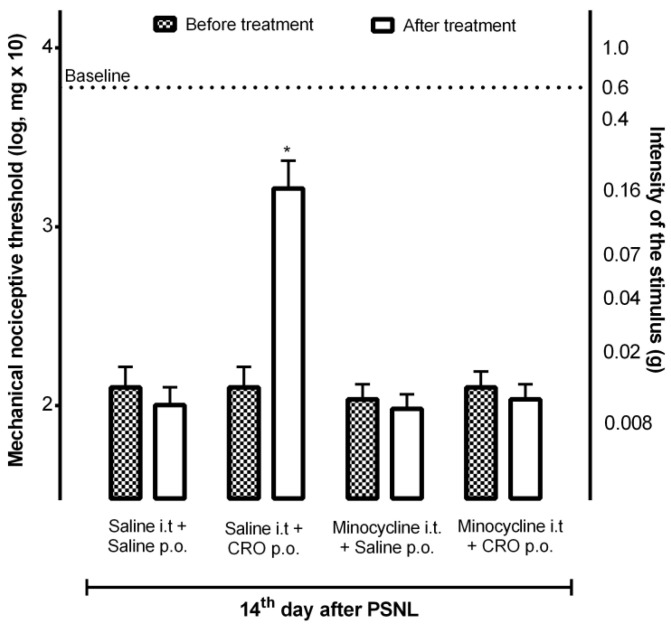
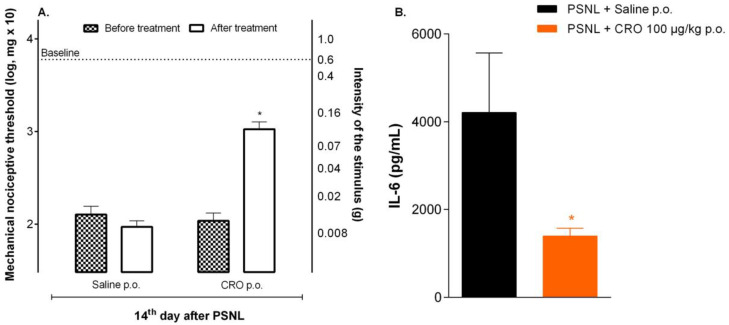
Pain is a worldwide public health problem and its treatment is still a challenge since clinically available drugs do not completely reverse chronic painful states or induce undesirable effects. Crotalphine is a 14 amino acids synthetic peptide that induces a potent and long-lasting analgesic effect on acute and chronic pain models, peripherally mediated by the endogenous release of dynorphin A and the desensitization of the transient receptor potential ankyrin 1 (TRPA1) receptor. However, the effects of crotalphine on the central nervous system (CNS) and the signaling pathway have not been investigated. Thus, the central effect of crotalphine was evaluated on the partial sciatic nerve ligation (PSNL)-induced chronic neuropathic pain model. Crotalphine (100 µg/kg, p.o.)-induced analgesia on the 14th day after surgery lasting up to 24 h after administration. This effect was prevented by intrathecal administration of CB1 (AM251) or CB2 (AM630) cannabinoid receptor antagonists. Besides that, crotalphine-induced analgesia was reversed by CTOP, nor-BNI, and naltrindole, antagonists of , , and -opioid receptors, respectively, and also by the specific antibodies for β-endorphin, dynorphin-A, and met-enkephalin. Likewise, the analgesic effect of crotalphine was blocked by the intrathecal administration of minocycline, an inhibitor of microglial activation and proliferation. Additionally, crotalphine decreased the PSNL-induced IL-6 release in the spinal cord. Importantly, in vitro, crotalphine inhibited LPS-induced CD86 expression and upregulated CD206 expression in BV-2 cells, demonstrating a polarization of microglial cells towards the M2 phenotype. These results demonstrated that crotalphine, besides activating opioid and cannabinoid analgesic systems, impairs central neuroinflammation, confirming the neuromodulatory mechanism involved in the crotalphine analgesic effect.
疼痛是一个全球性的公共卫生问题,其治疗仍然是一个挑战,因为临床上可用的药物不能完全逆转慢性疼痛状态或引起不良影响。Crotalphine 是一种由 14 个氨基酸组成的合成肽,它在外周通过内源性释放强啡肽 A 和瞬时受体电位锚蛋白 1(TRPA1)受体脱敏,对急性和慢性疼痛模型产生强大而持久的镇痛作用。然而,Crotalphine 对中枢神经系统(CNS)和信号通路的影响尚未得到研究。因此,评估了 Crotalphine 在坐骨神经部分结扎(PSNL)诱导的慢性神经病理性疼痛模型中的中枢作用。Crotalphine(100μg/kg,po)在手术后第 14 天给药,镇痛作用可持续 24 小时。这种作用被鞘内给予 CB1(AM251)或 CB2(AM630)大麻素受体拮抗剂所阻止。此外,Crotalphine 诱导的镇痛作用被 CTOP、nor-BNI 和 naltrindole 逆转,它们分别是 μ、δ 和 κ 阿片受体的拮抗剂,也被 β-内啡肽、强啡肽-A 和甲硫氨酸-脑啡肽的特异性抗体逆转。同样,鞘内给予米诺环素,一种小胶质细胞激活和增殖的抑制剂,也阻断了 Crotalphine 的镇痛作用。此外,Crotalphine 降低了脊髓中 PSNL 诱导的 IL-6 释放。重要的是,在体外,Crotalphine 抑制了 LPS 诱导的 BV-2 细胞中 CD86 的表达,并上调了 CD206 的表达,表明小胶质细胞向 M2 表型极化。这些结果表明,Crotalphine 除了激活阿片类和大麻素镇痛系统外,还损害中枢神经炎症,证实了 Crotalphine 镇痛作用涉及的神经调节机制。