Faculty of Life Science and Technology, Kunming University of Science and Technology, Kunming 650500, China.
School of Chemical, Biological and Environmental Sciences, Yuxi Normal University, Yuxi 653100, China.
Molecules. 2022 Oct 5;27(19):6615. doi: 10.3390/molecules27196615.
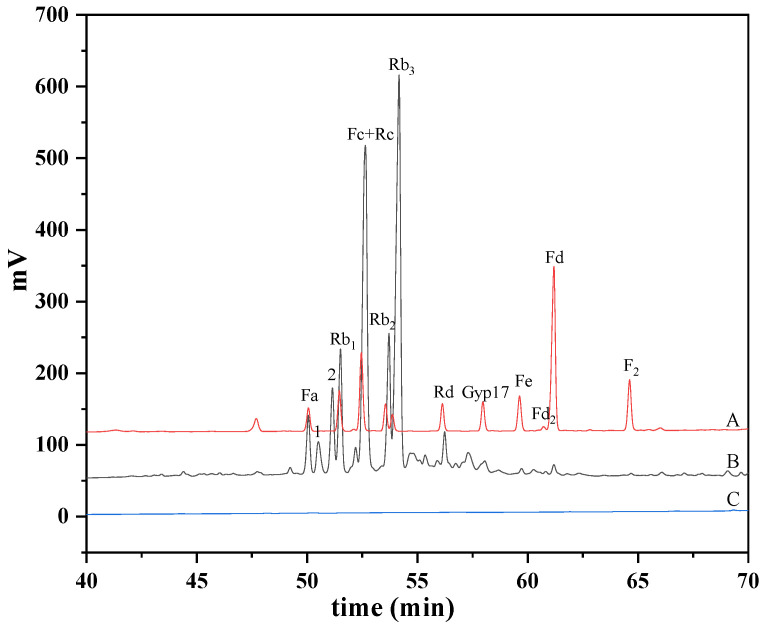
flowers have the highest content of saponins compared to the other parts of , but minor ginsenosides have higher pharmacological activity than the main natural ginsenosides. Therefore, this study focused on the transformation of the main ginsenosides in flowers to minor ginsenosides using the fungus of isolated from soil. The main ginsenosides Rb, Rb, Rb, and Rc and the notoginsenoside Fa in flowers were transformed into the ginsenosides F and Rd, the notoginsenosides Fd and Fe, and the ginsenoside R; the conversion rates were 100, 100, 100, 88.5, and 100%, respectively. The transformation products were studied by TLC, HPLC, and MS analyses, and the biotransformation pathways of the major ginsenosides were proposed. In addition, the purified enzyme of the fungus was prepared with the molecular weight of 66.4 kDa. The transformation of the monomer ginsenosides by the crude enzyme is consistent with that by the fungus. Additionally, three saponins were isolated from the transformation products and identified as the ginsenoside Rd and the notoginsenosides Fe and Fd by NMR and MS analyses. This study provided a unique and powerful microbial strain for efficiently transformating major ginsenosides in flowers to minor ginsenosides, which will help raise the functional and economic value of the flower.
与其他部位相比,花中的总皂苷含量最高,但某些次要人参皂苷的药理活性高于主要天然人参皂苷。因此,本研究集中于使用从土壤中分离的真菌来将花中的主要人参皂苷转化为次要人参皂苷。从花中分离的真菌可将主要人参皂苷 Rb、Rb、Rb 和 Rc 以及拟人参皂苷 Fa 转化为人参皂苷 F 和 Rd、拟人参皂苷 Fd 和 Fe 以及人参皂苷 R,转化率分别为 100%、100%、100%、88.5%和 100%。通过 TLC、HPLC 和 MS 分析研究了转化产物,并提出了主要人参皂苷的生物转化途径。此外,还使用该真菌制备了分子量为 66.4 kDa 的纯化酶。粗酶对单体人参皂苷的转化与真菌一致。此外,从转化产物中分离出三种皂苷,并通过 NMR 和 MS 分析鉴定为人参皂苷 Rd 和拟人参皂苷 Fe 和 Fd。本研究为有效将花中的主要人参皂苷转化为次要人参皂苷提供了独特且功能强大的微生物菌株,这将有助于提高花的功能和经济价值。