Department of Graduate School, Tianjin University of Traditional Chinese Medicine, Tianjin, China.
Department of Emergency, Tianjin Chest Hospital, Tianjin, China.
Front Endocrinol (Lausanne). 2022 Sep 27;13:940633. doi: 10.3389/fendo.2022.940633. eCollection 2022.
Previous studies on the association between thyroid function and carotid plaque have shown contradictory results, which may be attributable to the sensitivity to thyroid hormone indices. This study aimed to analyze the association between thyroid hormone sensitivity and risk of carotid plaque in patients with coronary heart disease (CHD) and further explore this association according to sex, age, smoking, and drinking status.
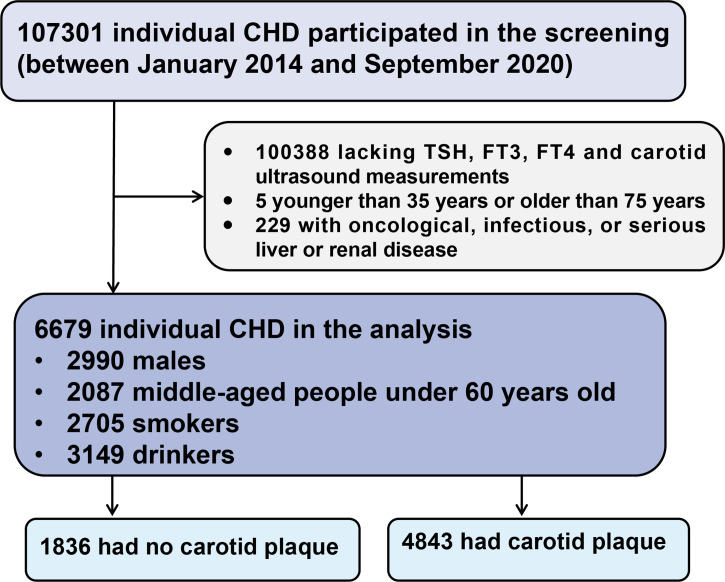
This large-scale, multi-center, retrospective, cross-sectional study included 6679 patients with CHD (age 35-75). Central sensitivity to thyroid hormone was evaluated by the thyroid feedback quantile-based index (TFQI), parametric thyroid feedback quantile-based index (PTFQI), thyroid-stimulating hormone index (TSHI), and thyrotroph thyroxine resistance index (TT4RI). Peripheral sensitivity to thyroid hormone was assessed by free triiodothyronine/free thyroxine (FT3/FT4) ratio. Taking no carotid plaque as a reference, this study used logistic regression to analyze the association between central and peripheral thyroid hormone sensitivity and carotid plaque in patients with CHD.
Of the 6679 patients with CHD, 4843 (72.50%) had carotid plaque. In the multi-adjusted models, the TFQI (odds ratio [OR]: 1.50; 95% confidence interval [CI]: 1.26-1.78; < 0.001), PTFQI (OR: 1.76; 95% CI: 1.46-2.12; < 0.001), TSHI (OR: 1.21; 95% CI: 1.10-1.33; < 0.001), and TT4RI (OR: 1.00; 95% CI: 1.00-1.01; = 0.003) were positively associated with the risk of carotid plaque. Compared with that in females and people > 60 years, the OR value for carotid plaque was higher in males and people ≤ 60 years. Similarly, smokers and drinkers had higher OR values for carotid plaque than non-smokers and non-drinkers. Conversely, FT3/FT4 ratio (OR: 0.75; 95% CI: 0.70-0.81; < 0.001) was negatively associated with carotid plaque, and the OR value for carotid plaque was lower in males, patients ≤ 60 years, smokers, and drinkers.
This study showed that thyroid hormone sensitivity is significantly associated with carotid plaque in patients with CHD. This association is more significant in males, patients ≤ 60 years, smokers, and drinkers.
先前关于甲状腺功能与颈动脉斑块之间关系的研究结果相互矛盾,这可能与甲状腺激素指标的敏感性有关。本研究旨在分析甲状腺激素敏感性与冠心病(CHD)患者颈动脉斑块风险之间的关系,并进一步根据性别、年龄、吸烟和饮酒状况探讨这种关系。
这是一项大规模、多中心、回顾性、横断面研究,共纳入 6679 例 CHD 患者(年龄 35-75 岁)。通过甲状腺反馈定量指数(TFQI)、参数甲状腺反馈定量指数(PTFQI)、促甲状腺激素指数(TSHI)和甲状腺刺激素甲状腺素抵抗指数(TT4RI)评估甲状腺激素的中枢敏感性。通过游离三碘甲状腺原氨酸/游离甲状腺素(FT3/FT4)比值评估甲状腺激素的外周敏感性。以无颈动脉斑块为参考,本研究采用 logistic 回归分析 CHD 患者中心和外周甲状腺激素敏感性与颈动脉斑块之间的关系。
在 6679 例 CHD 患者中,4843 例(72.50%)存在颈动脉斑块。在多因素调整模型中,TFQI(比值比[OR]:1.50;95%置信区间[CI]:1.26-1.78;<0.001)、PTFQI(OR:1.76;95%CI:1.46-2.12;<0.001)、TSHI(OR:1.21;95%CI:1.10-1.33;<0.001)和 TT4RI(OR:1.00;95%CI:1.00-1.01;=0.003)与颈动脉斑块风险呈正相关。与女性和年龄>60 岁者相比,男性和年龄≤60 岁者的颈动脉斑块 OR 值更高。同样,吸烟者和饮酒者的颈动脉斑块 OR 值高于不吸烟者和不饮酒者。相反,FT3/FT4 比值(OR:0.75;95%CI:0.70-0.81;<0.001)与颈动脉斑块呈负相关,且颈动脉斑块的 OR 值在男性、年龄≤60 岁、吸烟者和饮酒者中较低。
本研究表明,甲状腺激素敏感性与 CHD 患者的颈动脉斑块显著相关。这种关联在男性、年龄≤60 岁、吸烟者和饮酒者中更为显著。