Li Zeshi, Zhang He, Baraghtha Sulaiman, Mu Jiabao, Matniyaz Yusanjan, Jiang Xinyi, Wang Kuo, Wang Dongjin, Xue Yun Xing
Department of Cardio-Thoracic Surgery, Nanjing Drum Tower Hospital, Peking Union Medical College & Chinese Academy of Medical Sciences, Graduate School of Peking Union Medical College, Nanjing, People's Republic of China.
Department of Cardio-Thoracic Surgery, Nanjing Drum Tower Hospital, The Affiliated Hospital of Nanjing University Medical School, Nanjing, People's Republic of China.
J Inflamm Res. 2022 Oct 10;15:5785-5799. doi: 10.2147/JIR.S382573. eCollection 2022.
The postoperative survival of patients with acute type A aortic dissection (aTAAD) remains unsatisfactory. The current study developed an easy-to-use survival prediction model and calculator.
A total of 496 patients with aTAAD undergoing surgical repair were included in this study. The systemic immune-inflammation index (SII) and other clinical features were collected and subjected to logistic and Cox regression analyses. The survival prediction model was based on Cox regression analyses and exhibited as a nomogram. For convenience of use, the nomogram was further developed into calculator software.
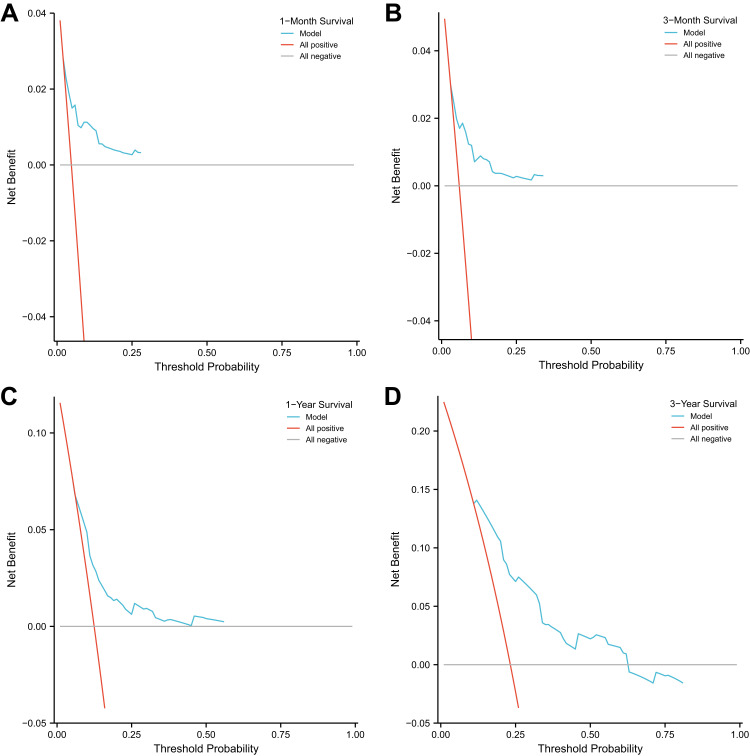
We demonstrated that a higher preoperative SII was associated with in-hospital death (OR: 4.116, p < 0.001) and a higher postoperative overall survival rate (HR: 2.467, p < 0.001) in aTAAD patients undergoing surgical repair. A survival prediction model and calculator based on SII and four other clinical features were developed. The overall C-index of the model was 0.743. The areas under the curves (AUCs) of the 1- and 3-month and 1- and 3-year survival probabilities were 0.73, 0.71, 0.71 and 0.72, respectively. The model also showed good calibration and clinical utility.
Preoperative SII is significantly associated with postoperative survival. Based on SII and other clinical features, we created the first easy-to-use prediction model and calculator for predicting the postoperative survival rate in aTAAD patients, which showed good prediction performance.
急性A型主动脉夹层(aTAAD)患者术后生存率仍不尽人意。本研究开发了一种易于使用的生存预测模型和计算器。
本研究纳入了496例行手术修复的aTAAD患者。收集全身免疫炎症指数(SII)和其他临床特征,并进行逻辑回归和Cox回归分析。生存预测模型基于Cox回归分析,并以列线图形式呈现。为方便使用,将列线图进一步开发为计算器软件。
我们证明,术前较高的SII与接受手术修复的aTAAD患者的院内死亡(OR:4.116,p<0.001)和较高的术后总生存率(HR:2.467,p<0.001)相关。基于SII和其他四个临床特征开发了生存预测模型和计算器。该模型的总体C指数为0.743。1个月和3个月以及1年和3年生存概率的曲线下面积(AUC)分别为0.73、0.71、0.71和0.72。该模型还显示出良好的校准和临床实用性。
术前SII与术后生存率显著相关。基于SII和其他临床特征,我们创建了首个易于使用的预测模型和计算器,用于预测aTAAD患者的术后生存率,其显示出良好的预测性能。