Max Planck Research Group NeuroCode, Max Planck Institute for Human Development, Berlin, Germany; International Max Planck Research School on the Life Course, Max Planck Institute for Human Development, Berlin, Germany.
Faculty of Psychology, Chair of Lifespan Developmental Neuroscience, Technische Universität Dresden, Dresden, Germany.
Neuroimage. 2022 Dec 1;264:119670. doi: 10.1016/j.neuroimage.2022.119670. Epub 2022 Oct 13.
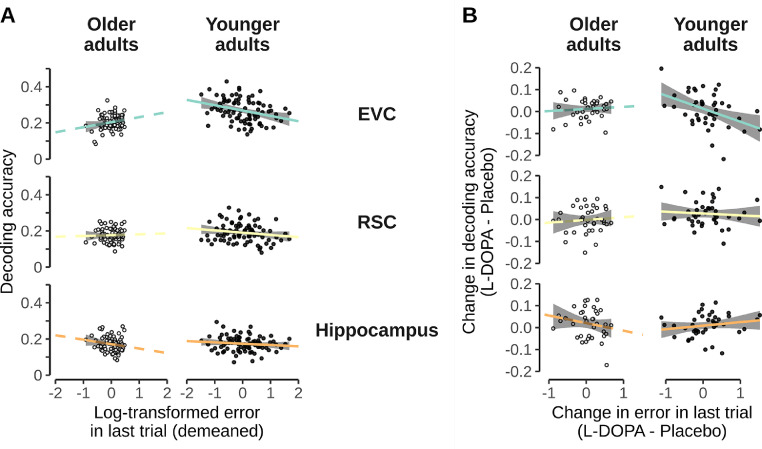
Previous studies indicate a role of dopamine in spatial navigation. Although neural representations of direction are an important aspect of spatial cognition, it is not well understood whether dopamine directly affects these representations, or only impacts other aspects of spatial brain function. Moreover, both dopamine and spatial cognition decline sharply during age, raising the question which effect dopamine has on directional signals in the brain of older adults. To investigate these questions, we used a double-blind cross-over L-DOPA/Placebo intervention design in which 43 younger and 37 older adults navigated in a virtual spatial environment while undergoing functional magnetic resonance imaging (fMRI). We studied the effect of L-DOPA, a dopamine precursor, on fMRI activation patterns that encode spatial walking directions that have previously been shown to lose specificity with age. This was done in predefined regions of interest, including the early visual cortex, retrosplenial cortex, and hippocampus. Classification of brain activation patterns associated with different walking directions was improved across all regions following L-DOPA administration, suggesting that dopamine broadly enhances neural representations of direction. No evidence for differences between regions was found. In the hippocampus these results were found in both age groups, while in the retrosplenial cortex they were only observed in younger adults. Taken together, our study provides evidence for a link between dopamine and the specificity of neural responses during spatial navigation. SIGNIFICANCE STATEMENT: The sense of direction is an important aspect of spatial navigation, and neural representations of direction can be found throughout a large network of space-related brain regions. But what influences how well these representations track someone's true direction? Using a double-blind cross-over L-DOPA/Placebo intervention design, we find causal evidence that the neurotransmitter dopamine impacts the fidelity of direction selective neural representations in the human hippocampus and retrosplenial cortex. Interestingly, the effect of L-DOPA was either equally present or even smaller in older adults, despite the well-known age related decline of dopamine. These results provide novel insights into how dopamine shapes the neural representations that underlie spatial navigation.
先前的研究表明多巴胺在空间导航中起着重要作用。尽管方向的神经表示是空间认知的一个重要方面,但尚不清楚多巴胺是否直接影响这些表示,或者仅影响空间大脑功能的其他方面。此外,多巴胺和空间认知都在年龄增长期间急剧下降,这就提出了一个问题,即多巴胺对老年人大脑中的方向信号有何影响。为了研究这些问题,我们使用了一种双盲交叉 L-DOPA/安慰剂干预设计,其中 43 名年轻成年人和 37 名年长成年人在进行功能磁共振成像 (fMRI) 的同时在虚拟空间环境中导航。我们研究了多巴胺前体 L-DOPA 对先前显示随年龄特异性丧失的空间行走方向的 fMRI 激活模式的影响。这是在包括早期视觉皮层、后扣带回皮层和海马体在内的预定义感兴趣区域中完成的。在 L-DOPA 给药后,所有区域的大脑激活模式分类都得到了改善,表明多巴胺广泛增强了方向的神经表示。没有发现区域之间存在差异的证据。在海马体中,这些结果在两个年龄组中均得到了发现,而在后扣带皮层中,仅在年轻成年人中观察到。总之,我们的研究为多巴胺与空间导航过程中神经反应的特异性之间的联系提供了证据。 意义声明:方向感是空间导航的一个重要方面,方向的神经表示可以在与空间相关的大脑区域网络中找到。但是,是什么影响了这些表示如何准确地跟踪一个人的真实方向呢?使用双盲交叉 L-DOPA/安慰剂干预设计,我们找到了因果证据,表明神经递质多巴胺会影响人类海马体和后扣带皮层中方向选择性神经表示的保真度。有趣的是,尽管多巴胺与年龄相关的下降是众所周知的,但 L-DOPA 的作用在老年人中要么同样存在,要么甚至更小。这些结果为多巴胺如何塑造基础空间导航的神经表示提供了新的见解。