School of Economics and Business Administration, Chongqing University, Chongqing, 400044, China.
Center for Psychiatric Neuroscience, Feinstein Institute for Medical Research, Hempstead, NY, USA.
Transl Psychiatry. 2022 Oct 16;12(1):448. doi: 10.1038/s41398-022-02201-8.
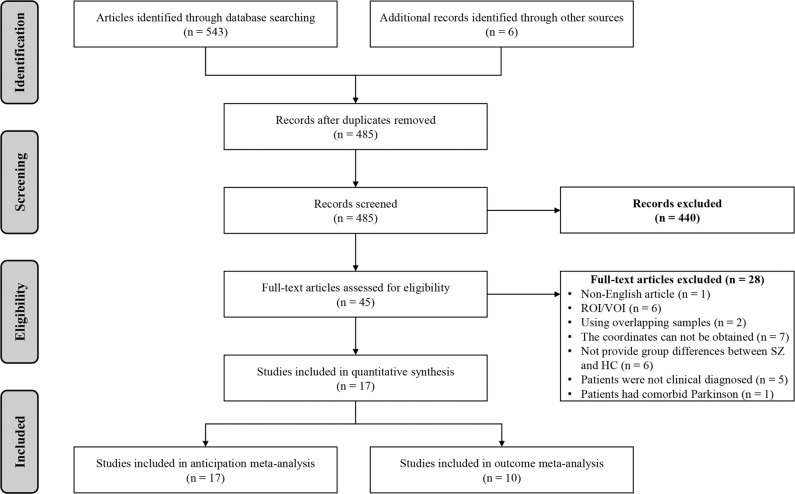
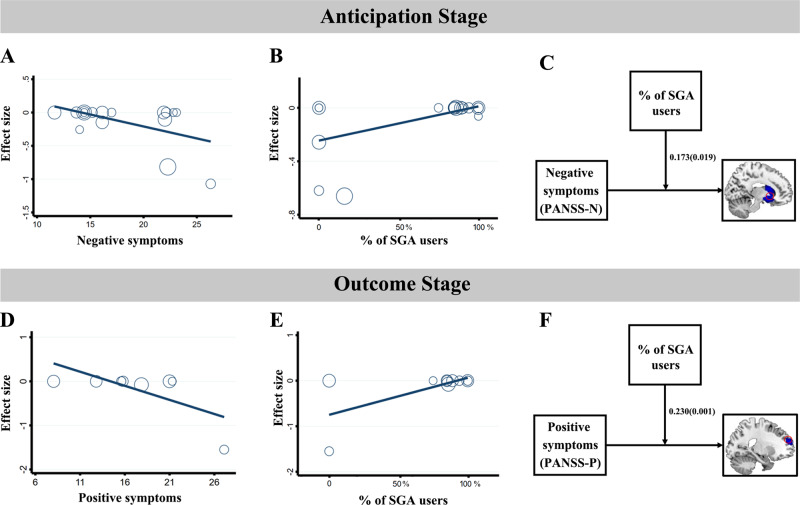
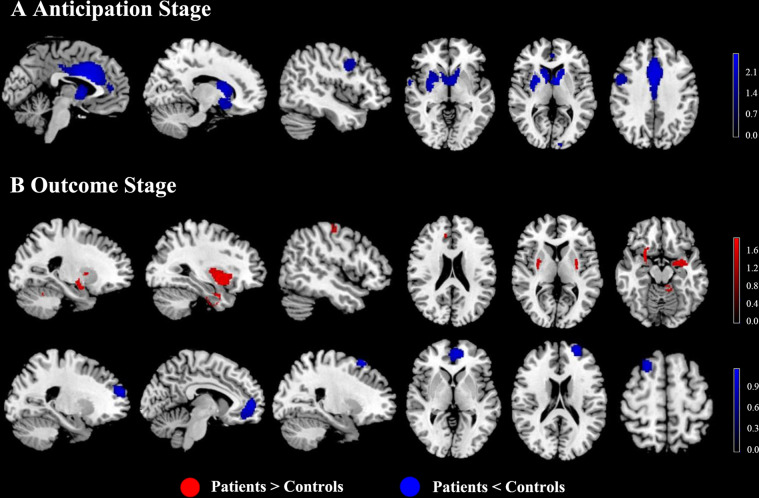
Dysfunction of the mesocorticolimbic dopaminergic reward system is a core feature of schizophrenia (SZ), yet its precise contributions to different stages of reward processing and their relevance to disease symptomology are not fully understood. We performed a coordinate-based meta-analysis, using the monetary incentive delay task, to identify which brain regions are implicated in different reward phases in functional magnetic resonance imaging in SZ. A total of 17 studies (368 SZ and 428 controls) were included in the reward anticipation, and 10 studies (229 SZ and 281 controls) were included in the reward outcome. Our meta-analysis revealed that during anticipation, patients showed hypoactivation in the striatum, anterior cingulate cortex, median cingulate cortex (MCC), amygdala, precentral gyrus, and superior temporal gyrus compared with controls. Striatum hypoactivation was negatively associated with negative symptoms and positively associated with the proportion of second-generation antipsychotic users (percentage of SGA users). During outcome, patients displayed hyperactivation in the striatum, insula, amygdala, hippocampus, parahippocampal gyrus, cerebellum, postcentral gyrus, and MCC, and hypoactivation in the dorsolateral prefrontal cortex (DLPFC) and medial prefrontal cortex (mPFC). Hypoactivity of mPFC during outcome was negatively associated with positive symptoms. Moderator analysis showed that the percentage of SGA users was a significant moderator of the association between symptom severity and brain activity in both the anticipation and outcome stages. Our findings identified the neural substrates for different reward phases in SZ and may help explain the neuropathological mechanisms underlying reward processing deficits in the disorder.
中脑边缘多巴胺奖赏系统功能障碍是精神分裂症(SZ)的核心特征,但它对不同阶段的奖赏处理的具体贡献及其与疾病症状的相关性尚不完全清楚。我们使用货币奖励延迟任务进行了基于坐标的荟萃分析,以确定在 SZ 的功能磁共振成像中哪些大脑区域与不同的奖赏阶段有关。共有 17 项研究(368 名 SZ 和 428 名对照)纳入了奖赏预期分析,10 项研究(229 名 SZ 和 281 名对照)纳入了奖赏结果分析。我们的荟萃分析表明,在预期阶段,与对照组相比,患者的纹状体、前扣带回皮层、中央扣带回(MCC)、杏仁核、中央前回和颞上回活动减少。纹状体活动减少与阴性症状呈负相关,与第二代抗精神病药物使用者的比例(第二代抗精神病药物使用者的比例)呈正相关。在结果阶段,患者的纹状体、岛叶、杏仁核、海马体、海马旁回、小脑、中央后回和 MCC 过度活跃,而背外侧前额叶皮层(DLPFC)和内侧前额叶皮层(mPFC)活动减少。结果阶段 mPFC 的活动减少与阳性症状呈负相关。调节分析表明,第二代抗精神病药物使用者的比例是预期和结果阶段症状严重程度与大脑活动之间关联的一个显著调节因素。我们的研究结果确定了 SZ 不同奖赏阶段的神经基础,可能有助于解释该障碍中奖赏处理缺陷的神经病理学机制。