Psychiatric Imaging Group, MRC London Institute of Medical Sciences, Hammersmith Hospital, Imperial College London, London, UK; Psychiatric Imaging Group, Institute of Clinical Sciences (ICS), Faculty of Medicine, Imperial College London, London, UK; Department of Psychosis, Institute of Psychiatry, Psychology and Neuroscience, Kings College London, UK.
Psychiatric Imaging Group, MRC London Institute of Medical Sciences, Hammersmith Hospital, Imperial College London, London, UK; Psychiatric Imaging Group, Institute of Clinical Sciences (ICS), Faculty of Medicine, Imperial College London, London, UK; Department of Psychosis, Institute of Psychiatry, Psychology and Neuroscience, Kings College London, UK; Department of Radiology, Addenbrooke's Hospital, Cambridge University Hospital NHS Foundation Trust, Cambridge, UK; Department of Radiology, University of Cambridge, Cambridge, UK.
Neuroimage Clin. 2023;39:103481. doi: 10.1016/j.nicl.2023.103481. Epub 2023 Jul 24.
Reward processing deficits are a core feature of schizophrenia and are thought to underlie negative symptoms. Pre-clinical evidence suggests that opioid neurotransmission is linked to reward processing. However, the contribution of Mu Opioid Receptor (MOR) signalling to the reward processing abnormalities in schizophrenia is unknown. Here, we examined the association between MOR availability and the neural processes underlying reward anticipation in patients with schizophrenia using multimodal neuroimaging.
37 subjects (18 with Schizophrenia with moderate severity negative symptoms and 19 age and sex-matched healthy controls) underwent a functional MRI scan while performing the Monetary Incentive Delay (MID) task to measure the neural response to reward anticipation. Participants also had a [C]-carfentanil PET scan to measure MOR availability.
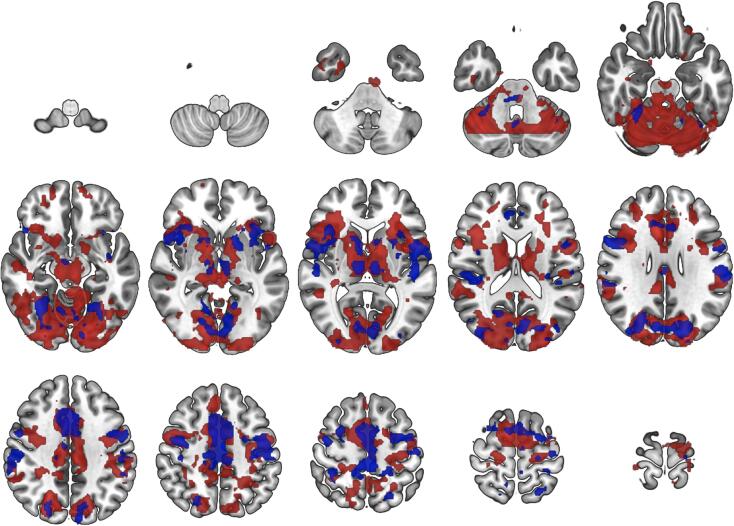
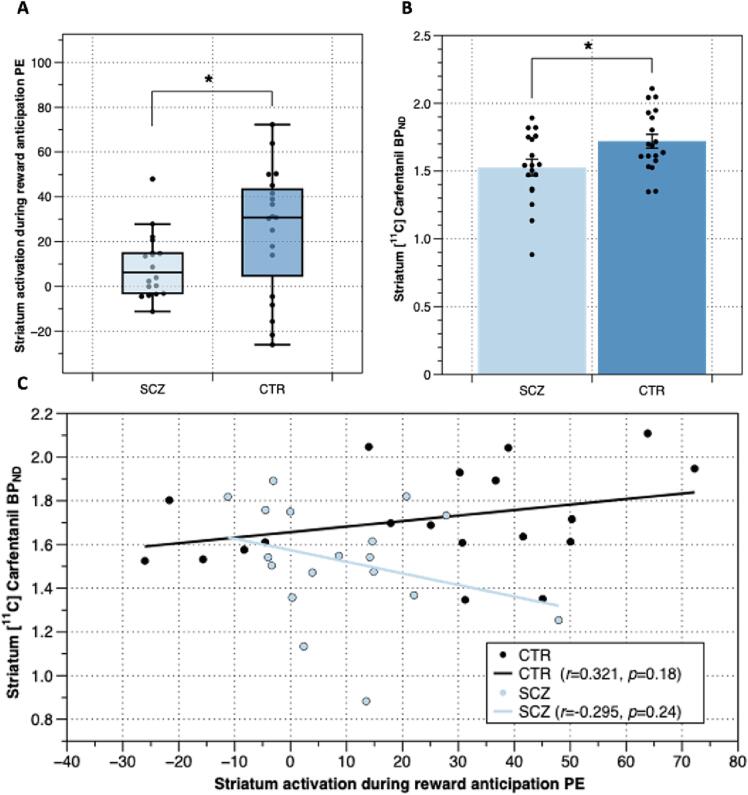
Reward anticipation was associated with increased neural activation in a widespread network of brain regions including the striatum. Patients with schizophrenia had both significantly lower MOR availability in the striatum as well as striatal hypoactivation during reward anticipation. However, there was no association between MOR availability and striatal neural activity during reward anticipation in either patient or controls (Pearson's Correlation, controls df = 17, r = 0.321, p = 0.18, patients df = 16, r = 0.295, p = 0.24). There was no association between anticipation-related neural activation and negative symptoms (r = -0.120, p = 0.14) or anhedonia severity (social r = -0.365, p = 0.14 physical r = -0.120, p = 0.63).
Our data suggest reduced MOR availability in schizophrenia might not underlie striatal hypoactivation during reward anticipation in patients with established illness. Therefore, other mechanisms, such as dopamine dysfunction, warrant further investigation as treatment targets for this aspect of the disorder.
奖赏处理缺陷是精神分裂症的核心特征,被认为是阴性症状的基础。临床前证据表明,阿片类神经递质与奖赏处理有关。然而,Mu 阿片受体(MOR)信号对精神分裂症奖赏处理异常的贡献尚不清楚。在这里,我们使用多模态神经影像学检查,研究了 MOR 可用性与精神分裂症患者奖赏预期相关的神经过程之间的关系。
37 名受试者(18 名中重度阴性症状的精神分裂症患者和 19 名年龄和性别匹配的健康对照者)在进行货币奖励延迟(MID)任务时进行功能磁共振扫描,以测量对奖励预期的神经反应。参与者还进行了 [C]-carfentanil PET 扫描以测量 MOR 可用性。
奖赏预期与大脑区域的广泛网络中的神经激活增加有关,包括纹状体。精神分裂症患者的纹状体中 MOR 可用性明显降低,并且在奖赏预期期间纹状体的激活减少。然而,无论是在患者还是在对照组中,MOR 可用性与奖赏预期期间的纹状体神经活动之间均无关联(Pearson 相关性,对照组 df=17,r=0.321,p=0.18,患者 df=16,r=0.295,p=0.24)。预期相关的神经激活与阴性症状(r=-0.120,p=0.14)或快感缺失严重程度(社会 r=-0.365,p=0.14,身体 r=-0.120,p=0.63)均无关联。
我们的数据表明,精神分裂症中 MOR 可用性降低可能不是患者疾病稳定期间奖赏预期期间纹状体激活减少的原因。因此,其他机制,如多巴胺功能障碍,作为该疾病方面的治疗靶点值得进一步研究。