Scott Ian C, Whittle Rebecca, Bailey James, Twohig Helen, Hider Samantha L, Mallen Christian D, Muller Sara, Jordan Kelvin P
Primary Care Centre Versus Arthritis, School of Medicine, Keele University, Keele, UK.
Haywood Academic Rheumatology Centre, Haywood Hospital, Midlands Partnership NHS Foundation Trust, High Lane, Burslem, Staffordshire, UK.
Lancet Reg Health Eur. 2022 Oct 10;23:100519. doi: 10.1016/j.lanepe.2022.100519. eCollection 2022 Dec.
Contemporary data on rheumatoid arthritis (RA), psoriatic arthritis (PsA) and axial spondyloarthritits (SpA) epidemiology in England are lacking. This knowledge is crucial to planning healthcare services. We updated algorithms defining patients with diagnoses of RA, PsA, and axial SpA in primary care and applied them to describe their incidence and prevalence in the Clinical Practice Research Datalink Aurum, an electronic health record (EHR) database covering ∼20% of England.
Algorithms for ascertaining patients with RA, axial SpA, and PsA diagnoses validated in primary care EHR databases using Read codes were updated (to account for the English NHS change to SNOMED CT diagnosis coding) and applied. Updated diagnosis and synthetic disease-modifying anti-rheumatic drug code lists were devised by rheumatologists and general practitioners. Annual incidence/point-prevalence of RA, PsA, and axial SpA diagnoses were calculated from 2004 to 2020 and stratified by age/sex.
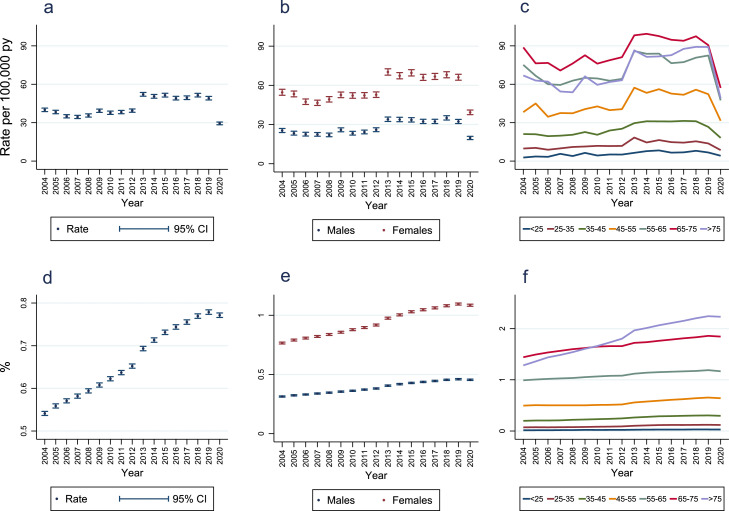
Point-prevalence of RA/PsA diagnoses increased annually, peaking in 2019 (RA 0·779% [95% confidence interval (CI) 0·773, 0·784]; PsA 0·287% [95% CI 0·284, 0·291]) then falling slightly. Point-prevalence of axial SpA diagnoses increased annually (except in 2018/2019), peaking in 2020 (0·113% [95% CI 0·111, 0·115]). RA diagnosis annual incidence was higher between 2013-2019 (after inclusion in the Quality and Outcomes Framework, range 49·1 [95% CI 47·7, 50·5] to 52·1 [95% CI 50·6, 53·6]/100,000 person-years) than 2004-2012 (range 34·5 [95% CI 33·2, 35·7] to 40·0 [95% CI 38·6, 41·4]/100,000 person-years). Increases in the annual incidence of PsA/axial SpA diagnosis occurred following new classification criteria publication. Annual incidence of RA, PsA and axial SpA diagnoses fell by 40·1%, 67·4%, and 38·1%, respectively between 2019 and 2020, likely reflecting the COVID-19 pandemic's impact on their diagnosis.
Recorded RA, PsA, and axial SpA diagnoses are increasingly prevalent in England, underlining the importance of organising healthcare services to provide timely, treat-to-target care to optimise the health of >1% of adults in England.
National Institute for Health and Care Research (NIHR300826).
英国缺乏关于类风湿性关节炎(RA)、银屑病关节炎(PsA)和轴性脊柱关节炎(SpA)流行病学的当代数据。这些信息对于规划医疗服务至关重要。我们更新了在初级保健中定义RA、PsA和轴性SpA诊断患者的算法,并将其应用于描述在临床实践研究数据链奥鲁姆(Clinical Practice Research Datalink Aurum)中的发病率和患病率,该电子健康记录(EHR)数据库覆盖了约20%的英国人口。
使用读码在初级保健EHR数据库中验证的用于确定RA、轴性SpA和PsA诊断患者的算法进行了更新(以适应英国国民健康服务体系向SNOMED CT诊断编码的转变)并应用。由风湿病学家和全科医生设计了更新后的诊断和合成改善病情抗风湿药物代码列表。计算了2004年至2020年RA、PsA和轴性SpA诊断的年发病率/点患病率,并按年龄/性别分层。
RA/PsA诊断的点患病率逐年增加,在2019年达到峰值(RA为0.779%[95%置信区间(CI)0.773,0.784];PsA为0.287%[95%CI 0.284,0.291]),然后略有下降。轴性SpA诊断的点患病率逐年增加(2018/2019年除外),在2020年达到峰值(0.113%[95%CI 0.111,0.115])。2013 - 2019年(纳入质量与结果框架后,范围为49.1[95%CI 47.7,50.5]至52.1[95%CI 50.6,53.6]/10万人口年)的RA诊断年发病率高于2004 - 2012年(范围为34.5[95%CI 33.2,35.7]至40.0[95%CI 38.6,41.4]/10万人口年)。新的分类标准发布后,PsA/轴性SpA诊断的年发病率有所增加。2019年至2020年期间,RA、PsA和轴性SpA诊断的年发病率分别下降了40.1%、67.4%和38.1%,这可能反映了新冠疫情对其诊断的影响。
在英国,记录的RA、PsA和轴性SpA诊断越来越普遍,这凸显了组织医疗服务以提供及时、达标治疗以优化英国超过1%成年人健康状况的重要性。
国家卫生与保健研究机构(NIHR300826)。