Zaman Shafquat, Hajibandeh Shahin, Hajibandeh Shahab, Mohamedahmed Ali Yasen Y, El-Asrag Mohammed E, Quraishi Nabil, Iqbal Tariq H, Beggs Andrew D
Institute of Cancer and Genomic Science, College of Medical and Dental Science University of Birmingham Birmingham UK.
Hepatobiliary and Pancreatic Surgery and Liver Transplant Unit University Hospitals Birmingham Birmingham UK.
JGH Open. 2022 Aug 29;6(10):711-22. doi: 10.1002/jgh3.12812.
To evaluate the demographic and prognostic significance of gastrointestinal (GI) symptoms in patients with coronavirus disease 2019 (COVID-19).
A systematic search of electronic information sources was conducted. Combined overall effect sizes were calculated using random-effects models for baseline demographic factors and outcomes including mortality, intensive care unit (ICU) admission, and length of hospital stay.
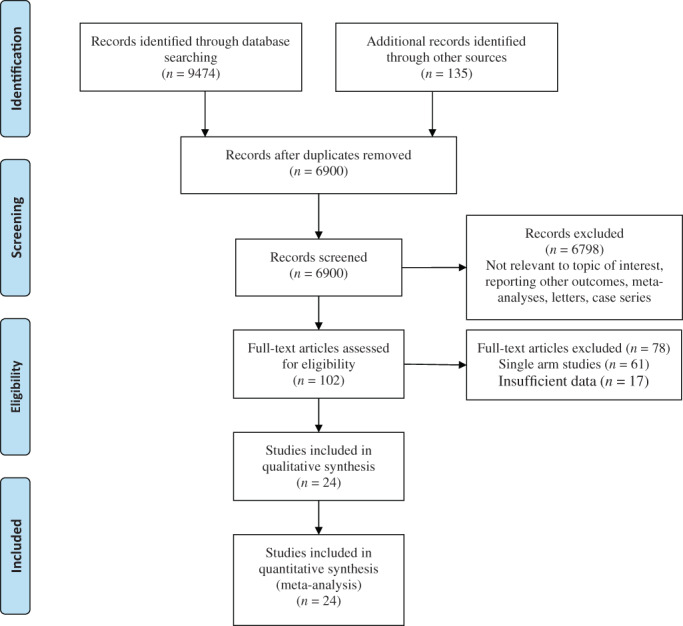
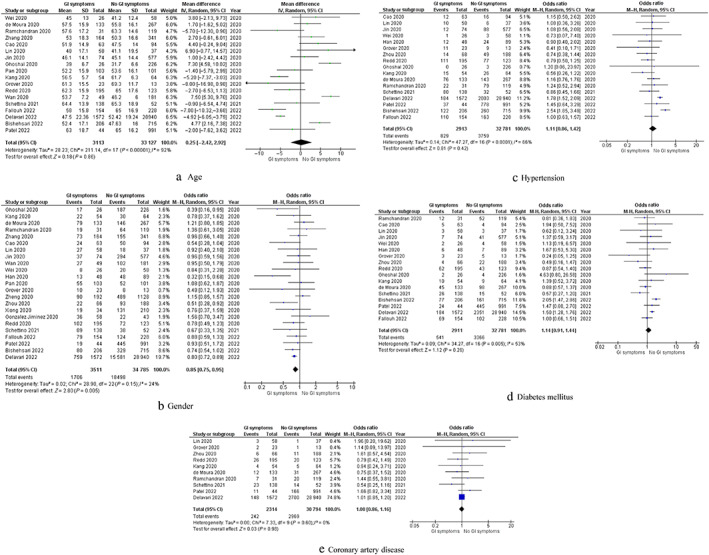
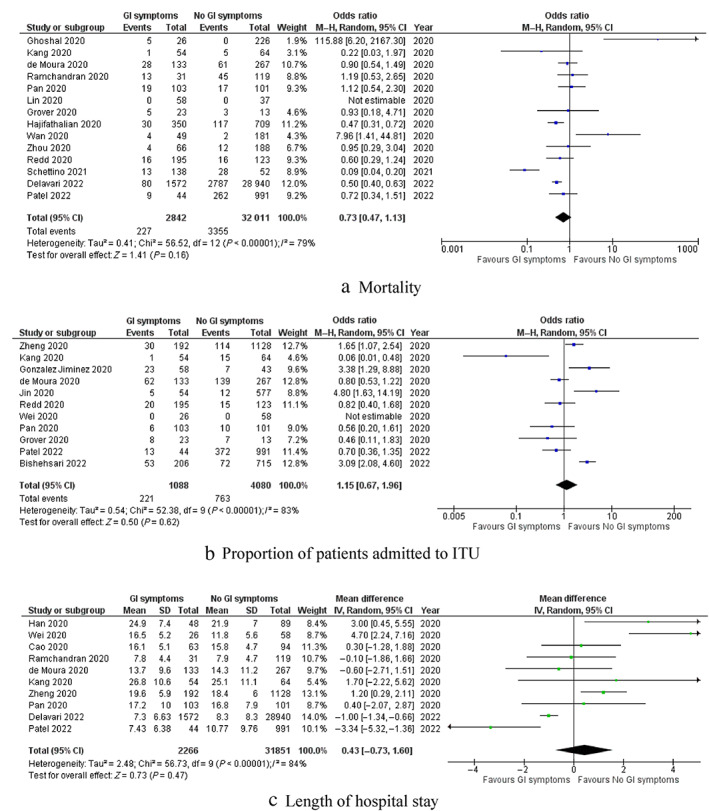
Twenty-four comparative observational studies reporting a total of 51 522 COVID-19 patients with ( = 6544) or without ( = 44 978) GI symptoms were identified. The patients with GI symptoms were of comparable age (mean difference [MD]: 0.25, 95% confidence interval [CI] -2.42 to 2.92, = 0.86), rate of pre-existing hypertension (odds ratio [OR]: 1.11, 95% CI 0.86-1.42, = 0.42), diabetes mellitus (OR: 1.14, 95% CI 0.91-1.44, = 0.26), and coronary artery disease (OR: 1.00, 95% CI 0.86-1.16, = 0.98) compared with those without GI symptoms. However, there were significantly more male patients in the GI symptoms group (OR: 0.85, 95% CI 0.75-0.95, = 0.005). The presence of GI symptoms was associated with similar risk of mortality (OR: 0.73; 95% CI 0.47-1.13, = 0.16), ICU admission (OR: 1.15; 95% CI 0.67-1.96, = 0.62), and length of hospital stay (MD: 0.43; 95% CI -0.73 to 1.60, = 0.47) when compared with their absence.
Meta-analysis of the best possible available evidence demonstrated that GI symptoms in COVID-19 patients do not seem to affect patients with any specific demographic patterns and may not have any important prognostic significance. Although no randomized studies can be conducted on this topic, future high-quality studies can provide stronger evidence to further understand the impact of GI symptoms on outcomes of COVID-19 patients.
评估2019冠状病毒病(COVID-19)患者胃肠道(GI)症状的人口统计学及预后意义。
对电子信息源进行系统检索。使用随机效应模型计算基线人口统计学因素和包括死亡率、重症监护病房(ICU)收治率及住院时间等结局的合并总体效应量。
共纳入24项比较性观察性研究,总计51522例COVID-19患者,其中有胃肠道症状者(n = 6544),无胃肠道症状者(n = 44978)。有胃肠道症状的患者与无胃肠道症状的患者在年龄(平均差[MD]:0.25,95%置信区间[CI] -2.42至2.92,P = 0.86)、既往高血压患病率(比值比[OR]:1.11,95% CI 0.86 - 1.42,P = 0.42)、糖尿病患病率(OR:1.14,95% CI 0.91 - 1.44,P = 0.26)及冠状动脉疾病患病率(OR:1.00,95% CI 0.86 - 1.16,P = 0.98)方面相当。然而,胃肠道症状组男性患者明显更多(OR:0.85,95% CI 0.75 - 0.95,P = 0.005)。与无胃肠道症状相比,有胃肠道症状与类似的死亡风险(OR:0.73;95% CI 0.47 - 1.13,P = 0.16)、ICU收治风险(OR:1.15;95% CI 0.67 - 1.96,P = 0.62)及住院时间(MD:0.43;95% CI -0.73至1.60,P = 0.47)相关。
对现有最佳证据进行的荟萃分析表明,COVID-19患者的胃肠道症状似乎不影响任何特定人口统计学模式的患者,可能也没有任何重要的预后意义。尽管无法针对该主题开展随机研究,但未来的高质量研究可为进一步了解胃肠道症状对COVID-19患者结局的影响提供更有力的证据。