Jiang Hezi, Mei Xiaofei, Jiang Yufeng, Yao Jialu, Shen Jinsheng, Chen Tan, Zhou Yafeng
Department of Cardiology, Dushu Lake Hospital Affiliated to Soochow University, Medical Center of Soochow University, Suzhou Dushu Lake Hospital, Suzhou, China.
Front Cardiovasc Med. 2022 Sep 30;9:979982. doi: 10.3389/fcvm.2022.979982. eCollection 2022.
The treatment of atrial fibrillation (AF) has made significant progress, but the prevention of AF has not received the attention it deserves. A few recent large-sized studies have conducted dose response analysis and reported different conclusions from previous studies on alcohol consumption and AF risk.
The aim of this study is to examine the potential non-linear association between alcohol consumption and risk of AF and explore the potential differences of gender.
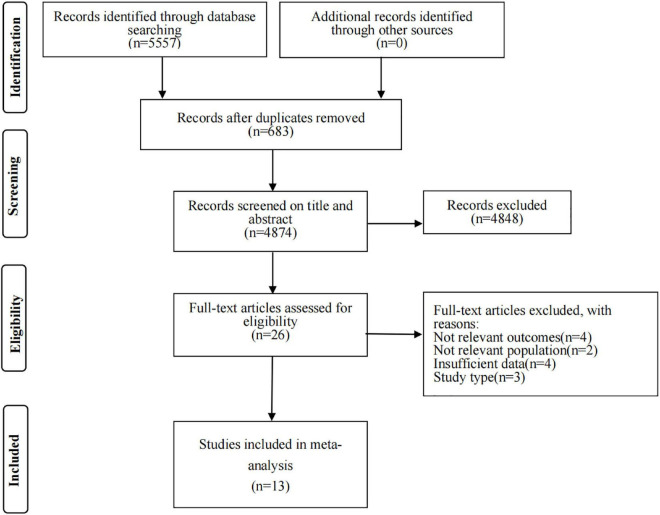
In this updated dose-response meta-analysis, PubMed, Embase and Cochrane databases were searched until June 2022. Risk estimates were reported as relative risk (RR) with 95% confidence intervals (CIs). The random-effects restricted cubic spline models are used to evaluate the potential non-linear association between alcohol consumption and AF risk.
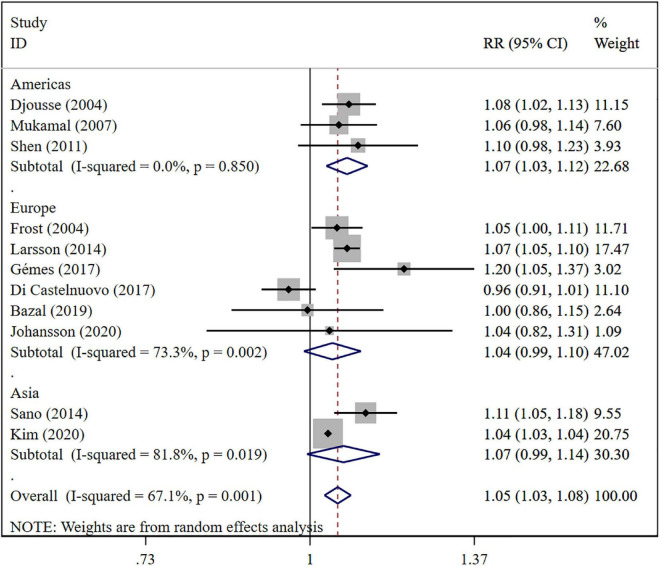
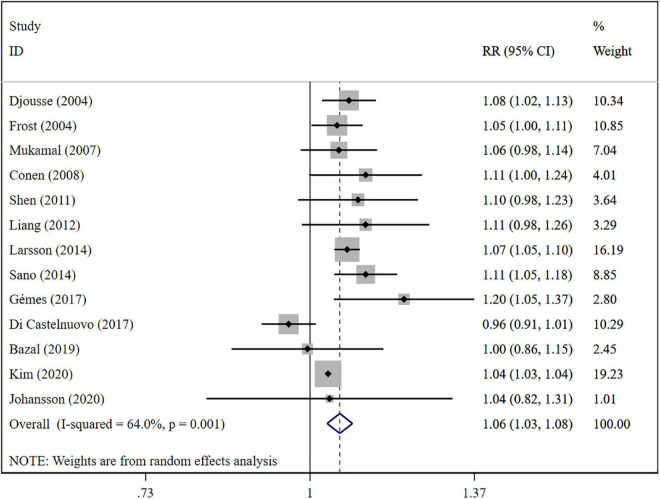
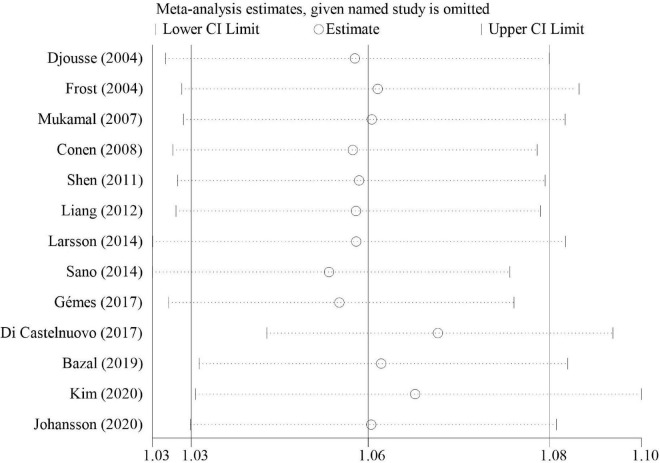
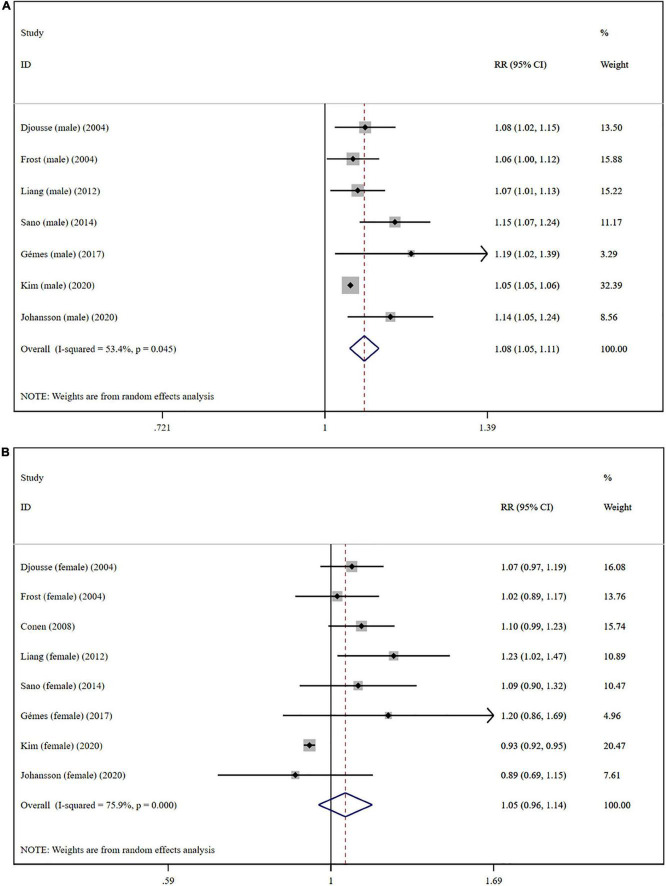
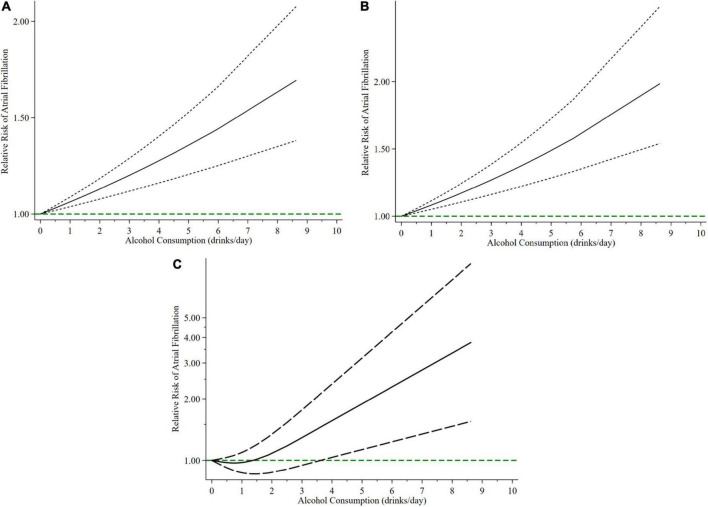
A total of 10,151,366 participants with 214,365 cases of AF enrolled in 13 prospective studies. The overall meta-analysis showed that a 1 drink/day increase in alcohol consumption increased the risk of AF by 6% (RR: 1.06; 95% CI: 1.03-1.08). In gender subgroup analysis, pooled results were different between men (RR: 1.08; 95% CI: 1.05-1.11) and women (RR: 1.05; 95% CI: 0.96-1.14). A linear relationship between alcohol consumption and risk of AF was found in men ( = 0.87) while a J-shaped curve was observed in women ( = 0.00). Regional subgroup analysis yielded broadly comparable results in Americas (RR: 1.07; 95% CI: 1.03-1.12), Europe (RR: 1.04; 95% CI: 0.99-1.1) and Asia (RR: 1.07; 95% CI: 0.99-1.14).
The relationship between AF risk and alcohol consumption is linear in men, while a potential non-linear J-shaped relationship is shown in women.
We conducted a dose-response meta-analysis on the relationship between alcohol consumption and risk of atrial fibrillation. We merged the data of over 10 million participants and found gender differences in the pattern of association with AF and alcohol consumption. The relationship between AF risk and alcohol consumption is linear in men, while a potential non-linear J-shaped relationship is shown in women. In summary, this research is vital in furthering our understanding of the role of alcohol consumption in new-onset AF, especially among different genders.
心房颤动(房颤)的治疗已取得显著进展,但房颤的预防却未得到应有的重视。最近的一些大型研究进行了剂量反应分析,报告了与先前关于饮酒与房颤风险研究不同的结论。
本研究旨在探讨饮酒与房颤风险之间潜在的非线性关联,并探索性别方面的潜在差异。
在这项更新的剂量反应荟萃分析中,检索了PubMed、Embase和Cochrane数据库直至2022年6月。风险估计值以相对风险(RR)及95%置信区间(CI)报告。采用随机效应限制立方样条模型评估饮酒与房颤风险之间的潜在非线性关联。
13项前瞻性研究共纳入10151366名参与者,其中房颤病例214365例。总体荟萃分析显示,每日饮酒量每增加1杯,房颤风险增加6%(RR:1.06;95%CI:1.03 - 1.08)。在性别亚组分析中,男性(RR:1.08;95%CI:1.05 - 1.11)和女性(RR:1.05;95%CI:0.96 - 1.14)的汇总结果不同。男性中饮酒与房颤风险呈线性关系( = 0.87),而女性中观察到J形曲线( = 0.00)。美洲(RR:1.07;95%CI:1.03 - 1.12)、欧洲(RR:1.04;95%CI:0.99 - 1.1)和亚洲(RR:1.07;95%CI:0.99 - 1.14)的区域亚组分析得出大致相似的结果。
房颤风险与饮酒之间的关系在男性中呈线性,而在女性中呈现潜在的非线性J形关系。
我们对饮酒与房颤风险之间的关系进行了剂量反应荟萃分析。我们合并了超过1000万参与者的数据,发现房颤与饮酒关联模式存在性别差异。房颤风险与饮酒之间的关系在男性中呈线性,而在女性中呈现潜在的非线性J形关系。总之,本研究对于进一步理解饮酒在新发房颤中的作用至关重要,尤其是在不同性别之间。