Faculty of Medicine, Dalhousie University, Halifax, NS, Canada.
Division of Nephrology, Department of Medicine, Nova Scotia Health Authority, Halifax, NS, Canada.
Transpl Int. 2022 Sep 29;35:10656. doi: 10.3389/ti.2022.10656. eCollection 2022.
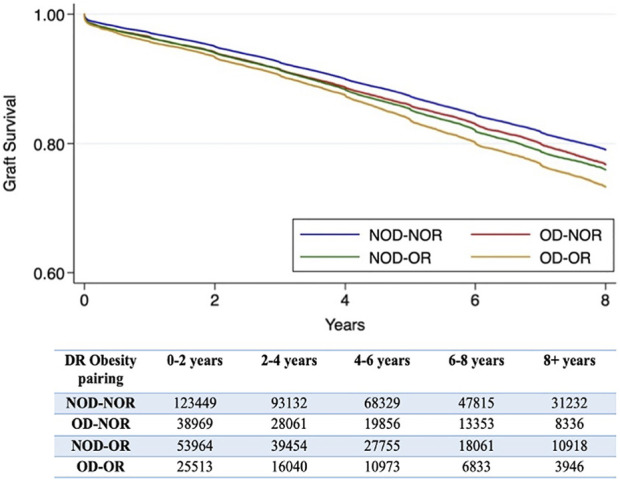
As the prevalence of obesity increases globally, appreciating the effect of donor and recipient (DR) obesity on graft outcomes is of increasing importance. In a cohort of adult, kidney transplant recipients (2000-2017) identified using the SRTR, we used Cox proportional hazards models to examine the association between DR obesity pairing (body mass index (BMI) >30 kg/m), and death-censored graft loss (DCGL) or all-cause graft loss, and logistic regression to examine risk of delayed graft function (DGF) and ≤30 days graft loss. We also explored the association of DR weight mismatch (>30 kg, 10-30 kg (D>R; D<R) and <10 kg (D = R)) with each outcome, stratifying by DR obesity pairing. Relative to non-obese DR, obese DR were highest risk for all outcomes (DCGL: HR 1.26, 95% CI 1.22-1.32; all-cause graft loss: HR 1.09, 95% CI 1.06-1.12; DGF: OR 1.98, 95% CI 1.89-2.08; early graft loss: OR 1.34, 95% CI 1.19-1.51). Donor obesity modified the risk of recipient obesity and DCGL [ = 0.001] and all-cause graft loss [ < 0.001] but not DGF or early graft loss. The known association of DR weight mismatch with DCGL was attenuated when either the donor or recipient was obese. DR obesity status impacts early and late post-transplant outcomes.
随着肥胖症在全球范围内的流行,了解供体和受体(DR)肥胖对移植物结局的影响变得越来越重要。在使用 SRTR 确定的一组成年肾移植受者(2000-2017 年)队列中,我们使用 Cox 比例风险模型来检查 DR 肥胖配对(体重指数(BMI)>30kg/m)与死亡风险校正移植物丢失(DCGL)或全因移植物丢失之间的关联,并使用逻辑回归检查延迟移植物功能(DGF)和≤30 天移植物丢失的风险。我们还探讨了 DR 体重不匹配(>30kg、10-30kg(D>R;D<R)和<10kg(D=R))与每种结局的关联,并按 DR 肥胖配对进行分层。与非肥胖 DR 相比,肥胖 DR 所有结局的风险最高(DCGL:HR 1.26,95%CI 1.22-1.32;全因移植物丢失:HR 1.09,95%CI 1.06-1.12;DGF:OR 1.98,95%CI 1.89-2.08;早期移植物丢失:OR 1.34,95%CI 1.19-1.51)。供体肥胖改变了受体肥胖与 DCGL 的风险[=0.001]和全因移植物丢失[<0.001],但不影响 DGF 或早期移植物丢失。当供体或受体肥胖时,DR 体重不匹配与 DCGL 的已知关联减弱。DR 肥胖状况影响移植后的早期和晚期结局。