Wentinck Koen, Gogou Christos, Meijer Dimphna H
Department of Bionanoscience, Kavli Institute of Nanoscience Delft, Delft University of Technology, van der Maasweg 9, 2629HZ, Delft, the Netherlands.
Curr Res Struct Biol. 2022 Oct 2;4:332-337. doi: 10.1016/j.crstbi.2022.09.005. eCollection 2022.
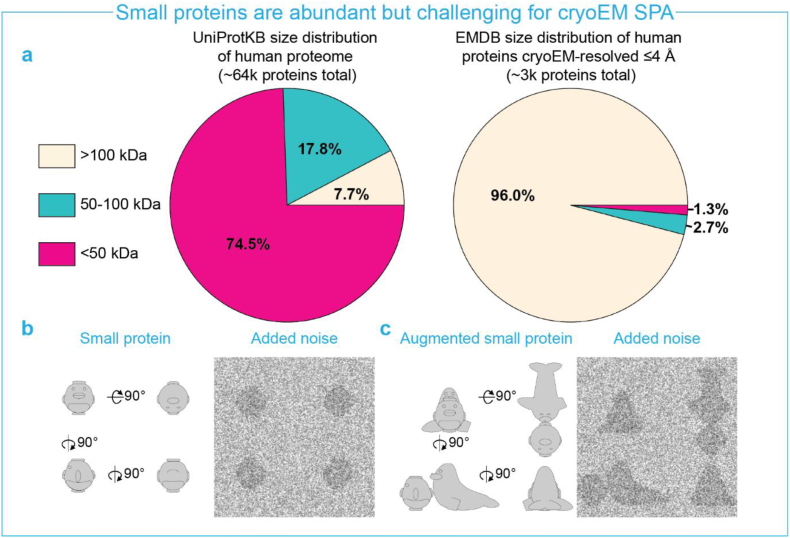
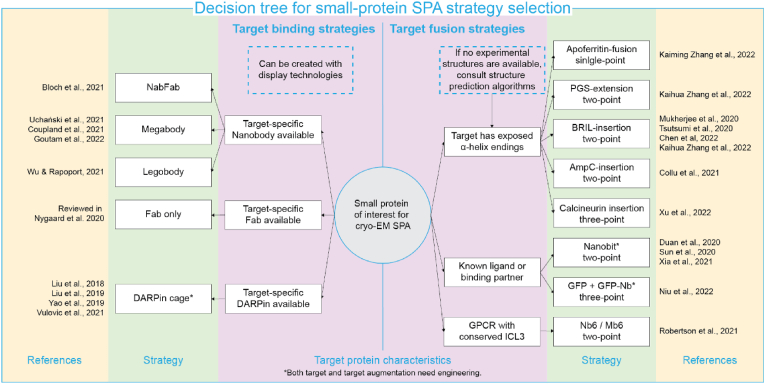
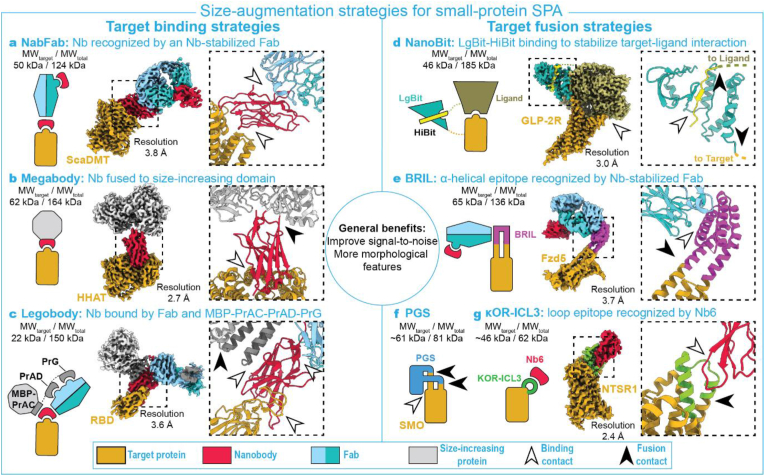
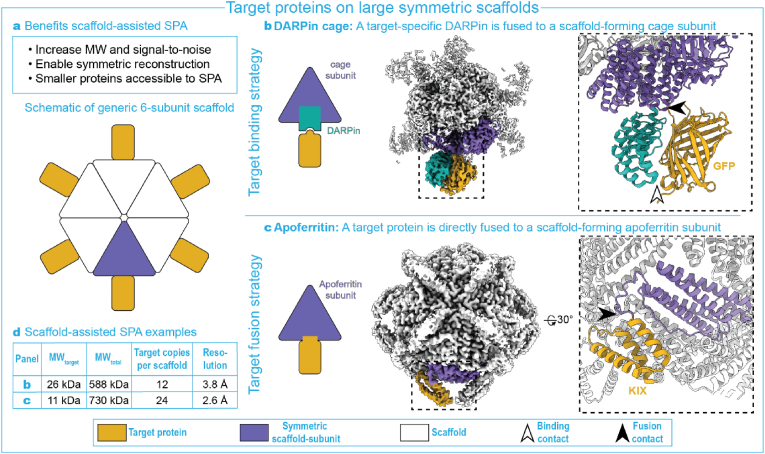
Significant advances in the past decade have enabled high-resolution structure determination of a vast variety of proteins by cryogenic electron microscopy single particle analysis. Despite improved sample preparation, next-generation imaging hardware, and advanced single particle analysis algorithms, small proteins remain elusive for reconstruction due to low signal-to-noise and lack of distinctive structural features. Multiple efforts have therefore been directed at the development of size-increase techniques for small proteins. Here we review the latest methods for increasing effective molecular weight of proteins <100 kDa through target protein binding or target protein fusion - specifically by using nanobody-based assemblies, fusion tags, and symmetric scaffolds. Finally, we summarize these state-of-the-art techniques into a decision-tree to facilitate the design of tailored future approaches, and thus for further exploration of ever-smaller proteins that make up the largest part of the human genome.
在过去十年中,低温电子显微镜单颗粒分析技术取得了重大进展,能够对多种蛋白质进行高分辨率结构测定。尽管样品制备、下一代成像硬件和先进的单颗粒分析算法有所改进,但由于信噪比低且缺乏独特的结构特征,小蛋白质的结构重建仍然困难重重。因此,人们进行了多项努力来开发小蛋白质的尺寸增加技术。在此,我们综述了通过靶蛋白结合或靶蛋白融合来增加分子量小于100 kDa蛋白质有效分子量的最新方法,具体是利用基于纳米抗体的组装体、融合标签和对称支架。最后,我们将这些先进技术总结成一个决策树,以方便设计定制化的未来方法,从而进一步探索构成人类基因组最大部分的越来越小的蛋白质。